Items
Search full-text
"Queensland Government releases Arts
- Elanor Davis
- Damian Lee
- Connie Harvey
-
“Deaf film ‘A Silent Agreement’ is released in 2017” The Deaf film ‘A Silent Agreement’ was released in 2017 (written and directed by Davo Hardy). This romantic drama features a profoundly Deaf human rights activist and his filmmaker boyfriend with a speech impediment. It is said to be the first Australian film to feature Auslan as the main dialogue. Some scenes are entirely in Auslan. Screen Australia calls it the “first Australian film to feature Auslan.”
-
“Deaf activist and artist Asphyxia creates a music course and accessible music app for D/deaf people” Asphyxia, a profoundly Deaf Australian activist, artist, author and composer created a music course (2020) for people who are D/deaf and Hard of Hearing to write their own music. In 2023, Asphyxia also created an app called Amplio to make music more accessible to D/deaf people.
-
“Les Murray's poetry is influenced by his autism” In 1974, Les Murray wrote a poem about autism, ‘Portrait of the Autist as a New World Driver’. Over the decades since, autism has continued to be a theme, as recognised by Amanda Tink.
-
"Founder of the Victorian Association of Braille Writers and the Association for the Advancement of the Blind publishes her memoirs" In 1947, “Memoirs of Tilly Aston: Australia's Blind Poet Author and Philanthropist” was published. “Memoirs of Tilly Aston” is an autobiography by Mathilda Ann Aston who was the first blind person in Australia to go to university. Aston founded the Victorian Association of Braille Writers and the Association for the Advancement of the Blind.
- "DADAA Inc. (2014). An evaluation of a year-long mentoring program for artists with disability in western Australia. Perth, Western Australia: Department of Family and Community Services."
-
"Amanda Cachia (2022) Networks of Care: Collectivity as Dialogic Creative Access, in Amanda Cachia ed. Curating Access: Disability Art Activism and Creative Accommodation. London: Routledge, 219-230" Reads, in part "The collectives that have formed in recent years and that will be the subject of this chapter include the Feminist Health Care Research Group (FHCRG), the Sickness Affnity Group (SAG), and Power Makes Us Sick (PMS). Each of these groups attempts to be intersectional in their approach, focusing on feminist and crip revisions to health care. Feminist and crip unite in the groups as the participants all identify as both women and as disabled. In shared spaces, which can be found in physical spaces, such as an art gallery or an artist’s home, or online through Zoom, artists can offer mutual understanding of their experiences with chronic illness, disability, the medical industrial complex, and simply be a shoulder to lean on in times of anxiety, anger, and sadness. The collectives also offer an opportunity for the artists to lift each other up, creating an environment of respect, dignity, and self-worth, becoming a strong circle of empowerment, affrmation, and allyship. The proliferation of these support groups shows a general shift in social norms, where the medical feld no longer holds the only authoritative voice on health. This phenomenon also indicates how nonmedical health based groups are flling a need and making up for a lack in social support networks elsewhere, particularly within sanctioned medical arenas."
-
 "DADAA Accessibility Services Webpage, captured 2023" DADAA Accessibility Services Webpage, captured 2023 - reads, in part "Working towards larger social and political goals of cultural democracy, DADAA offers services that are designed to facilitate access to arts and cultural activity for artists and audiences with disability."
 -
 "The Other Film Festival -What's On 2023" Webpage reads, in part "A free online season of films presented by The Other Film Festival"
 -
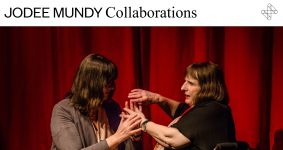 "Jodee Mundy Collaborations - Imagined Touch - Live Show" Reads, in part "Imagined Touch is a multi-sensory arts performance project exploring the fascinating world of Deafblind culture with its own tactile sign language, unique relationship to the senses, space and navigation of the world."
 -
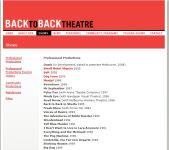 "Back to Back Theatre - Website - Shows, captured 2008" Back to Back Theatre 'Shows' page, captured 2008, with list of shows, and links to work from 1999 forward - Professional Productions (including ‘Big Bag’ 1987-88; ‘Stinking Houses’ 1989; ‘The Peg Machine’ 1990; ‘Everything and the Mermaid’ 1990, ‘I Don’t Want to Live in Lara Anymore 1991; ‘Yell Blue Murder’ 1991; ‘Woodenhead’ 1992; ‘The Adventures of Bobbi Dazzler’ 1992; ‘Voices of Desire’ 1993; ‘Freak Show with Circus Oz 1994; Back to Back in Shorts 1995; Road Movie with Melbourne Workers Theatre 1996; Minds Eye with Handspan Visual Theatre 1996; Peter Pan with Arena Theatre Company 1997; Mr September 1997; Boomtown with Snuff Puppets 1998; Mental 1999; Dog Farm 2000; Pornstar 2001; Soft 2002; Cow 2003; Small Metal Objects 2005), and Community Productions (including Ritual with Matthew Flinders Girls Secondary College 1998; Push Push 1999; Drag Racers in Love with Nelson Park School 1999; Arnold 2000 Fishman with Theatre of Speed 2001; Inside the Angel House with Theatre of Speed 2003; Minotaur with Theatre of Speed 2005; DMI with Theatre of Speed 2007; Pod Residences with Night School, Awakenings Festival, Brr Theatre Group, Ants Pantz Arts, Break of Day Players, Theatre of Speed, Arts Action and Amalgamation Festival 2003-2006), and films (including Mullet (1995), White Maggots (1996), Spill (1997), Mark Deans Human Cannonball (1998), Underpants (1999), Backscratch (2000), Porn Star (2002), Rhian Hinkley Theatre of Speed vs. BOZ'n'HOK, vs. HUGE COVILL (2004), D9 (2005), Out of our Minds (2001)).
 -
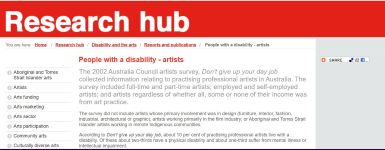 “Australia Council - People with a disability - artists 2003” Sourced from 'Australia Council- Don’t give up your day job: An Economic Study of Professional Artists in Australia' (Throsby and Hollister 2003) based on 2002 Survey - The website reads “The 2002 Australia Council artists survey, Don't give up your day job collected information relating to practising professional artists in Australia…..According to Don't give up your day job, about 10 per cent of practising professional artists live with a disability.”
 -
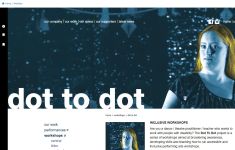 "Restless Dance - Dot to Dot" Restless Dance Theatre website, 'Dot to Dot', captured 2020 - reads, in part "The Dot To Dot project is a series of workshops aimed at broadening awareness, developing skills and teaching how to run accessible and inclusive performing arts workshops."
 -
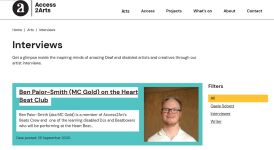 "Access2Arts Artist Interviews" Access2Arts Artist Interviews
 -
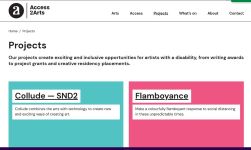 "Access2Arts Project Archive" Access2Arts programs as at 2022
 -
"The Other Film Festival launched in 2004" In 2004, Australia’s first international disability film festival, The Other Film Festival, was launched at the Melbourne Museum. In 2022, Screen Australia began providing funding for festival.
-
“The Deaf Film Society creates the documentary ‘Our World’.” In 1970, the Deaf Film Society created a documentary called ‘Our World’ on the lived experience of people who were d/Deaf. The Adult Deaf Society assisted with the project.
-
“Documentary ‘Stepping Out’ follows first group of intellectually disabled people to perform at the Sydney Opera House” In preparation for the International Year of Disabled Persons, a documentary was made called ‘Stepping Out’ directed by Chris Noonan and narrated by Romayne Grace, a resident at the Lorna Hodgkinson Sunshine Home. The documentary follows a group of residents as they prepare for their big debut at the Sydney Opera House. The movie was shown during the International Year of the Disabled's UN closing ceremony. The 1979/1980 Australia Council report had the following statement "A production staged at the Sydney Opera House by residents of the Lorna Hodgkinson Sunshine Home for the intellectually handicapped impressed the Theatre Board as both innovative arts-based therapy and worthwhile theatre in its own right." The 1980/81 report further stated "It was the first time anywhere in the world that a group of mentally handicapped people had performed publicly in the cultural centre of their city."
-
“Fusion Theatre established in 1997” Fusion Theatre (Victoria) was established in 1997. "Since its beginnings as a drama group, Fusion has expanded into two main performance ensembles that make up the company. The ensemble members collaborate with professional theatre makers, guest performing artists and designers, to devise theatre performances based on the stories, imagination and ideas of all participants." Fusion Theatre’s ongoing association with Deakin University's Faculty of Arts and Education means that each year, Deakin’s theatre and drama students work with Fusion as artists, performers, assistants, and theatre technicians. Some alumni continue to be involved with the company.
-
"A number of theatre companies are established in the 2000s" A number of theatre companies were established in the 2000s, particularly towards the end of the decade. Some key companies in disability theatre or inclusive arts practice to emerge in the 2000s are: Second Echo Ensemble (2005, integrated, often producing work in partnership with the Tasmanian Theatre Company), Ever After Theatre Company (2006, performers with disability), Rollercoaster Theatre Company (2007, performers with disability), DirtyFeet (2008, inclusive), and Blue Roo Theatre (2009, performers with disability).
-
“Studio A established in 2000” Studio A (NSW) was established in 2000 to create access and opportunities for visual artists with intellectual disabilities; their in-house artists’ “practices range from painting and drawing to sculpture, textiles and digital media”. In their own words, “At Studio A, we are dedicated to professionally empower artists with disability and have their voices heard within contemporary Australian culture.”
-
“The Bolshy Divas present ‘The Other 100 Conversations’ to Australian governments heads” In 2011, a group of disability activists called the Bolshy Divas presented a 100-page document, ‘The Other 100 Conversations,’ to heads of all Australian governments who had gathered in Canberra for a Council of Australian Governments (COAG) meeting. The document was addressed “to our elected representatives”. ‘The Other 100 Conversations’ comprised of 100 first-person accounts of participants of disability services in Western Australia, highlighting the lack of support and waiting times experienced.
-
“Auslan features intermittently on Australian television throughout the 1990s, 2000s, and 2010s” Auslan appeared intermittently on Australian television throughout the 1990s, 2000s, and 2010s. Ana Maria Belo has curated a video compilation of scenes featuring Auslan. Belo calls it “a very brief history lesson on Deaf Actors on Australian Television before Social Media.” As she explains, “this is not a complete list of performances, but a nod to the actors who blazed a mighty trail for those of us who attempt to follow.”