Items
Search full-text
"Queensland Government releases Arts
-
 "Jodee Mundy Collaborations - Imagined Touch - IMBD" Reads, in part, "When two Deafblind women asked a theatre director to help them make a show about being deaf and blind, never in their wildest dreams did they imagine it would become an award-winning show."
 -
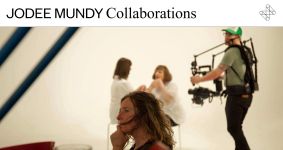 "Jodee Mundy Collaborations - Imagined Touch - Documentary" Reads, in part "When two deafblind women Heather Lawson and Michelle Stevens approached director Jodee Mundy to make a show, they pulled off the impossible. They turned their small community performance into IMAGINED TOUCH, a theatre production that became a sell-out success at the Sydney Festival, going on to win at the Victorian Green Room Awards. This documentary has followed Imagined Touch with cameras from the very beginning."
 -
 "Australia Council - Annual Report 2019-20" Australia Council - Annual Report 2019-20
 -
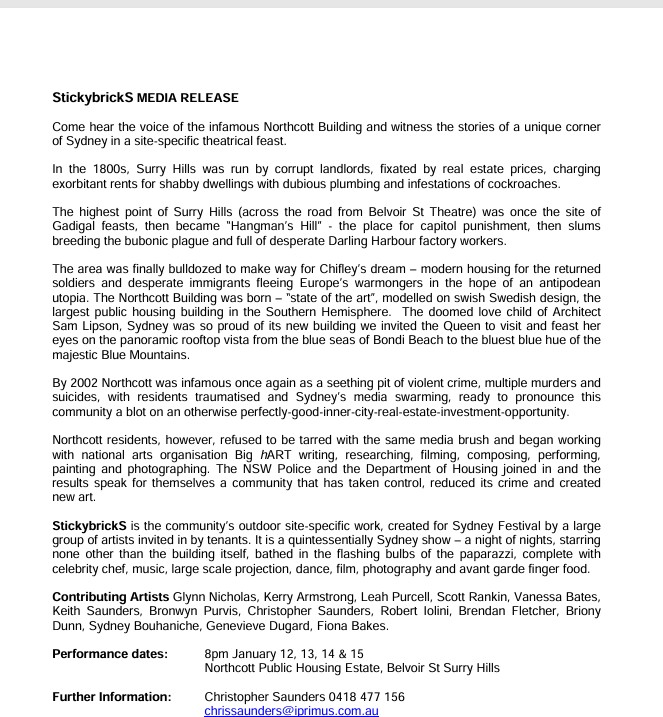 "Sydney Festival - StickybrickS MEDIA RELEASE - 2006" Sydney Festival - StickybrickS 2006 MEDIA RELEASE - Reads, in part "By 2002 Northcott was infamous once again as a seething pit of violent crime, multiple murders and suicides, with residents traumatised and Sydney’s media swarming, ready to pronounce this community a blot on an otherwise perfectly-good-inner-city-real-estate-investment-opportunity. Northcott residents, however, refused to be tarred with the same media brush and began working with national arts organisation Big hART writing, researching, filming, composing, performing, painting and photographing."
 -
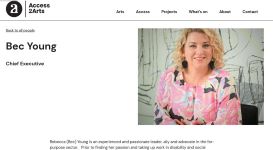 "Bec Young Chief Executive" Announcement of new CEO of Access2Arts, South Australia, Rebecca (Bec) Young, in 2022
 -
 "Access2Arts Events" Access2Arts news, events, and program information as at 2022
 -
 "Access2Arts Projects" Access2Arts current projects as at 2022
 -
“Larissa Macfarlane leads the installation of Australia’s first Disability Pride Mural” In 2017, Larissa Macfarlane led the installation of Australia’s first Disability Pride Mural. It was unfortunately removed by accident by council workers. It was re-installed in 2018 and was constructed of paper and fixed to the wall with wheat paste glue so that it was temporary. The aim was to raise awareness of Disability Pride in Australia.
-
"Soprano Marjorie Lawrence performs in her wheelchair in the 1940s" In the 1940s, Australian soprano Marjorie Lawrence contracted polio and performed in her wheelchair, both nationally and internationally, showing veterans life after disability was possible. Platforms were modied for her wheelchair so she could perform.
-
"Australian Film Commission created" In 1975, the Australian Film Commission was created, providing grants for film and television projects.
-
“The Mouth and Foot Painting Artists starts in Australia in 1971” The Mouth and Foot Painting Artists (MFPA) started in Australia in 1971. The roots of the international organisation of mouth and food painting artists go back to the 1950s in Europe.
-
“7-part series ‘Fair Go’ produced by Film Australia” In 1981, Film Australia produced a 7-part series, called Fair Go, on Australians with mental and physical disabilities and how it impacted their lives and the lives of their families. “Each program is presented from the viewpoint of the person with the disability and demonstrates the practical implications of coping with a disability in daily life at home, in the community, in the workplace or at school.” Film Australia was consolidated into Screen Australia in 2008.
-
“House Gang debuts on SBS” In 1996, a comedy television series debuted on SBS called ‘House Gang’ featuring three actors with intellectual disabilities.
-
“The first Focus on Ability film festival held in 2009” In 2009, the first Focus on Ability film festival was started by the CEO of NOVA Employment, Martin Wren. (NOVA is a Sydney-based disability employment service.) FOA holds events in Australia’s major cities and welcomes entries in open categories as well as a schools category and international section.
-
“Sydney Film Festival launches Screenability program in 2017” Sydney Film Festival launched its Screenability program in 2017. The international program was intended to offer a platform for screen practitioners with disability. Sofya Gollan was Screenability’s inaugural programmer and remained in the role until 2021.
-
“Screen Australia commissions the reports ‘Seeing Ourselves’ (2016) and ‘Seeing Ourselves 2’ (2023)” In 2016, Screen Australia commissioned a report "Seeing ourselves: Reflections on diversity in Australian TV drama". The report highlighted the lack of characters on TV with a disability. When characters with a disability were part of the story they were played by actors without a disability and were portrayed as either unemployed or retired. Screen Australia commissioned a follow-up report in 2023 called "Seeing Ourselves 2 - Diversity, equity and inclusion in Australian TV drama". This report shows that, while diversity is a global conversation and there is an increase of disability representation, it remained significantly lower than the actual disabled population.
-
“Essay collection ‘Growing Up Disabled in Australia’ is published in 2021” In 2021, Carly Findlay edited a book ‘Growing Up Disabled in Australia,’ a collection of more than 40 Australian writers with disabilities sharing their lived experiences.
-
“Off The List Records (VIC) established in 2020” Off The List Records (VIC) was established in 2020. Their Facebook page describes them as “an access-friendly and disability-led record label, working within the DIY, experimental and indie music scenes in and around Naarm.”
-
“Disabled actor and writer Heather Rose stars in ‘Dance Me to My Song’ (1998)” The 1998 film ‘Dance Me to My Song’ stars Heather Rose, who also co-wrote the film. It is about a woman with cerebral palsy, whose carer resents the job. The dramatic tension rises when the two women both take an interest in the same man. The Rolf de Heer-directed film is significant for casting a disabled actor at a time when authentic disability representation was rare, not to mention Rose’s contribution to the screenplay. ‘Dance Me to My Song’ was selected to feature in the Cannes International Film Festival in May 1998. The documentary ‘Heather Rose Goes to Cannes’ (1998, Christopher Corin) follows Rose’s journey from Adelaide to Cannes.
-
“Bus Stop Films begins operation in 2009” Bus Stop Films began operations in 2009. In their own words, they “educate, create and advocate.” Their primary focus is teaching filmmaking to disabled adults, but they also offer workshops to others of marginalised identities. Bus Stop “makes films with, for and about people from diverse backgrounds and abilities.” Their website lists support workers in every Australian state and territory.
-
“2023 Screen industry report ‘Disability and Screen Work in Australia’ finds disabled people fulfil a range of roles in the screen industry, despite facing prejudice and exclusion, and should be treated as experts of their access requirements” ‘Disability and Screen Work in Australia: Report for Industry’ (2023) was compiled by researchers Radha O’Meara, Laura Dunstan, Anna Debinski and Catherine Ryan. The study was supported by Melbourne Disability Institute and A2K Media. The authors summarise that disabled people fulfil a range of roles in the screen industry, despite facing prejudice and exclusion, and should be treated as experts of their access requirements. They find that “Disabled people experience a more precarious, lower paid, and less powerful position in the screen industry than their non-disabled counterparts.” O’Meara and her colleagues call for widespread change in the industry to expand access.
-
"Fayden D'Evie (2022) From Dust to Dust: Hallucinating the Absent Exhibition, in Amanda Cachia ed. Curating Access: Disability Art Activism and Creative Accommodation. London: Routledge, 87-98" Reads, in part "Over several months in 2018, I developed a hybrid artist-curatorial project for the Old Castlemaine Gaol, with the working title From Dust to Dust , which sought to invert the site’s association with the sensorial policing of bodies."
-
"Katherine Gale (2013) Review - Take Up Thy Bed and Walk, Arts Hub" Review of 'Take Up Thy Bed and Walk' (2013) by Vitalstatisix and Gaelle Mellis - reads, in part "The latest Vitalstatistix Theatre Company production asks subtle questions about society’s perception of people with disabilities."
-
“Alan Marshall writes ‘I Can Jump Puddles’ in 1955” Alan Marshall wrote 'I Can Jump Puddles' in 1955., the first in a series of works about growing up with a disability. The subsquent books were 'This Is the Grass' (1962), 'In Mine Own Heart' (1963), and 'Hammers Over the Anvil' (1975). Marshall contracted polio at age six and became physically disabled.
-
“The Cunningham Dax Collection of artworks opens” In 1952, an English psychiatrist Dr Eric Cunningham Dax was appointed as the Chairman of the Mental Hygiene Authority in Melbourne. In the UK, Dr Dax had introduced art therapy in programs for patients in psychiatric care and introduced art programs to Victorian Hospitals. In 1959, Dr Dax organised the first art exhibition of psychiatric patients held at Gallery A, Flinders Lane. The Cunningham Dax Collection of artworks grew, and an official opening occurred in Faraday Street Gallery in the 1980s. “Two distinct eras are represented in the Cunningham Dax Collection; artworks produced within psychiatric hospitals from 1940s into 1970s and artworks donated to the Collection by artists and community groups from 1980s until the present.” Dr Dax had introduced art therapy in programs for patients in psychiatric care and introduced art programs to Victorian Hospitals. In 1981, the National Gallery of Australia received 68 paintings from the Dax Collection - these were returned in 1994.