Items
Search full-text
"Queensland Government releases Arts
- Jacky Boxall
- Jackie Boxall
- Ian Cuming
- Gavin Porter
- Gali Weiss
- Gali Weis
- Frances Gubbay
- Desmond Beavis
- Des Beavis
- Brandon Williams
- Antonella Calvano
-
 "Tutti Arts - Annual Report 2018" Tutti Arts Annual Report 2018 – President’s, Artistic Directors, Disability & Quality Manager’s, Arts Manager Reports, information on Visual Arts, Performing Arts, Film and New Media and Choral and Kids & Youth Programs, Projects, and Exhibitions, including information on Say No More, Standing Up Standing Out, BEASTLY!, Sit Down Shutup and Watch Film Festival, The Sisters of Invention, Company AT, Financials, Staff, Supporters
 -
 "Crossroad Arts Annual Report 2015" Crossroad Arts Annual Report 2015 - Project Reports
 -
 "Artability - Access Arts' Programs, Practice and Perspectives" Explains history, members rights, policies, arts pathways, training, classes, and planning to support these activities, plus information on programs – including Caberet Erratica, Cartoon Advocacy, Melrose Park Project, New Farm Park Mosaics, Visual Arts Exhibition, Explaining Discrimination Video Project – and examples of writing by Access Arts members
 -
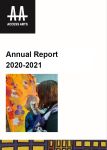 "Access Arts Annual Report 2020-2021" Access Arts Annual Report 2020-2021 - Performing Arts Workshops, Visual Arts Workshops, Exhibitions, First Nations Projects, Undercover Artist Online program and grants, Access Arts grants and Awards
 - Rachel Gaffney-Dawson
- Elizabeth Navratil
-
 "Access Arts Annual Report 1992" Access Arts Annual Report 1992 - Director’s Report, Project Officer’s Report, Program Manager’s Report, exhibitions, workshops, regional arts, touring, (DADAA) at ARTAbility Conference at the Queensland Cultural Centre 1992
 -
“Access Arts Achievement Award inaugurated in 2014” Access Arts announced a $10,000 Achievement Award in 2013 and first awarded the grant in 2014 to actor Doug Robins. Other recipients since then have included writers, musicians, visual artists, theatre makers, and multi-disciplinary artists. The funding goes to a Queensland artist with disability to “create, develop, present, produce, exhibit and/or tour their work.” Access Arts describe it as “a game-changing opportunity for Queensland artists, arts workers and producers to extend the life of an existing work or create a new one!”
-
“Crossroad Arts (Queensland) founded in 1996” Crossroad Arts (Queensland) was founded in 1996 by Steve Mayer-Miller. "Crossroad Arts collaboratively develops opportunities for people who experience a disability, to access and participate in the arts".
-
“Incite Arts (NT) established in 1998” What would become Incite Arts (Northern Territory) was established in 1998, known at that time as the Alice Springs Youth Arts Group (ASYAG). “ASYAG was formed as a response to a locally identified need for a vehicle to express young people’s stories in a valid contemporary cultural context.” In 2004, the organisation adopted the name InCite Youth Arts Inc and was incorporated as a not-for-profit. The following year, they became the host and auspice of Arts Access Central Australia (AACA), an arts and disability committee. The organisation’s name was revised once again in 2013, becoming Incite Arts.
-
"The Australian Council for the Arts established in 1968" The Australian Council for the Arts was established in 1968. This came after a push during the late 1960s for better support of the arts in Australia. The Council replaced the Elizabethan Trust as Australia’s main arts body, although the Trust continued to receive funding from State governments. The Council was later given statutory authority in 1975 and called Australia Council. Prime Minister Gough Whitlam is recognised as a key political supporter of the arts. The election of Whitlam (serving from December 1972 to November 1975) gave unprecedented and considerable attention and funding to an arts policy which would establish an Australian cultural identity raising international awareness. The Australian Council for the Arts received an unprecedented $14 million in funding in the 1973/74 budget. This was “more than double the allocation the bodies out of which it evolved had received the year before. The Council’s allocation was increased by a further 50 per cent in the 1974/75 Budget."
-
“Arts Project Australia is founded in 1974” In 1974, Myra Hilgendorf OAM founded Arts Project Australia, an organisation whose aim is for artists with an intellectual disability to have their work presented in a professional manner. In 1984, Arts Project moved to Hawthorn, Melbourne and started a studio workshop program. The organisation became an Incorporated Association in 1986. In 1994, Arts Project Australia artists exhibited their work internationally. Exhibitions occurred at MADMuseé and Centre d’Art Differencié in Belgium. Artist Julian Martin was selected for the Moët & Chandon Touring Exhibition. Arts Project published an education/slide kit in 1994 called ‘Between the Lines: Visual Arts and Intellectual Disability’. The organisation first published ‘Outline: News from Arts Project Australia’ in 1996. Arts Project Australia was recognised by the National Gallery of Australia in 2013 for having international significance.
-
“Arts Access Australia established” Arts Access Australia was established in 1992 as a national body for arts and disability with funding support from the Australian Council for the Arts.
-
”Bree Hadley, Donna McDonnald (Eds.) (2019) The Routledge Handbook of Disability Arts, Culture, and Media. Routledge International Handbooks. Routledge, London; New York.” “In the last 30 years, a distinctive intersection between disability studies – including disability rights advocacy, disability rights activism, and disability law – and disability arts, culture, and media studies has developed. The two fields have worked in tandem to offer critique of representations of disability in dominant cultural systems, institutions, discourses, and architecture, and develop provocative new representations of what it means to be disabled. Divided into 5 sections:- Disability, Identity, and Representation; Inclusion, Wellbeing, and Whole-of-life Experience; Access, Artistry, and Audiences; Practices, Politics and the Public Sphere; Activism, Adaptation, and Alternative Futures - this handbook brings disability arts, disability culture, and disability media studies – traditionally treated separately in publications in the field to date – together for the first time.”