
Items
Search full-text
“Activism leads to a Disability Royal Commission”
-
 "Tutti Arts Newsletter April 2005" Tutti Arts Newsletter April 2005 - reads, in part "Tutti Arts, the first vocational program for young artists with a disability in Australia began last October in partnership with Minda Inc."
-
 "Tutti Arts Newsletter Term 1 2005" Tutti Arts Newsletter Term 1 2005 - reads, in part "Tutti Arts, the first vocational program for young artists with a disability in Australia began last October in partnership with Minda Inc."
-
 "Tutti Ensemble Newsletter Term 1 2006" Tutti Ensemble Newsletter Term 1 2006 - reads, in part "The Tutti Arts Launch showed that Tutti Ensemble Inc is a key driver in the creation of a truly enterprising direction for inclusive community disability culture in SA. From the outset, Tutti has proved itself to be driven by innovation, and with a strategic plan and vision, we have every opportunity to continue showcasing our work internationally and also to export the model we have created."
-
 "Tutti Arts - Sit Down Shut Up & Watch - Call For Entries 2014 - Promotional Card" Tutti Arts - 'Sit Down Shut Up & Watch' 2014 Call For Entries - reads, in part "The first disability-led film festival in the southern hemisphere"
-
 "Tutti Arts - Sit Down Shut Up & Watch - Filmmaking Workshop 2016 - Press Release" Tutti Arts - 'Sit Down Shut Up & Watch Filmmaking Workshop' 2016 Press Release - reads, in part “ On October 21 the second Sit Down Shutup and Watch [SDSW] Film New Media Festival will happen in the Angaston Town Hall. The festival is the brainchild of seven talented young film makers with learning disability form Regional South Australia and Adelaide. Their first festival, held in October 2014 was a fabulous success with over 40 films screened from all over the world and nearly 500 people attending. In the lead up to our second Festival, we are delivering a series of 4-day film-making workshops for people with learning disabilities across regional areas of South Australia to ensure we have plenty of South Australian films in the mix. The first of these is the Renmark / Riverland workshop to be held from Tuesday 8th March - Friday 11th March, at the McCormick Centre, Rau Rau Ave, Renmark.”
-
 "Tutti Arts - Sit Down Shut Up & Watch - Promotional Poster 2022" Tutti Arts - 'Sit Down Shut Up & Watch 2022 Promotional Poster
-
 "Tutti Arts - The Unbounded Collection Exhibition - Program" Tutti Arts 'The Unbounded Collection' Exhibition 2020 Program" - Tutti Arts is one of Australia's leading disability arts companies where artists with a learning disability create visual art, music, theatre, dance, film, new media and installations for a growing local and international audience. In 2017, Tutti was awarded a prestigious Arts South Australia Ruby Award for Sustained Contribution to the Arts by an Organisation or Group. Tutti has been operating visual arts and film & new media programs in the Barossa since September 2017 with ongoing support from the Barossa Council.
-
 "Tutti Arts - Visual Arts & Design Program 2" Tutti Arts - Visual Arts & Design Program - reads, in part "Tutti Visual Arts and Design was established in 2005 as a vibrant and unique arts practice program for young adults with intellectual and learning disabilities."
-
"Tutti Arts - Visual Arts & Design Program" Tutti Arts - Visual Arts & Design Program - reads, in part "Tutti Visual Arts and Design was established in 2005 as a vibrant and unique arts practice program for young adults with intellectual and learning disabilities."
-
 'Festivals' Infographic
-
 'Government Policy, Strategy, Funding' Infographic
-
 Welcome!
-
 'Conferences' Infographic
-
 Website Tour Video
-
”Racheal Missingham, Bree Hadley (2022) Oppression and allyship in Australia's Deaf Arts. Australasian Drama Studies, 80, pp. 304-332.” "In this article, we investigate the history of Deaf theatre in Australia, through the lens of oppression and allyship. Through a review of the to date limited academic, industry, and media literature, in conjunction with survey and interview research with Deaf theatre practitioners, this research sheds light on Deaf theatre makers’ perceptions of the ways in which ally support can operate to create both social benefits and barriers, and how this has impacted on the non-linear development and recent decline in Deaf theatre companies in Australia. It finds that, in developing a framework to scaffold stronger allyship relationships with d/Deaf and hard of hearing artists, it is critical to consider the accessibility and cultural requirements not just in relation to theatre methodologies, but in relation to arts management practices, which support continuing company production, too."
-
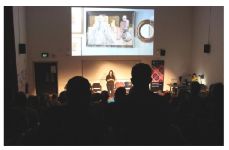 "Janice Rieger, Jasmien Herssens, Megan Strickfaden, Bree Hadley (2019) International Inclusive Film Screening, DfA Week (with films from Finland, Canada, China and Australia)." "The inclusive international film screening included films from Australia, Finland, Canada and China that represent different kinds of abilities, disabilities, inclusion and exclusion through material culture, architecture, urban spaces, landscapes and design. This screening was about access, inclusion and community outreach and included live audio descriptions and Auslan interpretation. The Film screening was separated into two parts with a total of 9 films screened: Part 1: ‘Seeing’ things from a Different Perspective, which included the films: Bakala, Australia (Aboriginal); Eske, (Finland); Musical Notes (Canada); Visitability #1 (Canada) Part 2: Part 2: Temporal and Embodied Encounters: Design, Disability and Slowing Down, which included the films: Smoke Time (Canada & China); Visitability #2 (Canada); Heel of a Time, Canada; Visitability #3 (Canada) ; Wandering on the Braille Trail (Australia)."
-
"Sarah Austin, Chris Brophy, Lachlan MacDowell, Edward Paterson, and Winsome Roberts (2015) Beyond Access: The Creative Case for Inclusive Arts. Melbourne: Arts Victoria." Reads, in part "Beyond Access sought to create an evidence base for the creative case for inclusive arts practice to support greater recognition for artists with a disability by transforming and extending notions of what art is and who produces it."
-
"Amanda Cachia (2013) ‘Disabling’ the museum: Curator as infrastructural activist. J. 12.3. pp. 257–289" Reads, in part "This article will explore how I attempt to ‘disable’ the museum through my infrastructural curatorial practice, which is the basis for my scholarly research and writing. By infusing my curatorial projects with critical reflection and theoretical development, I hope to begin this process of building a new vocabulary and methodology around curating disability and access."
-
"Kate Maguire-Rosier (2016). Moving “Misfits.” Australasian Drama Studies, (69), 29–55. https://search.informit.org/doi/10.3316/informit.590682266081795" Reads, in part "In Dianne Reid's recent work Dance Interrogations (a Diptych), performed as part of the 2015 Melbourne Fringe Festival by Reid and collaborating artist Melinda Smith, spectators had no seats but rather roamed, observing two mature dancers. In this article, I explore Reid and Smith's live performance, a combination of structured movement improvisation and screendance, as a provocation of the relationship between movement and agency. I address the theatrical event through the multifaceted lens of the performers' experiences, spectators' responses and my own observations."
-
"Anthea Skinner, Jess Kapuscinski-Evans (2021) Facilitate This! Reflections from Disabled Women in Popular Music. Journal of Popular Music Studies 1 June 2021; 33 (2): 3–14. doi: https://doi.org/10.1525/jpms.2021.33.2.3" Reads, in part "This article is a reflection by the authors on the impact that their identities as disabled women have had on their ongoing music careers. Skinner and Kapuscinski-Evans make up two-thirds of the Australian crip-folk trio, the Bearbrass Asylum Orchestra (the term “crip” is a cultural reappropriation of “cripple”). The Bearbrass Asylum Orchestra is a band that performs as part of the Disability Music Scene in Melbourne, Australia, using folk music to portray their experiences as people with disabilities. In this article Skinner and Kapuscinski-Evans discuss the formation of and philosophy behind the band, as well as the impact that growing up as disabled women had on their musical education, careers, and influences."
-
"Juliette Peers (2022) The ArtLink Archive Project: Inside the 'Outsider' Issue, 42(2)" "In 1992–93 ArtLink published Naïve & Outsider Art centring on themes linked by their shared invisibility in mainstream discussions. While the title obviously references art historian Roger Cardinal’s 1972 book Outsider Art, (after Jean Dubuffet’s ‘Art Brut’ or ‘raw art’), this outlying status was described by ArtLink’s founding editor Stephanie Britton in 2022 as ‘…the context changes, but at the time the concept [of various practices lying beyond the mainstream] functioned as a catch up on things that had been under the radar for decades already... [we were] collating a wide range of ideas'[1], a group of practices that existed but were hardly recognised in published texts. Looking back across ArtLink’s history, Naïve & Outsider Art offers much to think through about the magazine’s own platform, intentions and the trajectories of those practices foregrounded thirty years ago under what are now troubling rubrics."
-
"Sally Northfield (2014) Canvassing the Emotions: Women, Creativity and Mental Health in Context" PhD Thesis Victoria University, Melbourne, https://vuir.vu.edu.au/29985/, Australia, https://vuir.vu.edu.au/29985/1/NORTHFIELD%20Sally-thesis_nosignature.pdf " Reads, in part, "A multimedia movement-theatre show, incorporating dance, video- and slide- projections, a life-sized puppet and an original soundtrack. A diary come to life, portraying the true story of an Australian dancer who – after paralysing one of his arms in a motorcycle accident – journeys through the worlds of medicine, rehabilitation and disability, in recovery of self-expression. He finds new angles on perceiving the body, and new ways to move. "Body image" and concepts of "normality" are questioned."
-
"Bree Hadley (2007) Review - Mirage, by Igneous, Australian Stage Online" Reads, in part "In Mirage, a performance installation by Brisbane-based multimedia company Igneous, dancer James Cunningham uses a combination of dance and data projection to draw the audience into a strange new perceptual space, in which body parts can be transposed, twinned and mirrored, providing new capacity for movement in the face of challenges to a body’s conventional structure and integrity. The work, like Cunningham’s previous collaboration with multimedia artist Suzon Fuks on The Body in Question (1999), is based on Cunningham’s experience after a motorcycle accident in 1992 left him paralysed in his left arm. Both works touch on the perceptions and realities of the human body as it reacts, recovers and rediscovers its potentialities in the wake of injury"
-
“Australia Council (1989) The Arts and People with Disabilities: A code of practice for arts organisations. https://webarchive.nla.gov.au/awa/20000324231832/http://www.ozco.gov.au/publicat/Inprint.htm” Australia Council- 'The Arts and Disability: A code of practice for arts organisations' in print publications https://webarchive.nla.gov.au/awa/20000324231832/http://www.ozco.gov.au/publicat/Inprint.htm
- Lolly Jar Circus