
Items
Search full-text
“Australia Council releases its first Disability Action Plan”
-
 "Tutti Arts - Annual Report 2021" Tutti Arts Annual Report 2021 – What Tutti Does, Artists Making An Impact, Music, Performance, Visual Arts, and Film work in 2021, information on digital interactive version of ‘Impersonal Space,’ ‘The Big Tutti Singalong,’ Sit Down Shutup and Watch Film Festival, The Sisters of Invention, Company AT, Supporters
- Disability Employment Service
- Steven Ajzenberg
- Adult and Community Further Education (ACFE)
- Adult Community and Further Education Board
-
"Bree Hadley (2021) Ex/centric Fixations Project (theatrical play). In Sefel, John Michael, Slamcik Lassetter, Amanda, & Summerville, Jill (Eds.) At the Intersection of Disability and Drama: A Critical Anthology of New Plays. McFarland Publishers, Jefferson, USA, pp. 317-344.” "The Ex/Centric Fixations Project is a postdramatic performance work which renders the feeling of otherness visceral for spectators, without anchoring it any specific singlular experience of otherness, with the text unfolding with the musical flow and rhythm of a fugue state."
-
"Bree Hadley (2015) Participation, politics and provocations: People with disabilities as non-conciliatory audiences. Participations: journal of audience and reception studies, 12(1), pp. 154-174.” "Disability has always had a prominent place on the theatrical stage. Throughout the C19th, C20th and C21st to date, disabled characters have been used to signify corruption, innocence or suffering, and, of course, as salutary examples of how to overcome such suffering. In the past three decades, the work of disability scholars, activists and artists has also provided opportunities for people with disabilities to produce their own plays, performances or installations challenging these stereotypes. Interestingly, though both the body of literature on theatre makers with disabilities and the body of literature on theatre audiences has grown apace over the past decade, there is still surprisingly little written on people with disabilities as theatre audiences. In this article, I draw on observations made during five years of practical, empirical and theoretical research into disability theatre to discuss how people with disabilities work as a distinctive sub-group of spectators, with distinctive spectatorial processes, modalities and preferences, within contemporary theatre audiences. I begin with the factors that make attending theatre difficult for people with disabilities. I note that people with disabilities respond to the challenges they face in attempting to become active audiences of contemporary theatre in three common ways. I then unpack what these spectatorial modalities teach us about people with disabilities as audiences, other marginalised groups as audiences, as well as about audiences, audiencing and the part audiences play in theatre practice more generally."
-
"Bree Hadley, Clark Crystal (2017) Style, stage presence, and the poetic subversion of stereotypes: A case study of Blue Roo Theatre Company. Social Alternatives, 36(4), pp. 15-21." "In this article, we consider the work of Blue Roo Theatre Company (http://www.bluerootheatre.org.au/), a Brisbane-based theatre company which “creates contemporary performances lead by the artistry, experiences and imaginations of an ensemble of artists with diverse ability and impairment” (http://www.bluerootheatre.org.au/). Writing from a dual insider-outsider perspective – as a scholar of disability theatre and a creator of disability theatre in conversation – we discuss the work done in the training and rehearsal room in the lead up to Blue Roo Theatre Company’s performances, such as the company’s recent sell-out performance of Orpheus and Eurydice in collaboration with Opera Queensland at the Judith Wright Centre for Contemporary Arts, and the way it creates a distinctive performance style, poetics, stage presence, pleasure for the spectators who come along to witness the results of the work, and sense of community. We document moments in which facilitators, collaborators, co-creating artists, audiences and the media alike feel the physical, psychological, and aesthetic focus and force of voice, movement and character work by people with disabilities. We identify ways in which this stage presence can subvert dominant depictions of people with disabilities as innocent, childlike, or inspirational as significantly as the content of a show. In doing so, we provide insights into Blue Roo Theatre Company’s processes, and the aesthetic results it produces, and contribute to a growing body of commentary around disability theatre and performance, which – though increasingly well understood by those working in the form – clearly can still provide surprises for audiences and commentators anticipating conventional representations of people with disabilities onstage."
-
"Katie Ellis, Gerard Goggin, Beth Haller, Rosemary Curtis ed. (2019) Routledge Companion to Disability and Media. London & New York: Routledge." Reads, in part "An authoritative and indispensable guide to disability and media, this thoughtfully curated collection features varied and provocative contributions from distinguished scholars globally, alongside next-generation research leaders."
-
"Katie Ellis (2016) Disability Media Work: Opportunities and Obstacles. London: Palgrave." Reads, in part "Elevates disability media discussions beyond representation and access by considering employment and discriminatory attitudes in the media industry"
-
"Amanda Cachia (2022) Networks of Care: Collectivity as Dialogic Creative Access, in Amanda Cachia ed. Curating Access: Disability Art Activism and Creative Accommodation. London: Routledge, 219-230" Reads, in part "The collectives that have formed in recent years and that will be the subject of this chapter include the Feminist Health Care Research Group (FHCRG), the Sickness Affnity Group (SAG), and Power Makes Us Sick (PMS). Each of these groups attempts to be intersectional in their approach, focusing on feminist and crip revisions to health care. Feminist and crip unite in the groups as the participants all identify as both women and as disabled. In shared spaces, which can be found in physical spaces, such as an art gallery or an artist’s home, or online through Zoom, artists can offer mutual understanding of their experiences with chronic illness, disability, the medical industrial complex, and simply be a shoulder to lean on in times of anxiety, anger, and sadness. The collectives also offer an opportunity for the artists to lift each other up, creating an environment of respect, dignity, and self-worth, becoming a strong circle of empowerment, affrmation, and allyship. The proliferation of these support groups shows a general shift in social norms, where the medical feld no longer holds the only authoritative voice on health. This phenomenon also indicates how nonmedical health based groups are flling a need and making up for a lack in social support networks elsewhere, particularly within sanctioned medical arenas."
- Studio ARTES
- Multicultural Disability and Advocacy Service
- Sunnyhaven Disability Services
- Multicultural Disability Advocacy Association (MDAA)
- Jax Jacki Brown
-
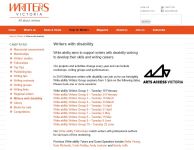 "Writeability website, captured 2015" Webpage reads, in part "Write-ability aims to support writers with disability wishing to develop their skills and writing careers. Our projects and activities change every year and can include workshops, writing groups and performances. In 2015 Melbourne writers with disability can join us for our fortnightly Write-ability Writers Group sessions from 1-3pm on the following dates. Please book one or more sessions."
-
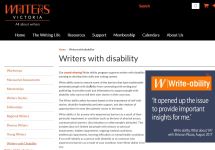 "Writeability website, captured 2018" Webpage reads, in part "Write-ability aims to remove some of the barriers that have traditionally prevented people with disability from connecting with writing and publishing. It provides tools and information to support people with disability who want to tell their own stories in their own way. The Write-ability ethos has been based on the importance of self-told stories, disability-leadership and peer support, and the creation of opportunities for even the quietest voices to be heard."
-
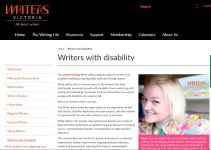 "Writeability website, captured 2019" Webpage reads, in part "Write-ability aims to remove some of the barriers that have traditionally prevented people with disability from connecting with writing and publishing. It provides tools and information to support people with disability who want to tell their own stories in their own way. The Write-ability ethos has been based on the importance of self-told stories, disability-leadership and peer support, and the creation of opportunities for even the quietest voices to be heard."
-
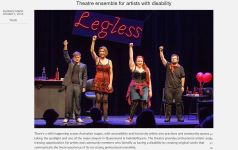 "Indelability Arts - Theatre Ensemble for Artists With Disability" News article by Kymberly Martin in Freedom2Live reads, in part, "The company, founded in 2015 by Rebecca Alexander and Catarina Hebbard, was inspired by local and international trailblazers and identified a gap within the creative sector for students with disabilities interested in pursuing a career in the arts after leaving school."
-
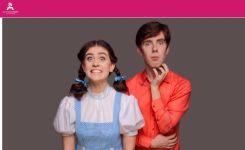 "Accessible Arts - Creative Initiatives, captured 2022" Accessible Arts - Creative Initiatives - reads, in part "The unique perspectives and experiences of artists with disability – as well as the intersection of cultural identities across all types of disability – present exciting avenues for new artistic possibilities right across the spectrum of visual, performing, literary, screen and digital arts. We’re here to work with arts and cultural organisations, government agencies and other funding partners to deliver creative initiatives focused on providing development and production opportunities for all kinds of artists with disability or who are d/Deaf."
-
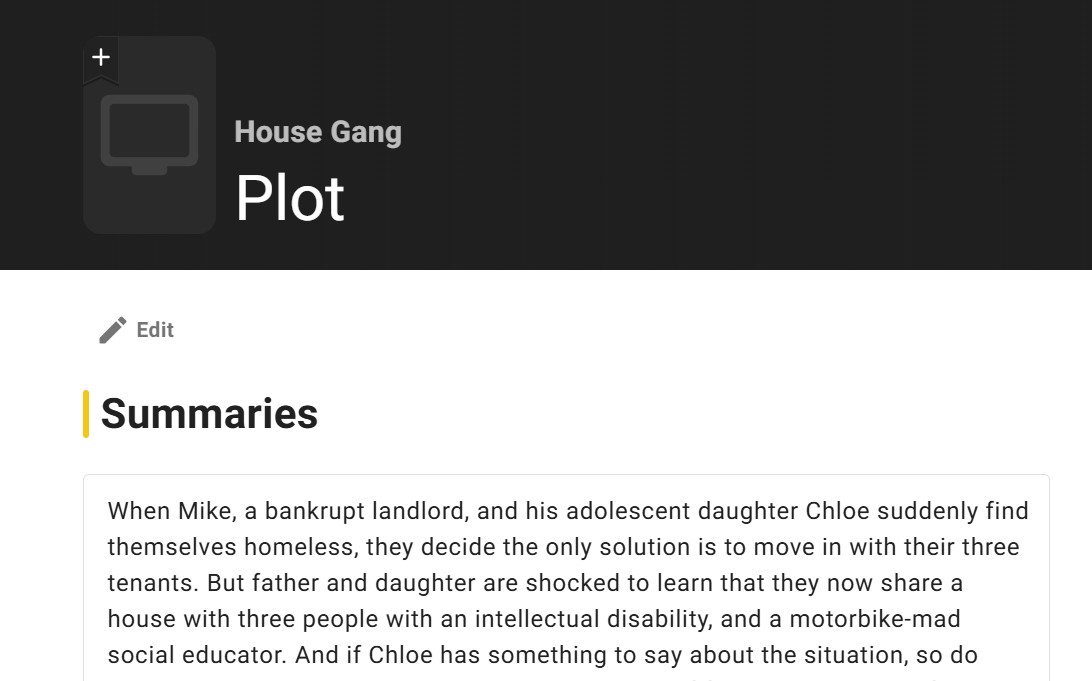 "House Gang - IMDB" Reads, in part "House Gang is an energetic and irreverent domestic comedy with a naughty sense of fun. Featuring three remarkable young actors, each with an intellectual disability, it takes an unconventional look at "family" in the 90s. Above all else House Gang celebrates diversity-you don't need to have a disability to be challenged by the problems of modern life. And being "normal" doesn't give us sole rights on love, sex, ambition, or laughter."
-
 "Access Arts Moving Matters Workshops" Access Arts Moving Matters Workshops, with Monique de Goey, flyer reads "These workshops are designed to develop body awareness, creativity, self expression, imagination and play through participation in visual arts and movement based activities."
-
 "Accessible Arts - ACE Arts Creativity Expression - Helen Connors - Article: Why Do All The Bad Guys Have A Disability - Iss17, 1997, Pg11-13" Accessible Arts - ACE Arts Creativity Expression - Helen Connors - Article: Why Do All The Bad Guys Have A Disability - Iss17, 1997, Pg11-13
-
 "Accessible Arts - ACE Arts Creativity Expression - Promotional Notice - Public Television Conference and Commonwealth State Disability Agreement - 1992 - Iss7, Pg5" Accessible Arts - ACE Arts Creativity Expression - Promotional Notice - Public Television Conference and Commonwealth State Disability Agreement - 1992 - Iss7, Pg5