Items
Search full-text
“Australia Council releases its first Disability Action Plan”
- Tutti Ensemble
-
 "Australia Council - Annual Report 1995-96" Australia Council Annual Report 1995-96- discusses functions, organisation chart, arts funding, audience development and advocacy with collaboration with various government departments to focus on advocacy for minority groups including people with disabilities, strategy and policy with Arts and Disability report, describing the barriers to intellectual and physical access to the arts experienced by people with a disability and the implications for arts organisations of the Disability Discrimination Act 1992, main activities of Council and its Boards, and includes financial statements and lists of grants made including grants for programs, projects, information and advocacy.
 -
“Larissa Macfarlane leads the installation of Australia’s first Disability Pride Mural” In 2017, Larissa Macfarlane led the installation of Australia’s first Disability Pride Mural. It was unfortunately removed by accident by council workers. It was re-installed in 2018 and was constructed of paper and fixed to the wall with wheat paste glue so that it was temporary. The aim was to raise awareness of Disability Pride in Australia.
-
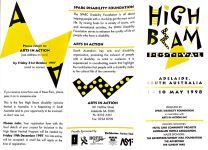 "High Beam Festival 1998 Flyer" High Beam Festival Flyer 1998 reads "This is the first High Beam disability inclusive festival in Australia. It is happening in South Australia and its your opportunity to be involved so don't miss out. … HIGH BEAM FESTIVAL INCLUDES: • A spectacular opening night of celebration. • A lively Cabaret/Porty featuring some of Australia's top entertainers. • Two days of stimulating seminars with topics covering arts, disability and healthy communities. • A week-long program of disability inclusive events at The Governor Hindmarsh Hotel. • A promotional campaign that will attract people from around Australia. • Multi-media promotional opportunities including free entry in the official festival program."
 -
 "Australia Council - Annual Report 1988-89" Australia Council Annual Report 1988-89 - discusses objectives, Council Committees and members, board members, allocation chart, main activities of Council and its Boards, and includes financial statements and lists of grants made including grants for community cultural development traineeships, training, programs, projects, performances and promotion and publications including “The Arts and People with Disabilities: A code of practice for arts organisations.”
 -
“‘Arts and Disability: A Research Report’ published in 1995” In 1995, ‘Arts and Disability: A Research Report’ was published. Des Walsh and Juliet London were commissioned by the Australia Council to prepare the report. However, they found little information that was relevant to the theme of the report. In addition to a review of existing literature, they met with people involved in arts organisations, disability organisations and organisations dedicated to both, as well as funding bodies. Walsh and London outlined the different ways that disabled people interact with the arts: as artists, consumers, and through art therapy. They also recognised the “negative or unduly limiting notions attached to arts in relation to disability” (12). Overall, they found “no conclusive evidence […of a] widely shared, articulated concept of a ‘disability arts’ movement in Australia” at that time. The report was intended to inform meaningful policy going forward. They made recommendations related to buildings and physical barriers, leadership, education and training and action plans.
- Alan Constable
-
“The South Australian Film Corporation announces their disability screen strategy” The South Australian Film Corporation launched their disability screen strategy. First, their Diversity and Inclusion Strategy 2022-2032, which they say “breaks new ground nationally,” defines quantifiable 10-year targets. In addition, the SAFC has developed a Disability Equality Plan, Targeted Diversity Attachments, the FULL TILT Short Documentary Initiative, and Film Lab: New Voices, a feature film development program presented by SAFC with Adelaide Film Festival and Mercury CX.
-
 "Australia Council - Annual Report 1989-90" Australia Council Annual Report 1989-90 - discusses objectives, highlights, support for artform development, main activities of Council and its Boards, and includes financial statements and lists of grants made including grants for conferences, access and touring, programs training and resource development as well as publications such as “The Arts and People with Disabilities”
 -
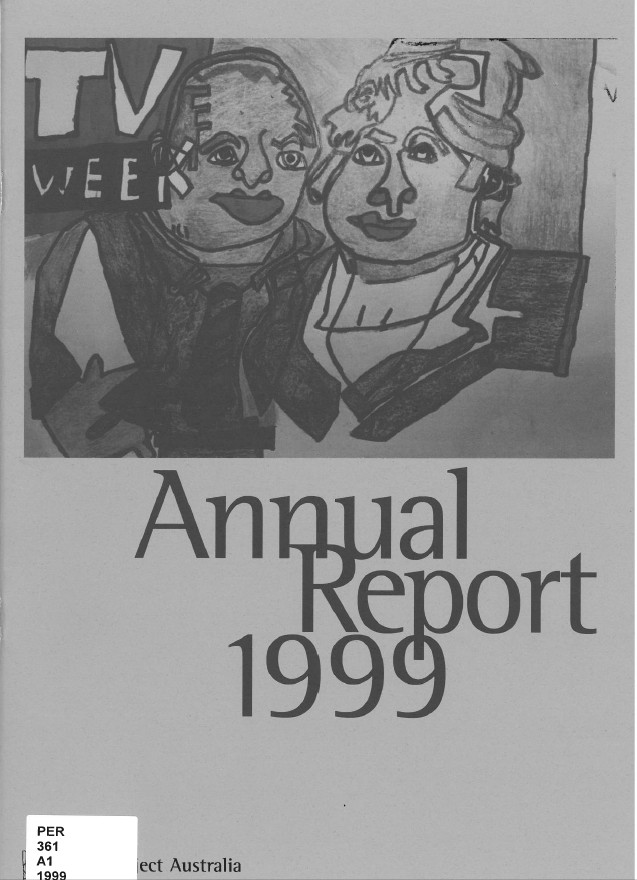 "Arts Project Australia - Annual Report 1999" Arts Project Australia - Annual Report 1999 - Management Committee, Aims and Objectives, President's Report, Director's Report, Studio Workshop Program, Outreach Program, Exhibitions, Financials - reads, in part "Arts Project Australia celebrated its 25th anniversary in' 1999. Since its inception, Arts Project Australia has gone from strength to strength and has enriched the lives of·all those wbo have been privileged enough to be involved with it"
 -
 "Australia Council - Annual Report 2018-19" Australia Council - Annual Report 2018-19 - reads, in part "This year the Council made a new commitment of $750,000 over three years to support structured mentorships and two new national awards for artists with disability. Empowering and celebrating artists with disability is imperative in ensuring that Australia’s rich diversity is truly reflected across the breadth of our arts."
 - Dance Integrated Australia
-
“Disabled People’s International (Australia) (DPIA) formed in 1983” The organisation Disabled People’s International (Australia) (DPIA) was formed in 1983. Thirteen disabled Australians who attended Disabled People’s International (DPI) first world assembly in Singapore in 1981, the International Year of the Disabled Person, returned home to set up the Australian branch two years later. The Women with Disabilities Australia online history reports that DPIA “from the outset, was dominated by disabled men. Only 3 of the 11 members of its governance structure were women, and there was no mention of women or gender in DPIA goals and objectives.” This led to the establishment of a women’s network within DPIA, known as the National Women’s Network (DPIA).
-
 "Australia Council - Annual Report 1990-91" Australia Council Annual Report 1990-91 - discusses objectives, organisation chart, year in review, support for artform development, main activities of Council and its Boards, and includes financial statements and lists of grants made including grants for Self Advocacy tor Intellectually Disabled, programs, artists and playwrights in residence and resource development and an increase of Australia Council staff with disabilities following Equal Opportunity Employment program.
 -
 "Arts and Disability: A research summary" Australia Council - Arts and Disability: A research summary, 2018 - reads, in part "The great art created by artists with disability, and participation of people with disability in the arts, are integral to the artistic and cultural life of Australia. This summary brings together findings from Australia Council research publications and a research overview compiled by the Meeting of Cultural Ministers to build the evidence base about disability and the arts."
 -
“The report ‘Inquiry into Health Services for the Developmentally Disabled and Psychiatrically Ill’ (aka the Richmond Review) is published by the NSW Government.” In 1983, the seminal NSW Government report, ‘Inquiry into Health Services for the Developmentally Disabled and Psychiatrically Ill’ was published. The NSW inquiry, also known as the Richmond Report due to its chair, David T. Richmond, revolutionised the institutional landscape by explicitly linking disability services to human rights for the first time in Australia and highlighting the critical need for advocacy "mechanisms" that actively allowed people with disabilities to "speak for themselves."
-
“ABC appoints Stella Young as editor of Ramp Up” In 2010, ABC announced the appointment of Stella Young as editor of its first (and short-lived) dedicated disability platform, ABC Ramp Up. Shawn Burns’s 2014 article in The Conversation laments the closure of the initiative and the loss of a vital platform for better disability representation in Australian media. The URL link to the Ramp Up page now opens with the following statement: “This website is no longer being updated but remains online as an archive of three and a half years of discussions and conversations regarding disability in Australia.”
-
"The Australian Council for the Arts established in 1968" The Australian Council for the Arts was established in 1968. This came after a push during the late 1960s for better support of the arts in Australia. The Council replaced the Elizabethan Trust as Australia’s main arts body, although the Trust continued to receive funding from State governments. The Council was later given statutory authority in 1975 and called Australia Council. Prime Minister Gough Whitlam is recognised as a key political supporter of the arts. The election of Whitlam (serving from December 1972 to November 1975) gave unprecedented and considerable attention and funding to an arts policy which would establish an Australian cultural identity raising international awareness. The Australian Council for the Arts received an unprecedented $14 million in funding in the 1973/74 budget. This was “more than double the allocation the bodies out of which it evolved had received the year before. The Council’s allocation was increased by a further 50 per cent in the 1974/75 Budget."
-
"The first ACT DisAbility Arts Festival is held" In 2004, the first ever ACT DisAbility Arts Festival was held as part of International Day of DisAbility celebration.
-
“Assistance to Composers Advisory Board created by the Commonwealth government.” In 1967, the Commonwealth government created the Assistance to Composers Advisory Board with an aim to advise on funding needs for music composition and promotion of Australian composers. The Board was to judge work based on “musical distinction or excellence of its kind, and on the promotion of Australian composers both in Australia and abroad”. The Board’s functions were later absorbed by the Australia Council.
-
 "Accessible Arts - Annual Report 2001" Accessible Arts - Annual Report 2001 - report from the chairperson, treasurer's report, independant auditor's report, report on the 2001 operational plan, report on the 2002-03 operational plan, Organisation Infrastructure, Consultative Services, Training, Regional Networks, Website development
 -
"David Throsby, Katya Petetskaya (2024) Artists as Workers: An Economic Study of Professional Artists in Australia, Creative Australia, 2024." "Artists as Workers: An Economic Study of Professional Artists in Australia, by David Throsby and Katya Petetskaya, is the seventh in a landmark study, carried out independently over the last four decades by Professor Throsby and colleagues at Macquarie University, with support from Creative Australia (previously the Australia Council for the Arts). Conducted at roughly six–year intervals, the series tracks the working conditions of artists, providing information about their artistic practice, income, career development and pathways, and their broader working lives. The latest survey was in the field late 2022 and early 2023 and examines activity in the 2021-22 financial year. This edition therefore captures the conditions for artists in the wake of COVID-19 and coincides with the Australian Government’s January 2023 announcement of its five-year national cultural policy Revive: A place for every story, a story for every place."
-
 "Accessible Arts - Annual Report 1998" Accessible Arts - Annual Report 1998 - ACE Magazine, Issue 20, 1999, includes Strategic Plan, 1998 Annual Report, 1998 Accounts, What's on & Info, with Staff, Strategic Plan includes Guiding Principles and Key Directions, Annual Report includes Aims and Objectives, Chairperson Report, Treasurer Report, Executive Officer Report , Consultancy, Regional Networks, Partnerships, Resources, Administrator Report , Financials
 -
"The first known disability-led activism occurred in 1971 when John Roarty formed a committee among the residents of Weemala nursing home." John Roarty, who had cerebral palsy, was a resident of Weemala nursing home for 35 years. In what would become known as the first known disability-led activism, John formed a residents committee to fight against maltreatment and to fight for control and choice over their daily lives.
-
“The Australian Government’s Creative Nation policy released in 1994” ‘Creative Nation’ was released in 1994. This was the first ever cultural policy formally developed by an Australian Government. Alongside a number of art forms, the policy included establishments like libraries in its definition of culture and pledged $250 million in funding to cultural organisations.