
Items
Search full-text
“Australia Council start development of Code of Conduct for Access in The Arts”
- Wendy Muche
- Wendy Rix
- Weston Bruner
- Youla Therios
- Yve Fallon
- Yvonne Bouwman
-
 "The Other Film Festival Program 2010 - A Broken Puzzle by Dianne Reid (2010)" The Other Film Festival Program 2010 - A Broken Puzzle by Dianne Reid - reads, in part "Performers from Weave Movement Theatre create a physically and vocally evocative story about place."
-
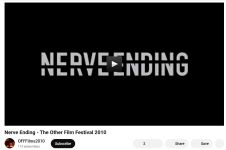 "The Other Film Festival Program 2010 - Nerve Ending by Peter Humble (2009)" The Other Film Festival Program 2010 - Nerve Ending by Peter Humble (2009) - reads, in part "What happens when our nerves get the better of us, literally? Michelle Ryan from Dance North takes us on a powerful exploration of resilience"
-
 "Salubrious Productions Website, captured 2007" Salubrious Productions website, captured 2007, promoting a diverse range of artists and entertainers - bands and ensembles - across genres.
-
 "Blue Roo Theatre Company - AnnualReport 2018-19"
- Sophie Janzen
- Michele Castagna
-
 "Accessible Arts - Arts Extraordinare Festival 1993 - Promotional Flyer" Accessible Arts - Arts Extraordinare Festival 1993 - Promotional Flyer - reads, in part "Arts Extraordinaire -Celebrating Where The Arts Can Take You is Australia's first festival to celebrate the diverse talents and artistic skills of people with disabilities. "
-
 "Tutti Arts - Choir - Broadway Spectacular - Program" Tutti Arts Choir 'Broadway Spectacular' 2010 Program - reads, in part "The show is rich in melodies and potent lyrics by Berlin, Coleman, Porter, Gershwin, Bernstein, Sondheim, Lerner and Lowe, Rodgers and Hammerstein, and the Tutti Choir and soloists have worked with typical enthusiasm and joy to bring you their interpretation of the music."
-
"Bree Hadley (2014) Disability, Public Space Performance, and Spectatorship: Unconscious Performers. London: Palgrave Macmillan." "Why would disabled people want to re-engage, re-enact and re-envisage the everyday encounters in public spaces and places that cast them as ugly, strange, stare-worthy? In Disability, Public Space Performance and Spectatorship: Unconscious Performers, Bree Hadley examines the performance practices of disabled artists in the US, UK, Europe and Australasia who do exactly this. Operating in a live or performance art paradigm, artists like James Cunningham (Australia), Noemi Lakmaier (UK/Austria), Alison Jones (UK), Aaron Williamson (UK), Katherine Araniello (UK), Bill Shannon (US), Back to Back Theatre (Australia), Rita Marcalo (UK), Liz Crow (UK) and Mat Fraser (UK) all use installation and public space performance practices to re-stage their disabled identities in risky, guerilla-style works that remind passersby of their own complicity in the daily social drama of disability. In doing so, they draw spectators' attention to their own role in constructing Western concepts of disability. This book investigates the way each of us can become unconscious performers in a daily social drama that positions disability people as figures of tragedy, stigma or pity, and the aesthetics, politics and ethics of performance practices that intervene very directly in this drama. It constructs a framework for understanding the way spectators are positioned in these practices, and how they contribute to public sphere debates about disability today."
-
"Bree Hadley (2017) Disability, Sustainability, Austerity: The Bolshy Divas Arts-Based Protests Against Policy Paradoxes. Centre for Sustainable Practice in the Arts Journal 18 Spring. http://www.sustainablepractice.org." "In this short article, I want consider some of the ways theatrical artists, activists and advocates in Australia are tackling the paradoxical relationship between sustainability and austerity discourses, and, as a result, some changes this may be starting to produce in disabled people’s aesthetic prerogatives. For the last 30 years, artists, activists and scholars in Australia and beyond have avoided casting disability in terms of trauma, crisis, catastrophe and disaster. Accounts of the way disability theatre challenges stereotypes , as well as analysis of disability signifiers in screen, stage, and social performance , have expressed concern about deploying disability as a metaphor for disaster, or defining disabled people as monstrous, tragic, stoic, or inspirational, the way the medical model of disability traditionally defines us. Instead, modern disabled artists and the scholars who analyse them have advocated for work that deploys live art, performance art, and performative intervention in public space to challenge stereotypes, oppressive institutional systems, and other factors the social model of disability sees as the cause of disability oppression .In the last few years, though, there has been an increase in work that does associate disability with trauma, tragedy and disaster, in what seems to be a response to austerity, accountability and economic sustainability agendas that call for cuts to disability services spending to make our societies more sustainable going forward."
-
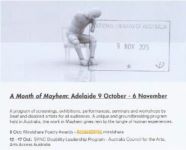 "A Month Of Mayhem" RealTime article on A Month of Mayhem, "A program of screenings, exhibitions, performances, seminars, and workshops by Deaf and colourblind artists for all audiences," presented by Access2Arts, in partnership with Adelaide Film Festival, Australian Network for Art and Technology (ANAT), Arts Access Australia, Unlimited UK, Tutti Arts, Sit Down Shut Up and Watch Film Festival
-
 "The Arts and Disability"
-
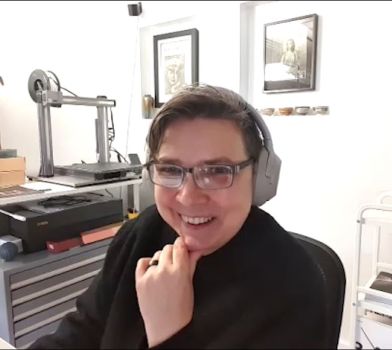 "Interview with Alison Bennett" Dr Alison Bennett is a senior lecturer in photography at RMIT School of Art specialising in expanded photography, webXR, queer and feminist creative practices. Interview Summary Alison Bennett, an artist and academic, spoke about her work in expanded photography, their experiences with autism, and the intersection of disability discourse with queer activism in their life and work. Their current project, vegetal/digital, arose from their experiences during the pandemic and connects audiences with plant sentience through interactive digital art. Alison also discussed the political nature of their work, aiming to shift ontological frameworks and exploring new modes of engagement through art. They reflected on the significant cultural changes regarding neurodiversity in the last few decades, highlighting the growing self-advocacy among autistic artists and their increasing impact in the arts.
- Pavlos Soteriou
- Frank Wood
- Jill Smith
- Sarah Masters
- Scott Weinger
-
 "Writeability website, captured 2014" Webpage reads, in part "Mentor in Residence – writers with disability can get up to four hours of free, one-on-one support from our in-house Mentor in Residence. This can include meetings, phone or Skype conversations or feedback on up to 5,000 words of your work. Please note that demand for this service is very high, so you will be placed on a waiting list."