Items
Search full-text
“Australia Council start development of Code of Conduct for Access in The Arts”
-
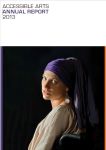 "Accessible Arts - Annual Report 2013"
-
 "Accessible Arts - Annual Report - Yearly Report - 1992"
-
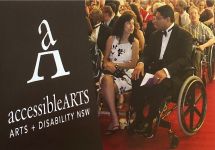 "Accessible Arts - Inclusive Leadership: Innovation and Impact keynote address by Betty Siegel Director of Accessibility at the Kennedy Centre for Performing Arts in Washington - Promotional Card" Accessible Arts - Inclusive Leadership: Innovation and Impact keynote address by Betty Siegel Director of Accessibility at the Kennedy Centre for Performing Arts in Washington - Promotional Card
-
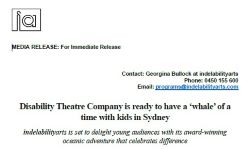 "IndelabilityArts - Wilbur The Optical Whale - Media Release" Media release reads, in part, "‘Wilbur the Optical Whale’ tells the story of a glasses-wearing whale named Wilbur who, along with his best friend Cecil the Shark, encourages children to accept everyone just as they are. The story takes place under the sea, where the audience is taken on an immersive journey to engage with the environment around them. Collaborating with Flipside Circus, the show employs art forms including circus, stunning projections, vivid music, and interactive games to take the audience on a deep-sea sensory dive to meet Wilbur and his cheeky friends."
-
"Janice Rieger and Megan Strickfaden(2019) “Dis/ordered assemblages of disability in museums.” In The Routledge Handbook of Disability Art, Culture, and Media, edited by Bree Hadley and Donna McDonald, 48–61. London & New York: Routledge." "Museums are spaces of power and care. They are institutions that present assemblages (Deleuze & Guattari 2002), which are reconstructions and representations of history and societal values, and thus are partial realities that curate human existence. These assemblages cannot ever represent the totality of human existence because it is never possible to do so, and yet these assemblages are embedded with power because choices are made about what ought or ought not be represented within museums (Ott 2013; Bennet 2017). The nature of partial realities is that, at their centre, these are still representations that tell stories of what one would imagine to be the most significant events related to a place (nation, city), with a particular focus on a societal event or issue (war, art, sports, nature, human rights, etc.) and peoples (e.g. immigrants, migrants, First Nations or Indigenous peoples, etc.). Persons attending museums rely on the expertise of historians, curators, archivists, conservators, and exhibition designers to present materials within the museum that focus upon and represent societal values. Most museum visitors are not aware of the power that museums hold, although more and more museum visitors push against narratives which they do not feel to be adequate representations of the places, events, issues, and peoples of society (Hooper-Greenhill 1992, 2000; Anderson 2004; Janes 2009, 2010). Where there is power, there is also care. Historians, curators, archivists, conservators, and exhibition designers take great care in how they assemble materials within museums."
-
"Rachel Carling-Jenkins, Mark Serry (2014) Disability and social movements: learning from Australian experiences. Burlington : Ashgate Publishing Company" Reads, in part "This book provides the reader with a ground-breaking understanding of disability and social movements. By describing how disability is philosophically, historically, and theoretically positioned, Carling-Jenkins is able to then examine disability relationally through an evaluation of the contributions of groups engaged in similar human rights struggles. The book locates disability rights as a new social movement and provides an explanation for why disability has been divided rather than united in Australia.."
-
"Margaret Cooper (1999) The Australian Disability Rights Movement Lives. Disability & Society, 14(2), 217–226. https://doi.org/10.1080/09687599926280" Reads, in part "The Australian Disability Rights Movement is surviving despite funding threats to advocacy programmes. The integral relationship of advocacy funding to the Australian Disability Rights Movement is outlined. A brief history of the Australian Disability Rights' Movement is given, and whether this is a new social movement, or not, is discussed. The role of Women With Disabilities Australia is outlined."
-
"Anthea Skinner, Jess Kapuscinski-Evans (2021) Facilitate This! Reflections from Disabled Women in Popular Music. Journal of Popular Music Studies 1 June 2021; 33 (2): 3–14. doi: https://doi.org/10.1525/jpms.2021.33.2.3" Reads, in part "This article is a reflection by the authors on the impact that their identities as disabled women have had on their ongoing music careers. Skinner and Kapuscinski-Evans make up two-thirds of the Australian crip-folk trio, the Bearbrass Asylum Orchestra (the term “crip” is a cultural reappropriation of “cripple”). The Bearbrass Asylum Orchestra is a band that performs as part of the Disability Music Scene in Melbourne, Australia, using folk music to portray their experiences as people with disabilities. In this article Skinner and Kapuscinski-Evans discuss the formation of and philosophy behind the band, as well as the impact that growing up as disabled women had on their musical education, careers, and influences."
- Through Art Unity
- Blue Folk Theatre
- Angel Leggas
- Benjamin Hancock
- Qambar Ali Akhteyari
- Una Rey
-
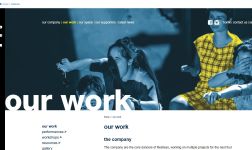 "Restless Dance - Our Work" Restless Dance Theatre website, ‘Our Work,’ captured 2020 – links to pages on history, performances, workshops, resources, gallery, shop, and bequests – information about the core Company, workshop programs, and other opportunities
-
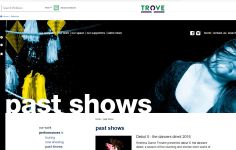 "Restless Dance - Past Shows 2012 - 2016" Restless Dance Website, information about past shows 2012-2016, captured 2020 – information about Debut 5: the dancers direct (five short works from Youth/Senior ensembles), In The Balance (at Adelaide Cabaret Festival) Touched (directed by Michelle Ryan with Youth ensemble), What’s a Nice Girl Like You Doing in a Place Like This? (directed by Emma Stokes with the Senior ensemble), Naturally (directed by Michelle Ryan with Youth ensemble), Salt (touring work developed by Rob Tannion), Debut 4 – the dancers direct 2013 (short works by five company members), high voltage 2012 (short work directed by Lorcan Hopper, as part of Debut 3 – the dancers direct and toured to Port Moresby) and Howling Like A Wolf (creative via collaborations between Restless and Melbourne based Rawcus Theatre led by Kate Sulan).
-
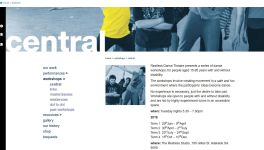 "Restless Dance - Central Workshop" Restless Dance Theatre website, 'Central Workshop,' captured 2020 – reads, in part, "Restless Dance Theatre presents a series of dance workshops, for people aged 15-26 years with and without disability. The workshops involve creating movement in a safe and fun environment where the participants’ ideas become dance. No experience is necessary, just the desire to take part. Workshops are open to people with and without disability and are led by highly experienced tutors in an accessible space."
-
"Restless Dance - Links Workshop" Restless Dance Theatre website, 'Links' captured 2020 – reads, in part, "Restless Dance Theatre presents Links, a dance theatre workshop for 8-14 year olds. The workshops involve creating movement in a safe and fun environment where the participants’ ideas become dance. No experience is necessary, just the desire to take part. Workshops are open to people with and without disability and are led by highly experienced tutors in an accessible space."
-
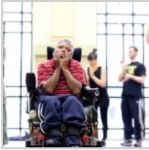 "Weave Movement Theatre - Born in a Taxi - One Lump Or Two - 2012" Image of work - Weave Movement Theatre - Born in a Taxi - One Lump Or Two - 2012
-
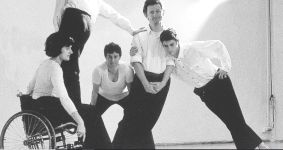 "Weave Movement Theatre - State Of Flux" Image of work - Weave Movement Theatre - State Of Flux
-
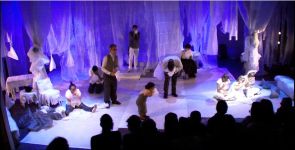 "Weave Movement Theatre - White Day Dream - 2016" Image of work - Weave Movement Theatre - White Day Dream - 2016
-
“Sydney Film Festival launches Screenability program in 2017” Sydney Film Festival launched its Screenability program in 2017. The international program was intended to offer a platform for screen practitioners with disability. Sofya Gollan was Screenability’s inaugural programmer and remained in the role until 2021.
- Castlemaine Art Museum
- Fox Jensen Gallery
- Newcastle Art Gallery