
Items
Search full-text
“Australia Council start development of Code of Conduct for Access in The Arts”
-
“Queensland Advocacy Incorporated spearhead campaigns to close institutions” In 1989, when the Bjelke-Petersen-Ahern Government was coming to an end, the newly established Queensland Advocacy Incorporated was spearheading campaigns around the state to close down institutions and provide financing for individual help for individuals with disabilities.
-
“Demonstrators protest inadequate funding for disability support in Adelaide, 1992” On the 13th March, 1992, 100 demonstrators gathered in Adelaide to protest inadequate funding for disability support. Deputy Prime Minister and Minister for Health, Housing and Community Services Brian Howe was “heckled” by the group outside an event at Jubilee Hall during a health care expo. Howe agreed later that year to “honour a federal government promise to expand the National Attendant Care Scheme,” that is, after another demonstration by 70 advocates outside Parliament House.
-
“Protesters gather in Lismore (NSW) to oppose proposed cuts to services” In 2004, 300 disabled persons, along with their relatives and carers, gathered in Lismore to protest proposed cuts to adult, training, learning, and support programs, among other services. These were a part of a series of demonstrations against the state government that included hundreds of demonstrators in Newcastle and resulted in the state government reversing its position on modifications to the Post-Schools Options Disability Program.
-
“The documentary series ‘You Can't Ask That’ premieres in 2016” The ABC started a documentary series in 2016 called ‘You Can't Ask That,’ which asks "outrageous, uncomfortable and shocking questions to uncover the truth behind some of the most marginalised and misunderstood Australians." The series has featured episodes focused on people with short stature, Downs syndrome, schizophrenia, and autism, Deaf people, blind people, and wheelchair users.
- State Theatre of South Australia
- Force Majeure
- Alfonso Puautjimi
- Alfonso Punitjimi
- Danielle Micich
- Jess Kapuscinski-Evans
- Lorna Kantilla
- Stephen Smith
-
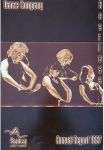 “Restless Dance – Annual Report 1997" Restless Dance Theatre Annual Report 1997 - reads, in part "The Company's activities were evenly distributed between high profile performance and community based workshops. Restless hos consolidated itself os on independent leader in youth performing arts in Australia. It is well managed and well skilled using local, interstate and overseas artistic talent to blend the skills of the Company members. Highlights include Sex Juggling, the tour of northern South Australia and the Northern Territory and Kin" - includes Financials and News Clippings
-
"Bree Hadley (2019) Disability arts in an age of austerity. In Hadley, B & McDonald, D (Eds.) The Routledge handbook of disability arts, culture, and media. Routledge, United Kingdom, pp. 347-361." "Is the current “age of austerity” (Summers 2009) impacting on art, culture, and media practices by and about people with disabilities, and, in particular, on art-based protest practices by people with disabilities? In recent years, much has been written about austerity as neo-liberal economic, political, social, and ideological agenda (Harvey 2005; Barnett 2010; Seymour 2014). Much has been written about the way groups effected by local and global governmental shifts towards austerity are protesting, presenting themselves, and being represented by others (Fritsch 2013; Goodley, Lawthom, & Runswick-Cole 2014; Runswick- Cole & Goodley 2015; della Porta 2015; Kokoli & Winter 2015; Beresford 2016; Dodd 2016; Giugni & Grasso 2016; Berry 2017). The question of whether disabled artists are adapting their practices to address these changing cultural circumstances has received less attention (Hadley 2017) and is thus the topic I focus on in this chapter."
-
"Bree Hadley, Donna McDonald, Sarah Austin, Kath Duncan, Gerard Goggin, Lachlan MacDowall, Veronica Pardo, Eddie Paterson, with collaborators Dave Calvert, Jori De Coster, Shawn Goh, Alice Fox, Ann M. Fox, Andy Kempe, Petra Kuppers, Justin Lee, Alex Lubet, Sarah Meisch Lionetto, Ann Millett-Gallant, Laura Misener, Bronwyn Preece, Megan Strickfaden, Joanne Tay, Matthew Reason, Nancy Quinn, and Sarah Whatley (2019) Conclusion: practicing interdependency, sharing vulnerability, celebrating complexity - the future of disability arts, culture, and media research. In Hadley, B & McDonald, D (Eds.) The Routledge handbook of disability arts, culture, and media. Routledge, United Kingdom, pp. 362-372." "In this chapter, the authors conclude The Routledge Handbook of Disability Art, Culture, and Media studies by reflecting on the past, present, and potential future of disability art practice debated throughout the book. Based on research currently underway in the work of many of the Australian contributors, and including reflections from the global contributors, this concluding chapter reflects on what the disability arts, culture, and media practice and research of the future might look like, do, and achieve in the public sphere."
- Jo Dunbar
- Lesley Hall
- Margot Curry
- Margot Currey
- Peter Binning
-
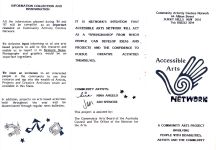 "Accessible Arts - PromotionalFlyer - 1986-87" Accessible Arts Network - Promotional Flyer - 1986-87 - reads, in part "It is network's intention that Accessible Arts Network will act as a "springboard" from which people can develop ideas and projects and the confidence to pursue themselves."
-
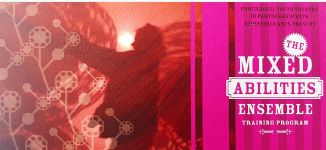 "Accessible Arts and Powerhouse Youth Theatre - The Mixed Abilities Ensemble Training Program - Promotional Card" Accessible Arts and Powerhouse Youth Theatre - The Mixed Abilities Ensemble Training Program 2008 - Promotional Card - reads, in part "In this 15 week course you will work with highly experienced and professional tutors to develop your skills in movement, voice, performance and theatre making. This training program is open to people with and without a disability."
-
 "DADAA Opportunity and Awareness Report" Opportunity & Awareness Report prepared by Gay McCormick-Saunders for Disability in the Arts, Disadvantage in the Arts (WA) Inc. (DADAA) in 1995, includes information on Disabled artists in database, trainers willing to work with disability groups, accessible workshops, including organisations developing programs, support, resources, and funding required, and recommendations.
- Dr John Dally
- Jorge Papanaoum