Items
Search full-text
“Australia Council start development of Code of Conduct for Access in The Arts”
- Scott Weinger
- Jill Smith
- Frank Wood
-
"Bree Hadley (2016) Cheats, charity cases and inspirations: disrupting the circulation of disability-based memes online. Disability and Society, 31(5), pp. 676-692." "With the increasing part online self-performance plays in day-to-day life in the twenty-first century, it is not surprising that critiques of the way the daily social drama of disability plays out in online spaces and places have begun to gain prominence. In this article, I consider memes as a highly specific style or strategy for representing disability via social media sites. I identify three commonly circulating categories of meme – the charity case, inspiration and cheat memes – all of which offer representations that people with disabilities find highly problematic. I then investigate the ways in which disabled people have begun to resist the representation and circulation of these commonly circulating categories of memes, via the production of counter or parodic memes. I focus, in particular, on the subversive potential of these counter memes, within disability communities online and within broader communities online."
-
"Bree Hadley (2018) Disability, disabled dance audiences and the dilemma of neuroaesthetic approaches to perception and interpretation. In Wood, K, Brown, A, Waelde, C, Harmon, S, Blades, H, & Whatley, S (Eds.) Dance, disability and law: Invisible difference. Intellect Ltd, United Kingdom, pp. 293-315.” "In this chapter, I want to consider one emerging approach to spectatorship – the neuroaesthetic approach – through the lens of disability spectatorship. In the twenty-first century, neuroaesthetics is gaining traction amongst scholars looking to provide accounts of spectatorship in less story-based performing arts such as classical and contemporary dance, as well as in more story-based practices in drama, theatre and performance. ‘It would be fair to say that neuroaesthetics has become a hot field’, as Alva Noë puts it (2011). To date, though, the assumptions that underpin neuroaesthetic approaches to spectatorship have not been brought together with the assumptions that underpin the equally emergent field of disability spectatorship studies. As Carrie Sandahl (2002: 18) has noted, different cognitive, sensory and corporeal abilities result in a range of different phenomenologies, perceptual processes and perceptual preferences that can in turn produce different styles of engagement with experiences, events and objects. These differences impact on how people with disabilities produce and perceive aesthetic performances – somatically, syntactically, symbolically and socially, as disabled people hear with their eyes, see with their fingers, or perceive phenomena vicariously via the intervention of technologies or translators. Accordingly, disability spectatorship, and more detailed attention to the presence of distinctive cognitive, sensory and corporeal processes amongst disabled spectators, has the potential to complicate, extend and challenge assumptions embedded in emerging neuroaesthetic approaches to spectating."
-
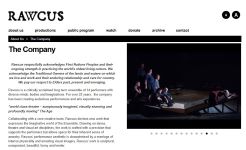 "Rawcus Website, captured 2024" Rawcus website, captured 2024, reads, in part "Rawcus is a critically acclaimed long term ensemble of 14 performers with diverse minds, bodies and imaginations. For over 22 years, the company has been creating audacious performances and arts experiences." Links to productions, public program, watch, and archive sections.
 -
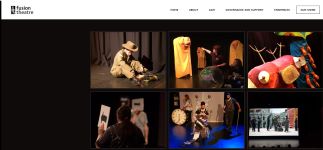 "Fusion Theatre Our Works, captured 2022" Fusion Theatre Our Work, captured 2022 - links to pages about past works, including A Long Way From Home, After the Beginning of Everything, The Beginning of Everything, A Place Called Maze, Microcosma, No Strongs Attached, Inside Out, The Color Project, Mind the Light, Facets of Us
 -
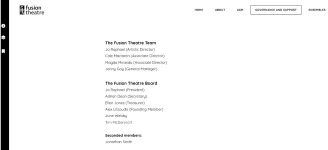 "Fusion Theatre Governance and Support, captured 2022" Fusion Theatre Governance and Support page, captured 2022 - Board, governance, and funding arrangements
 -
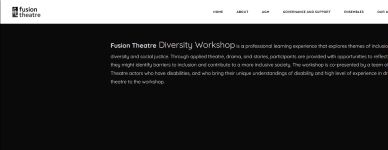 "Fusion Theatre Diversity Workshop, captured 2022" Fusion Theatre Diversity Workshop page, captured 2022 - reads, in part "Fusion Theatre Diversity Workshop is a professional learning experience that explores themes of inclusion, diversity and social justice. Through applied theatre, drama, and stories, participants are provided with opportunities to reflect on how they might identify barriers to inclusion and contribute to a more inclusive society."
 -
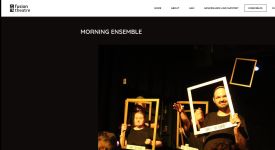 "Fusion Theatre Ensembles, captured 2022" Fusion Theatre Ensembles, captured 2022 - information about morning ensemble, evening ensemble, and ‘Movement in Conversation’ described as "and occasional project that Fusion Theatre offers in association with the Asylum Seeker Resource Centre (ASRC), and other local groups"
 -
 "Fusion Theatre Website, captured 2013" "Fusion Theatre Website, captured 2013 - reads, in part "Original contemporary theatre, built by people of all abilities", with links to About, Reviews and Media, Board and Support, Fusion and Deakin University pages
 -
"Bree Hadley, Janice Rieger (2021) Co-designing choice: objectivity, aesthetics and agency in audio-description. Museum Management and Curatorship, 36(2), pp. 189-203.” "The ‘Vis-ability’ exhibition, presented at the QUT Art Museum in 2019 was an exhibition curated with clear social inclusion goals from the outset. Through it, the museum sought to develop innovative, cost effective, and readily replicable techniques to allow blind and low vision visitors and artists to engage with the institution and its collections. The results affirm the benefits of offering blind and low vision visitors a spectrum of engagement choices, and also affirm that blind and low vision artists and visitors have capacity to make a critical contribution in co-designing that spectrum of choices. This exhibition and its use of multisensorial elements offers a useful prompt to museums to engage this community more fully in co-designing inclusion in the future."
-
”Hadley, Bree, Batch, Morgan, & Whelan, Michael (2021) The entitled ally: Authorship, consultation, and the 'right' to stage autistic people's stories. Disability and Society, 36(9), pp. 1489-1509.” "Theatre has a long tradition of presenting disabled characters as plot devices to tell someone else’s story. A recent production, All in a Row, resulted in heated debate around this issue. This article examines not the play itself, but the conflict between those who objected to the play’s representation of autism, and its creators, who defended their choices by citing their disability-adjacent identities and processes of consultation. For critics, the fact that the creators did not take the community’s concerns seriously was a source of trauma. This article uses this conflict to draw out lessons about how we might better negotiate the right to tell disability stories and strengthen frameworks to support that negotiation. We propose a decision tree diagram to assist artists in understanding the meaning, role, and most importantly the potential consequences of consultation – up to and including a community saying ‘no’ to an artist’s planned representation."
-
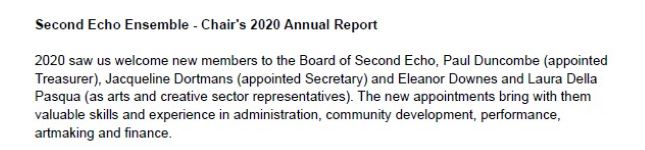 "Second Echo Ensemble - Chair's, Creative Producer's and Financial Reports 2020" Second Echo Ensemble Chair’s, Creative Producer’s and Financial Reports for 2020, including reports on work during the year (Let Me Dry Your Eyes, The CHAIN, What Makes You Beautiful), and reflections on the impact of Covid 19 Pandemic
 - Bernzerk Productions
- Yum Productions
- Art Day South
- Guiness Entertainment
- Sidetrack Theatre
-
 "The Other Film Festival Program 2010 - Be My Brother by Genevieve Clay (2008)" The Other Film Festival Program 2010 - Be My Brother by Genevieve Clay (2008) - reads, in part "A young man's charm and charisma enchants a stranger at a bus stop. But someone else's heart is at stake."
 -
 "The Other Film Festival Program 2010 - Blink by Kyra Kimpton and Lachlan Tetlow-Stuart (2009)" The Other Film Festival Program 2010 - Blink by Kyra Kimpton and Lachlan Tetlow-Stuart (2009) - reads, in part, "A young woman transforms a simple moment in time into a surreal fantasy. A film that pushes hard against the limitations of makeup."
 -
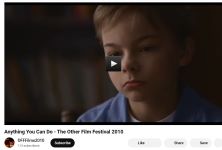 "The Other Film Festival Program 2010 - Anything You Can Do by Emma Buckley (2009)" The Other Film Festival Program 2010 - Anything You Can Do by Emma Buckley (2009) - reads, in part "Game on! Two boys face off in a back room. The competition is fierce. Faces are pulled and burps unleashed. But when victory is at hand, will it still taste sweet?"
 -
 "The Other Film Festival Program 2010 - Necessary Games by Sophie Hyde (2009)" The Other Film Festival Program 2010 - Necessary Games by Sophie Hyde (2009) - reads, in part "A triptych from Restless Dance Company about our human need to connect and the urgent games we play."
 - Wielding Theatre
- Inside Out Dance