Items
Search full-text
“Australia Council start development of Code of Conduct for Access in The Arts”
- Louise Hall
- Mary Carlson
- Mary Mormile
- Mary Schneider
- Mathew Lys
- Melissa Delaney
- Micheala Williams
- Monica Doyle
- Peter Dymond
- Peter Maley
- Renae Burton
- Sharin Hart
- Sue Parkes
- Victoria Lister
- Wenda Edwards
-
 "Access Arts - You Tube - Undercover Artist Festival 2015 - Captured in Three Minutes" Access Arts - You Tube - Undercover Artist Festival 2015 in 3 minutes
-
 "The Other Film Festival - Writing on Film and Disability - Online" The Other Film Festival Writing on Film and Disability - includes ‘Mind’s Eye” Re-envisioning Mental Health in the Arts’ by Adolfo Aranjues; ‘I know it shouldn’t matter, but do you think I’m pretty’ by Naomi Chainey; ‘The Other Film Festival – Disability, Comedy & Subverting Expectations’ by Alastair Baldwin; ‘Filmdis Q&A with Dominick Evans’ by Jax Jacki Brown
- Eddie Paterson
-
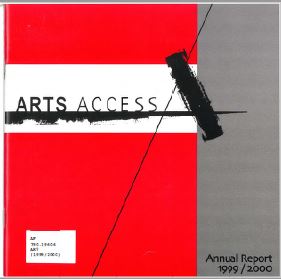 “Arts Access Victoria – Annual Report 1999-2000”
-
"Amanda Cachia (2022) Networks of Care: Collectivity as Dialogic Creative Access, in Amanda Cachia ed. Curating Access: Disability Art Activism and Creative Accommodation. London: Routledge, 219-230" Reads, in part "The collectives that have formed in recent years and that will be the subject of this chapter include the Feminist Health Care Research Group (FHCRG), the Sickness Affnity Group (SAG), and Power Makes Us Sick (PMS). Each of these groups attempts to be intersectional in their approach, focusing on feminist and crip revisions to health care. Feminist and crip unite in the groups as the participants all identify as both women and as disabled. In shared spaces, which can be found in physical spaces, such as an art gallery or an artist’s home, or online through Zoom, artists can offer mutual understanding of their experiences with chronic illness, disability, the medical industrial complex, and simply be a shoulder to lean on in times of anxiety, anger, and sadness. The collectives also offer an opportunity for the artists to lift each other up, creating an environment of respect, dignity, and self-worth, becoming a strong circle of empowerment, affrmation, and allyship. The proliferation of these support groups shows a general shift in social norms, where the medical feld no longer holds the only authoritative voice on health. This phenomenon also indicates how nonmedical health based groups are flling a need and making up for a lack in social support networks elsewhere, particularly within sanctioned medical arenas."
- Melbourne Comedy Festival
- Museum Victoria
- Melbourne International Comedy Festival
- Ahmed Zeed
- Alison Parsons