
Items
Search full-text
“Commonwealth Disability Strategy launched in December 1994”
- Danielle Micich
- Rose Dennis
-
"International Year of the Disabled Person (IYDP)" In 1976, the General Assembly proclaimed 1981 would be the Year of the Disabled Person. The 1981 International Year of the Disabled Person inspired an increase in awareness and disability arts. While UN theme was “full participation and equality” the theme in Australia was “Break down the Barriers”, raising the prole and issues of people with disabilities. The international year of the disabled persons was a catalyst for connecting Australian disability activists to each other and the international disability rights movement (Royal Commission, 2021, p. 6). Australia saw an increase in disability-themed theatre from 1981 to 1984; however, these performances were largely staged with non-disabled casts. Records of these productions can be found on the AusStage database.
-
“Arts Access Australia CEO encourages other non-disabled CEOs of disability organisations to step down” In 2012, Kate Larsen stepped down from role as CEO of Arts Access Australia. In a Ramp Up article, she explained “Now, I love my job. I'm good at it. I think that I've been useful here. But on the same day I accepted the position last February I also did something else. I gave notice of my resignation, and undertook to hand over the organisation by the end of 2012. The reason? Because I believe that Arts Access Australia should be led by a person with disability.” Upon her resignation, she encouraged other non-disabled CEOs of disability organisations to step aside to make space for disabled people to take up these leadership roles.
-
“The Bolshy Divas present ‘The Other 100 Conversations’ to Australian governments heads” In 2011, a group of disability activists called the Bolshy Divas presented a 100-page document, ‘The Other 100 Conversations,’ to heads of all Australian governments who had gathered in Canberra for a Council of Australian Governments (COAG) meeting. The document was addressed “to our elected representatives”. ‘The Other 100 Conversations’ comprised of 100 first-person accounts of participants of disability services in Western Australia, highlighting the lack of support and waiting times experienced.
-
“2023 Screen industry report ‘Disability and Screen Work in Australia’ finds disabled people fulfil a range of roles in the screen industry, despite facing prejudice and exclusion, and should be treated as experts of their access requirements” ‘Disability and Screen Work in Australia: Report for Industry’ (2023) was compiled by researchers Radha O’Meara, Laura Dunstan, Anna Debinski and Catherine Ryan. The study was supported by Melbourne Disability Institute and A2K Media. The authors summarise that disabled people fulfil a range of roles in the screen industry, despite facing prejudice and exclusion, and should be treated as experts of their access requirements. They find that “Disabled people experience a more precarious, lower paid, and less powerful position in the screen industry than their non-disabled counterparts.” O’Meara and her colleagues call for widespread change in the industry to expand access.
-
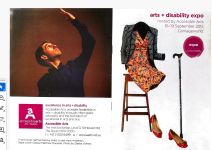 "Accessible Arts - Arts and Disability Expo - Program" Accessible Arts - Arts and DIsability Expo 2015 - Program - reads, in part "'Welcome to the first arts + disability expo. The arts + disability expo aims to provide you with information, advice and access to arts and cultural opportunities. With a variety of arts programs, organisations, venues and practitioners on hand, we hope to provide you with all the support that you need to become involved in creative pursuits. We encourage you to watch some of the performances, listen to the talks about the National Disability Insurance Scheme (NDIS), and view the photographic exhibition. The expo is also a good opportunity to see new and different levels of creative work by artists with disability.' - Sancha Donald, CEO, Accessible Arts"
- Anna Smith
- Bev Roberts
- Dorothy Berry
- Eve Lawson
- Harold (Jimmy) Fuller
- Nerrida Weller
- Sam Lemann
- Sonia Teuben
- Valerio Ciccone
-
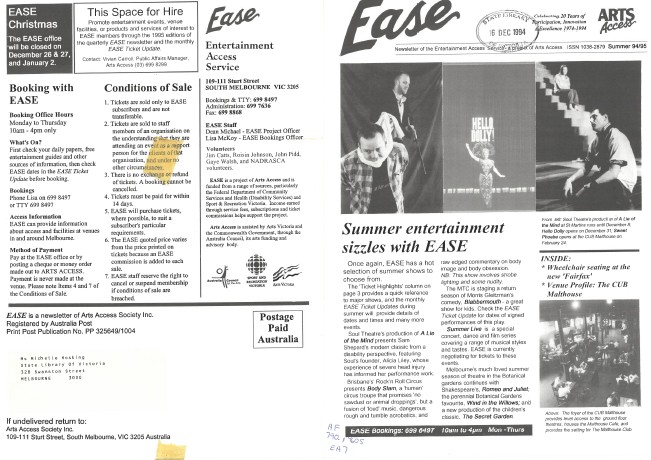 “Arts Access Victoria EASE Entertainment Access Service Newsletter Summer 1994-1995" Arts Access Victoria EASE Entertainment Access Service Newsletter Summer 1994-1995 - Playhouse Access Policy, venue profile, CUB Malthouse, improved wheelchair seating at Melbourne Theatre Company Fairfax Theatre
-
 “Arts Access Victoria EASE Entertainment Access Service Newsletter Autimn 1994" Arts Access Victoria EASE Entertainment Access Service Newsletter Autimn 1994 - EASE Consumers' Afternoon meeting for staff and members, low cost tickets to Comedy Festival, venue profile for improved wheelchair seating and access The Fairfax / Melbourne Theatre Company
-
"Creative Australia (2024) releases 'Equity: Arts and Disability Associated Plan" Reads, in part "The Australia Council for the Arts have released their critical new report Towards Equity: A research overview of diversity in Australia’s arts and cultural sector. This overview gathers published and unpublished data and research on representation within the arts and cultural sector in Australia."
-
"Bree Hadley (2018) Disability, disabled dance audiences and the dilemma of neuroaesthetic approaches to perception and interpretation. In Wood, K, Brown, A, Waelde, C, Harmon, S, Blades, H, & Whatley, S (Eds.) Dance, disability and law: Invisible difference. Intellect Ltd, United Kingdom, pp. 293-315.” "In this chapter, I want to consider one emerging approach to spectatorship – the neuroaesthetic approach – through the lens of disability spectatorship. In the twenty-first century, neuroaesthetics is gaining traction amongst scholars looking to provide accounts of spectatorship in less story-based performing arts such as classical and contemporary dance, as well as in more story-based practices in drama, theatre and performance. ‘It would be fair to say that neuroaesthetics has become a hot field’, as Alva Noë puts it (2011). To date, though, the assumptions that underpin neuroaesthetic approaches to spectatorship have not been brought together with the assumptions that underpin the equally emergent field of disability spectatorship studies. As Carrie Sandahl (2002: 18) has noted, different cognitive, sensory and corporeal abilities result in a range of different phenomenologies, perceptual processes and perceptual preferences that can in turn produce different styles of engagement with experiences, events and objects. These differences impact on how people with disabilities produce and perceive aesthetic performances – somatically, syntactically, symbolically and socially, as disabled people hear with their eyes, see with their fingers, or perceive phenomena vicariously via the intervention of technologies or translators. Accordingly, disability spectatorship, and more detailed attention to the presence of distinctive cognitive, sensory and corporeal processes amongst disabled spectators, has the potential to complicate, extend and challenge assumptions embedded in emerging neuroaesthetic approaches to spectating."
-
 "Australia Council - Making the Journey: Arts and Disability in Australia" Reads, in part "A collection of inspiring examples of how to include people with disabilities in the arts, as participants, creators and organisers"
-
 "Australia Council - Arts and disability a priority as Australia Council commits significant new funding" Australia Council - Arts and disability a priority as Australia Council commits significant new funding - reads, in part "The Australia Council has committed $750k over three years to support sustainable careers and to recognise the artistic excellence of artists with disability."
-
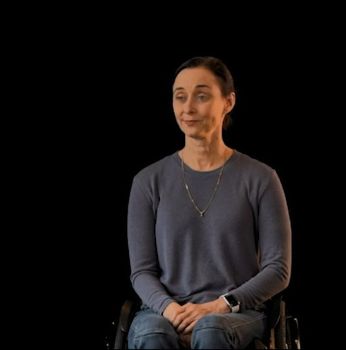 "Interview with Michelle Ryan" Michelle Ryan is the artistic director of Restless Dance Theatre and has extensive experience as a dancer and performer. Interview Summary Michelle Ryan, the artistic director of Restless Dance Theatre, shares her journey from being a successful dancer diagnosed with multiple sclerosis at 30 to becoming an advocate for artists with disabilities. Despite her initial hesitations to perform with her disability, a positive experience dancing with a European company reignited her passion and led her to Restless Dance Theatre, where she aims to change perceptions of who can create art. Michelle emphasizes the importance of providing professional opportunities and proper compensation for disabled artists, challenging the notion that disability work is charity or hobbyist. She advocates for representation that is genuine and not tokenistic, ensuring the inclusion of people with disabilities is meaningful and respectful.
-
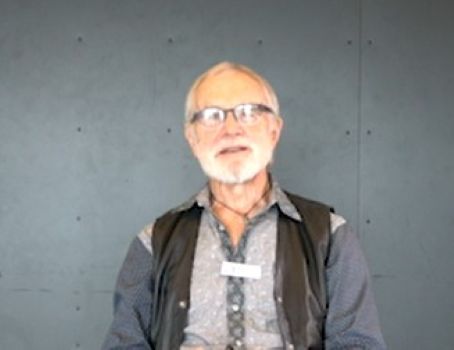 "Interview with Peter Vance" Peter Vance is a singer, songwriter, musician, performer, facilitator and disability arts advocate. Interview Summary: Peter Vance is a songwriter, performer, musician and singer. Peter suggested disability arts in the last 20 years has become more visible and popular reflecting a positive shift in how society views disability as part of the rich tapestry of human experience. This is reflected in how the arts now tell the stories of individuals with disabilities, not simply as artists with a disability, but as whole people whose varied experiences - visible and invisible - inform and enrich their creative expression. However, there are still challenges with funding and accessibility and ongoing struggles for recognition and support of disability art. Changes in how organisations operate to suit new funding such as the NDIS have potentially limited the spontaneity and personal touch that smaller, community-driven organizations once offered. Peter said it is essential to continue to push for better understanding, support, and visibility for people with all kinds of disabilities in every aspect of life, including the arts, to truly embrace inclusivity.
-
"Juliet London and Des Walsh (1995) Arts & Disability: Report Australia Council: Surry Hills." Juliet London and Des Walsh - Arts & Disability, Australia Council 1995 - Reads, in part "The Australian Bureau of Statistics estimates that 18 per cent of the Australian population has a disability. There is a basic lack of data on participation in the arts by artists with a disability. No figures were available on the number of people with disabilities applying for grants from the Australia Council or from State or Territory arts agencies. The current dearth of statistical information needs to be overcome by systematic and sustained research."