
Items
Search full-text
“Commonwealth Disability Strategy launched in December 1994”
-
"First ABS Survey of Disability, Ageing and Carers (SDAC)" An ABS Survey of Disability, Ageing and Carers (SDAC) starting in 1981 and made people with disability more 'visible' for services and highlighted differences of experiences.
-
"Disability activist Geoff Bell leads significant advocacy” In the 1970s, Geoff Bell was a disability activist who, after a diving accident left him quadriplegic at age 21, was placed in a nursing home. Not accepting nursing homes as appropriate residences for young people, he wrote to the then Minister for Social Security Bill Hayden. The letter was presented to parliament. In April 1978, Geoff Bell led ten members of the Disabled People’s Action Forum as they blockaded the entrance to a Medibank claims office for an hour. The protest was held outside Medibank to raise awareness of the architectural barriers to conducting personal business when Medibank was supposed to be of service. Signs held by the members read “We don’t need a stairway to paradise, We want ramps to independence".
-
"The first known disability-led activism occurred in 1971 when John Roarty formed a committee among the residents of Weemala nursing home." John Roarty, who had cerebral palsy, was a resident of Weemala nursing home for 35 years. In what would become known as the first known disability-led activism, John formed a residents committee to fight against maltreatment and to fight for control and choice over their daily lives.
-
“Senator Margaret Guilfoyle creates a committee of people with disabilities representing their own interests” In 1979, Senator Margaret Guilfoyle, the Federal Minister for Social Security created a committee of people with disabilities representing their own interests. This followed a complaint by Richard Llewellyn that he was the only token disability representative. This committee led to the formation of formal advocacy groups such as People with Disability Australia (PWDA) and Disability Resource Centre (DRC). The PWDA celebrated their 30th year anniversary in 2011.
-
“Australia Council grants funding for projects about disability or for disabled participants throughout the 1970s” The 1974/75 Australia Council annual report states $1,350 in funding granted to Spectrum Films (NSW) to "develop a screenplay for a feature film of the social pressures on a deaf mute”, as well as a $4,500 travel/study grant to Lloyd Nickson (QLD) "to attend summer schools in children's theatre and theatre for deaf children (USA and UK) for six months". In the same year, the Council reported Bryan Gracey as one of numerous individuals in receipt of Experimental Film funding for his short film ‘The World of a Blind Child’ (1975) about the emotional and physical difficulties 10-year-old Peter faces and how he navigates his disability. In the 1974/75 financial year, Australia Council’s crafts board awarded $1,288 to the Wheelchair and Disabled Association (NSW) for "Jewellery making tools and equipment". The 1979/1980 Australia Council annual report describes the following funding: "As in previous years, a grant was given to the Braille and Talking Book Library for its Braille Book of the Year.”
-
“A national Disability Advisory Council is established in 1983” The national Disability Advisory Council (DACA) was established in 1983. Parliamentary information from 26 July that year reports: “Disabled people will form a significant majority on the new body. Announcing this today, the Minister for Social Security, Senator Don Grimes, said the new Disability Advisory Council of Australia represented an important breakthrough for disabled people. For the first time, an Australian Government will be looking to disabled people themselves for advice on government policy and programs affecting them.”
-
“The report ‘Inquiry into Health Services for the Developmentally Disabled and Psychiatrically Ill’ (aka the Richmond Review) is published by the NSW Government.” In 1983, the seminal NSW Government report, ‘Inquiry into Health Services for the Developmentally Disabled and Psychiatrically Ill’ was published. The NSW inquiry, also known as the Richmond Report due to its chair, David T. Richmond, revolutionised the institutional landscape by explicitly linking disability services to human rights for the first time in Australia and highlighting the critical need for advocacy "mechanisms" that actively allowed people with disabilities to "speak for themselves."
-
“Demonstrators protest inadequate funding for disability support in Adelaide, 1992” On the 13th March, 1992, 100 demonstrators gathered in Adelaide to protest inadequate funding for disability support. Deputy Prime Minister and Minister for Health, Housing and Community Services Brian Howe was “heckled” by the group outside an event at Jubilee Hall during a health care expo. Howe agreed later that year to “honour a federal government promise to expand the National Attendant Care Scheme,” that is, after another demonstration by 70 advocates outside Parliament House.
-
“Australia signs the UN Convention on the Rights of People with Disability” In 2007, Australia signed the UN Convention on the Rights of People with Disability. The CRPD seeks to “promote, protect and ensure the full and equal enjoyment of all human rights and fundamental freedoms by all persons with disabilities”. The Convention came into effect in Australia on 16 August 2008.
-
“The inaugural Undercover Artist Festival, a biennial, disability-led performing arts festival, is held in 2015” In 2015, the inaugural Undercover Artist Festival took place. The festival was founded by Access Arts in consultation with Access Arts participants and a group of artists with disability. The festival has consistently been directed by leaders who identify as experiencing disability.
-
“ABC appoints Stella Young as editor of Ramp Up” In 2010, ABC announced the appointment of Stella Young as editor of its first (and short-lived) dedicated disability platform, ABC Ramp Up. Shawn Burns’s 2014 article in The Conversation laments the closure of the initiative and the loss of a vital platform for better disability representation in Australian media. The URL link to the Ramp Up page now opens with the following statement: “This website is no longer being updated but remains online as an archive of three and a half years of discussions and conversations regarding disability in Australia.”
-
“Larissa Macfarlane leads the installation of Australia’s first Disability Pride Mural” In 2017, Larissa Macfarlane led the installation of Australia’s first Disability Pride Mural. It was unfortunately removed by accident by council workers. It was re-installed in 2018 and was constructed of paper and fixed to the wall with wheat paste glue so that it was temporary. The aim was to raise awareness of Disability Pride in Australia.
-
“Screen producer, editor, and accessibility consultant Stephanie Dower is interviewed for Screen Queensland On Air, in an episode called How They See Us: Disability in the Screen Industry” Stephanie Dower was interviewed in 2020 for Screen Queensland On Air, in an episode called How They See Us: Disability in the Screen Industry. Dower is an editor, producer, and writer for screen. She has also worked with Get Skilled Access and as an accessibility consultant for Queenslanders with Disability Network.
- Rawcus
- Alice Springs Youth Arts Group (ASYAG)
- InCite Youth Arts
- Veronica Pardo
- Caroline Bowditch
- Donna McDonald
- Janice Rieger
- Lachlan MacDowall
- Petra Kuppers
-
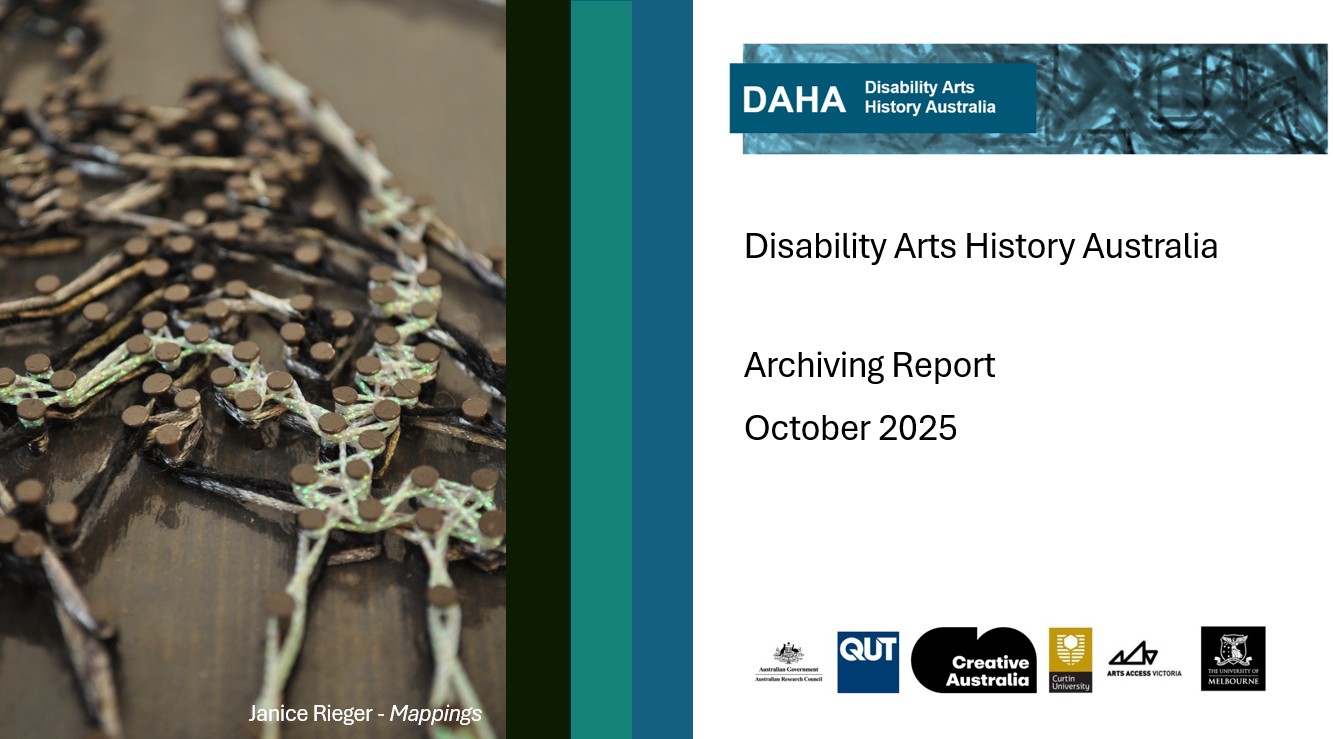 Disability Arts History Australia Launch 2025 - Archiving Report
-
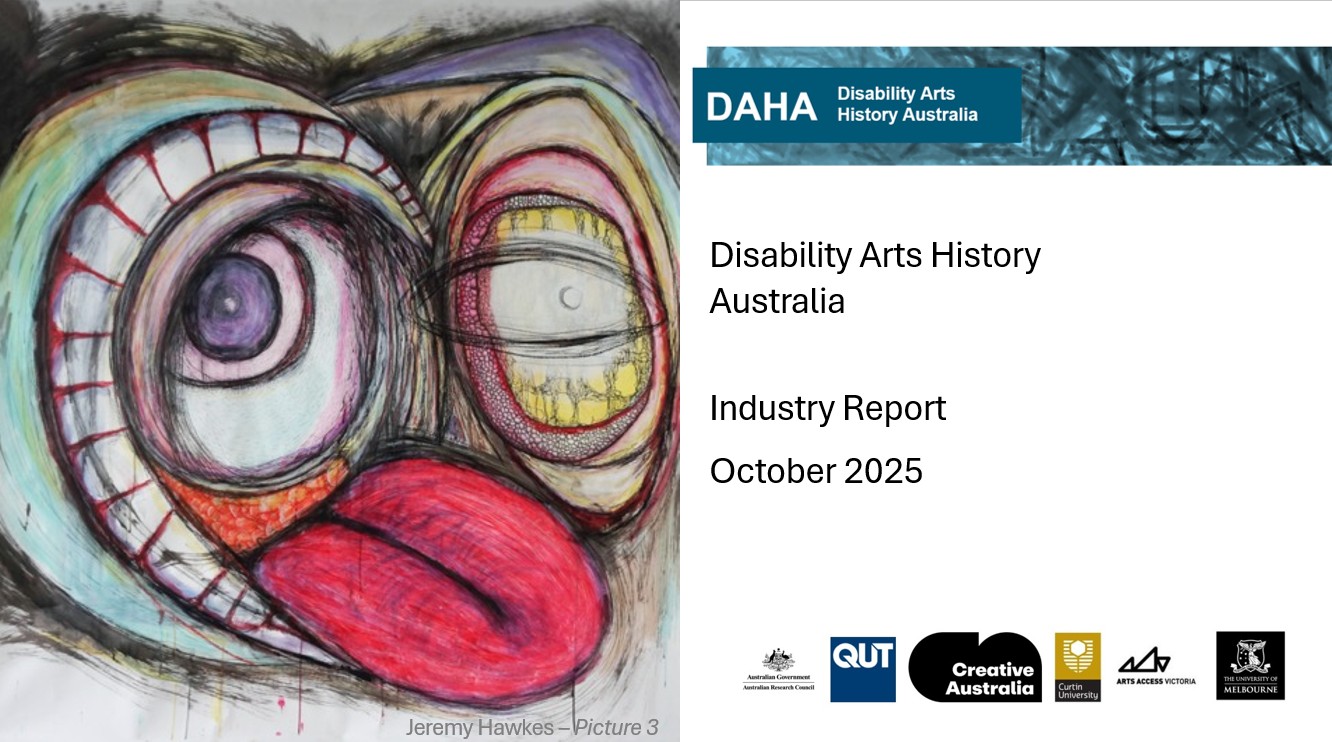 Disability Arts History Australia Launch 2025 - Industry Report
-
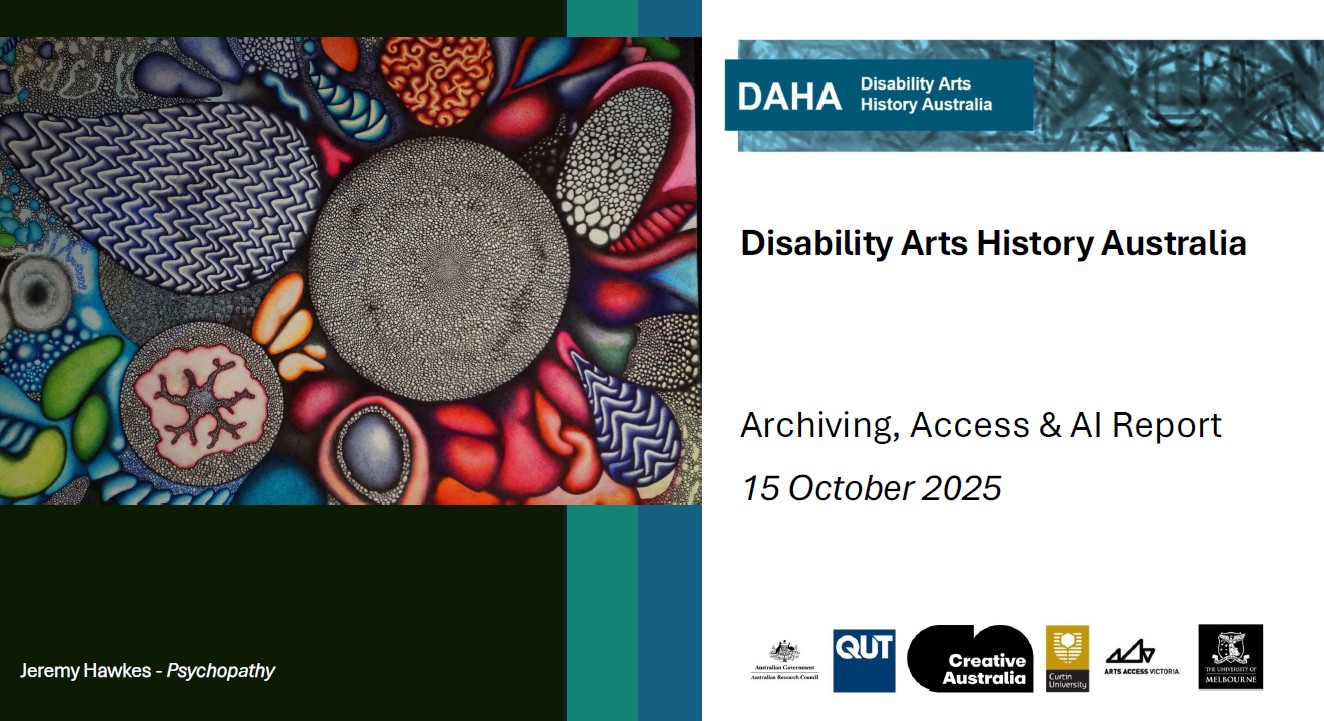 Disability Arts History Australia Launch 2025 - Archiving, Access and AI Report