
Items
Search full-text
“Commonwealth Disability Strategy launched in December 1994”
-
”Bree Hadley, Janice Rieger, Katie Ellis, Eddie Paterson (2024) Cultural safety as a foundation for allyship in disability arts. Disability & Society, 39(1), pp. 213-233.” "In this article, we argue that cultural safety, respect, and trust is a precursor to good allyship in the creative industries. We outline factors that influence feelings of safety or non-safety for disabled arts and media makers, and the way the legacy of the medical model makes it difficult for many arts and media workers to appreciate and enact enablers of safety as part of an allyship relationship."
-
"Bree Hadley, Janice Rieger, Eddie Paterson (2024) Reinhabiting, Reimagining, and Recreating Ableist Spaces: Embodied Criticality In Art. In Ellis, Katie, Kent, Mike, & Cousins, Kim (Eds.) The Routledge International Handbook of Critical Disability Studies. Routledge, pp. 48-58." "In this chapter we bring critical disability studies into dialogue with disability artworks that resituate critiques of inaccessibility and exclusion as complicated encounters with space, lived experience and embodiment. Drawing on Irit Rogoff’s (2003, 2006) notions of embodied criticality, and the pioneering work of performance studies scholar Petra Kuppers (2003, 2014), we argue for an embodied, embedded and creative form of critical disability studies – enacted through art. We examine two recent performance and installation works in hotels: Welcome Inn (2019) by British artist Christopher Samuel, and Intimate Space (2017) by Australian performance company Restless Dance Theatre."
-
"Bree Hadley (2022) Disability and the Arts, Creative, and Cultural Industries in Australia. Australian Academy of Humanities" "This week saw the release of Ensuring Occupations are Responsive to People with Disabilities, a landmark report by the Australian Council of Learned Academies (ACOLA) commissioned by the Australian Government Department of Social Services. As part of the Academy of Humanities’ support for the project, Professor Bree Hadley provided a study of disability in the arts, creative, and cultural industries for the project, and Professor Gerard Goggin was a member of the Expert Reference Group. In this week’s Five-Minute Friday Read, they explain why disability training needs fundamental reform now."
-
”Hadley, Bree, Batch, Morgan, & Whelan, Michael (2021) The entitled ally: Authorship, consultation, and the 'right' to stage autistic people's stories. Disability and Society, 36(9), pp. 1489-1509.” "Theatre has a long tradition of presenting disabled characters as plot devices to tell someone else’s story. A recent production, All in a Row, resulted in heated debate around this issue. This article examines not the play itself, but the conflict between those who objected to the play’s representation of autism, and its creators, who defended their choices by citing their disability-adjacent identities and processes of consultation. For critics, the fact that the creators did not take the community’s concerns seriously was a source of trauma. This article uses this conflict to draw out lessons about how we might better negotiate the right to tell disability stories and strengthen frameworks to support that negotiation. We propose a decision tree diagram to assist artists in understanding the meaning, role, and most importantly the potential consequences of consultation – up to and including a community saying ‘no’ to an artist’s planned representation."
-
“Kate Larsen (2012) Disability Leadership: If You're Gonna Talk the Talk .... ABC: Ramp Up, March 30. https://www.abc.net.au/ram pup/articles/2012/03/30/3467 452.htm.” Reads, in part "Now, I love my job. I'm good at it. I think that I've been useful here. But on the same day I accepted the position last February I also did something else. I gave notice of my resignation, and undertook to hand over the organisation by the end of 2012. The reason? Because I believe that Arts Access Australia should be led by a person with disability."
-
"Australia Council for the Arts (2014) Australia Council Promotes Disability Leadership in the Arts. Australia Council for the Arts. 25 June 2014." Reads, in part "The Australia Council for the Arts is presenting a suite of activities from next month to develop the leadership skills of people with disability and enhance their access to leadership roles across the cultural sector."
-
"Hickey Moody, Anna. 2009. Unimaginable Bodies: Intellectual Disability, Performance and Becomings. Rotterdam: Sense." Reads, in part "Unimaginable Bodies radically resituates academic discussions of intellectual disability. Through building relationships between philosophy, cultural studies and communities of integrated dance theatre practice, Anna Hickey-Moody argues that dance theatre devised with and performed by young people with and without intellectual disability, can reframe the ways in which bodies with intellectual disability are known."
-
"Mary Hutchison (2005) Making the Journey: Arts & Disability in Australia. Sydney: Arts Access Australia." Reads, in part "A collection of inspiring examples of how to include people with disabilities in the arts, as participants, creators and organisers"
-
"Katie Ellis (2019) Disability and Digital Television Cultures Representation, Access, and Reception. London & New York: Routledge." Reads, in part "Disability and Digital Television Cultures offers an important addition to scholarly studies at the intersection of disability and media, examining disability in the context of digital television access, representation and reception."
-
"Ted Evans, Michelle Bellon, Brian Matthews (2017). Leisure as a human right: An exploration of people with disabilities’ perceptions of leisure, arts and recreation participation through Australian community access services. Annals of Leisure Research, 20(3), 331–348." Reads, in part "Community Access Services (CAS) are defined as ‘Services designed to provide opportunities for people with disability to gain and use their abilities to enjoy their full potential for social independence’ [Australian Institute of Health and Welfare. 2015. Disability Services National Minimum Data Set Collection: Data Transmission and Technical Guide. Canberra: AIHW]. A notable absence of international research regarding leisure, arts and recreation through CAS exists. This study explores perceptions of people with disabilities on their participation in leisure, arts and recreation through Australian CAS."
-
"Anthea Skinner, Grace Thompson, Katrina Skewes McFerran (2022). Professional Pathways for Musicians with Disability in Victoria, Australia. Musicology Australia, 44(1), 21–42. https://doi.org/10.1080/08145857.2022.2088930" Reads, in part "The work of disabled musicians has become the focus on of an increasingly large body of academic work; however, existing literature rarely provides details about the educational experiences of these musicians, or how disability impacted these experiences. This study interviewed eleven performing musicians living with disability in Australia to elucidate the barriers and enablers that they faced in their music educations and careers."
-
"Gerard Goggin, Christopher Newell (2003). Digital disability: The social construction of disability in new media. Rowman and Littlefield." Media representation of and for the disabled has been recharged in recent years with the expansion of new media worldwide. Interactive digital communications--such as the Interact, new varieties of voice and text telephones, and digital broadcasting--have created a need for a more innovative understanding of new media and disability issues. This engaging analysis offers a global perspective on how people with disabilities are represented as users, consumers, viewers, or listeners of new media, by policymakers, corporations, programmers, and the disabled themselves.
-
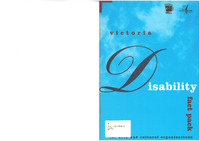 "Victoria : disability fact pack for arts and cultural organisations - DADAA National Network and Australia Council (1998)" Disability fact pack for arts and cultural cultural organisations in Victoria
-
 "NuunaRon Art Group - ‘Tracks in the Sand’ Artwork Story by Brendan Ball" First Peoples Disability Network NuunaRon Art Group - ‘Tracks in the Sand’ Artwork Story by Brendan Ball - reads, in part "The 'Culture is Inclusion' art exhibition showcases art work by the NuunaRon First Nations art group, with a lived experience of disability, telling their stories of resilience and strength through connecting to their culture"
-
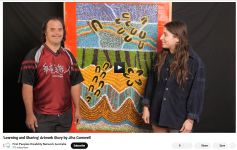 "NuunaRon Art Group - ‘Learning and Sharing’ Artwork Story by Jiha Cornwell" First Peoples Disability Network NuunaRon Art Group - ‘Learning and Sharing’ Artwork Story by Jiha Cornwell - reads, in part "The 'Culture is Inclusion' art exhibition showcases art work by the NuunaRon First Nations art group, with a lived experience of disability, telling their stories of resilience and strength through connecting to their culture"
-
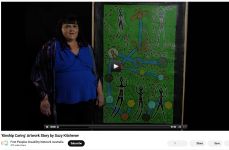 "NuunaRon Art Group - ‘Kinship Caring’ Artwork Story by Suzy Kitchener" First Peoples Disability Network NuunaRon Art Group - ‘Kinship Caring’ Artwork Story by Suzy Kitchener - reads, in part "The 'Culture is Inclusion' art exhibition showcases art work by the NuunaRon First Nations art group, with a lived experience of disability, telling their stories of resilience and strength through connecting to their culture"
-
 “Australia Council - Artists with Disability Program 2014” The website reads “The Artists with Disability Program provides funding for Australian artists with disability (including Deaf artists) to create, develop, present, produce, exhibit and/or tour their work”
-
 "Australia Council - Creating Pathways: Insights on support for artists with disability - 2018" Reads, in part "This report brings together findings and insights from a range of research undertaken in 2017–18 to inform the Council’s approach to future support for artists with disability."
-
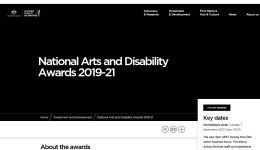 "Australia Council - Awards - National Arts and Disability Awards 2019-2021" The website reads “The Australia Council National Arts and Disability Awards 2019-21 celebrate the work and achievements of both established and young artists, and the significant contribution of artists with disability to the vibrancy of Australian arts”
-
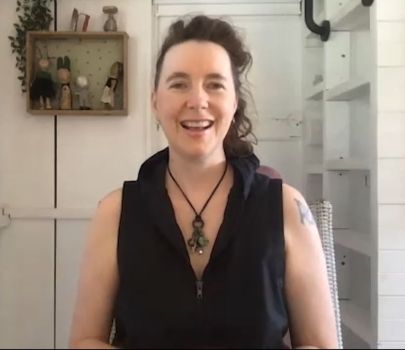 "Interview with Asphyxia" Asphyxia is an artist, author, activist and performer who has founded Amplio, a music app for Deaf and hard of hearing people. She also provides free online Auslan lessons and online art courses. Interview Summary Asphyxia is a Deaf artist whose journey into the arts started with a deep love for ballet, but after facing discrimination due to her Deafness, she pivoted to a successful career in circus performance and later puppetry, which embraced her Deafness and signing skills. Her work in performance art led her to write and illustrate the Awards-winning art-journal book, Future Girl, which explores Deaf identity and environmental issues. She has now moved into music, creating an app that makes music accessible and writing music designed with Deaf and hard of hearing audiences in mind. Although not sure about the major milestones in disability arts history in Australia, she considers her art to be both political and personal, often tackling issues related to her identity as a Deaf person and the aesthetics of disability equipment. While Asphyxia identifies as a Deaf artist, above all, she sees herself as an artist whose work appeals to the mainstream while celebrating Deafness and diversity.
-
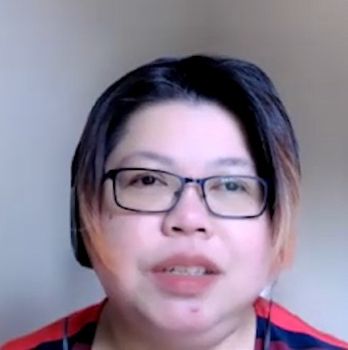 "Interview with CB Mako" CB Mako is a non-fiction, fiction and fanfiction writer and disability advocate. Interview Summary cubbie||CB Mako is a creative practitioner and disability advocate who emphasizes the importance of accessibility in the arts, advocating for digital inclusivity and the elimination of ableist practices. cubbie pushes for systemic change so that future generations, like their disabled child, don't have to fight for access to art and literature. Success for cubbie is defined by the progress made when institutions include disability in their funding, competitions, and programming. Using the pen name CB Mako and going by pronouns cubbie/they/them, urges non-disabled artists, particularly from communities of colour, to proactively incorporate access in their work.
-
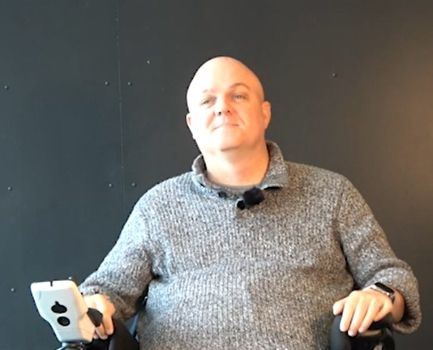 "Interview with Tim McCallum" Tim McCallum is a singer, performer and speaker and disability advocate. Interview Summary Tim McCallum is a performer who specializes in singing and acting, with singing being his foremost talent. Having sustained a spinal cord injury resulting in quadriplegia before beginning his studies at the Western Australian Academy of Performing Arts, Tim's childhood passion for the performing arts has continued to motivate his career. Through his experiences, both positive and negative, regarding inclusion and discrimination in the arts, Tim has become determined to challenge preconceived notions and make disability a visible and celebrated aspect of performance. He is a strong advocate for the representation of artists with disabilities in leadership roles within arts governance, stressing the importance of lived expertise over tokenism for lasting change in the industry.
-
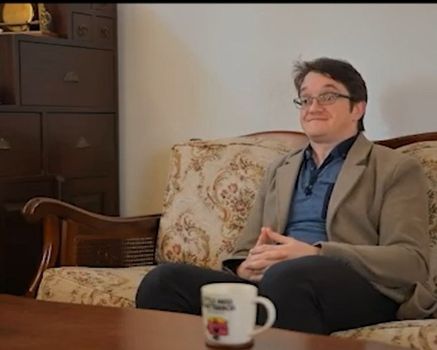 "Interview with Matthew Shilcock" Matthew Shilcock is a stage and film performer, dancer, director, choreographer, producer, project planner, manager, consultant and disability advocate. Interview Summary Matthew Shilcock, a contemporary dancer, lives with osteogenesis imperfecta, a condition that led him to discover dance as an affordable alternative to physiotherapy. His 12-year dance career has been shaped by working with both disabled and non-disabled artists, including elite companies and individual dancers, where he found a passion for the unique problem-solving and rewarding experiences that come with working with disabled dancers. As he transitions from performer to dance maker, Matthew's motivation has shifted from personal excitement and self-discovery to a focus on the next generation, aiming to pass on his unique experiences and methodologies. He acknowledges that while being on stage as a disabled artist can be inherently political, he values his authenticity and the impact of his work over the perceptions and labels placed upon disability in the arts.
-
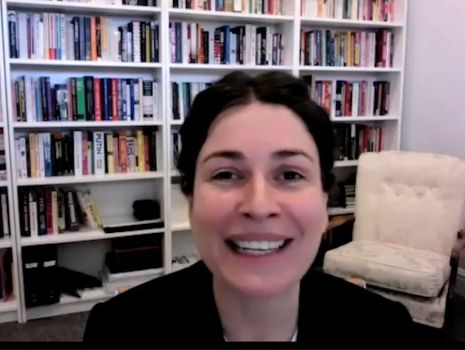 "Interview with Astrid Edwards" Astrid Edwards is a writer, publisher, lecturer, podcast host and disability advocate. Interview Summary Astrid Edwards, a former teacher and policy consultant, discusses in the interview how she pivoted her career towards writing and literature after being diagnosed with multiple sclerosis at 32, inspiring her to focus on work she loves. Astrid talks about writing at RMIT University, working with a diverse cohort of students, (many of whom have disabilities or are writing about trauma), which she finds rewarding. Though her work includes advocacy roles and a focus on disability, she does not wish to be defined solely by her illness, emphasizing the importance of allowing disabled individuals the freedom to explore and create beyond their disabilities. Currently, Astrid says she is a judge for the Stella Prize and discusses exploring a potential PhD about publishing and climate fiction, expressing a passion for addressing climate change within her work.
-
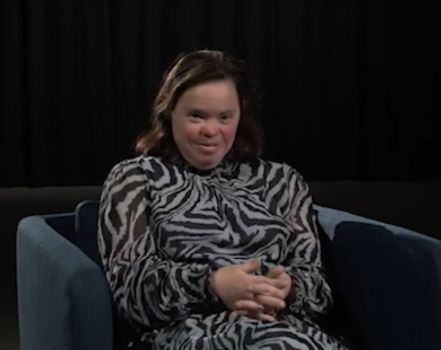 "Interview with Tina Fielding" Tina is a writer, actor, film maker and disability advocate Interview Summary Tina is an actress with Down Syndrome who identifies strongly with her art form, viewing her disability as an ability that enhances her talent and quality in storytelling through acting. She enjoys the process of acting and finds joy in watching her family perform, which inspired her to pursue the craft; however, she acknowledges that there are difficult moments that can be challenging but ultimately rewarding. Her artistic journey has involved working with various local companies in Perth and her work has evolved by adapting to new roles, with the aim of authenticity in her performances. Tina's influence and acknowledgment in the field are growing, noted by positive media attention, and she encourages other artists with disabilities to embrace and identify with their unique abilities.