
Items
Search full-text
“Commonwealth Disability Strategy launched in December 1994”
- Screen Australia
- Jodee Mundy Collaborations
- Awakenings Festival
- ACT DisAbility Arts Festival
- Australian Film Commission (AFC)
- Film Finance Corporation Australia (FFC)
- Film Australia Limited
- Film Australia
- Morwena Collett
- Amanda Cachia
- Christopher Newell
-
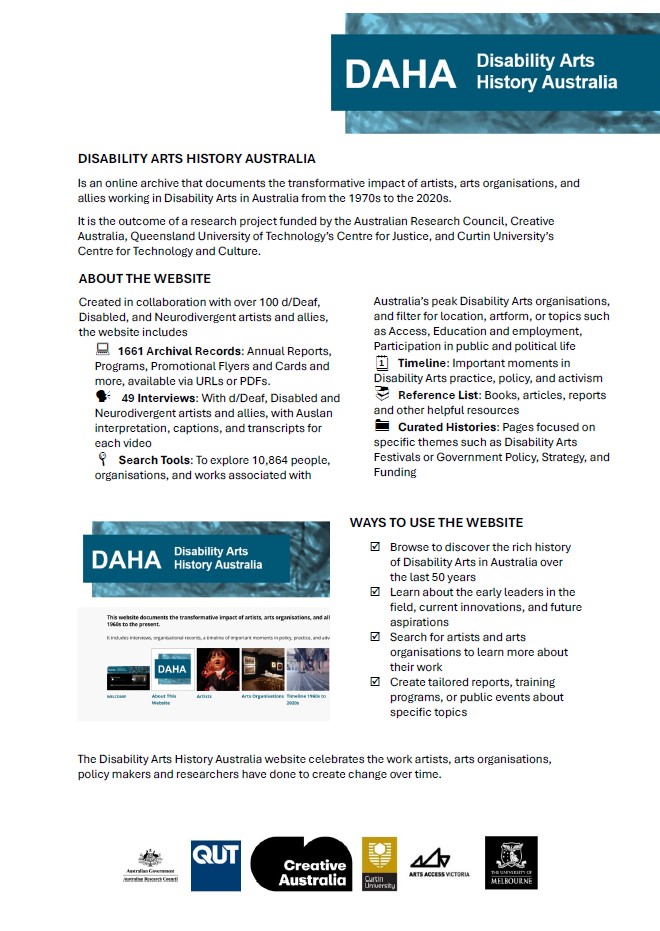 Disability Arts History Australia Launch 2025 - 3 Page Information Sheet
- Museum of Contemporary Art
- David King
- Dave King
- Helen Connor
-
"1963 and 1967 sees the introduction of the Disabled Persons Accommodation Act and Sheltered Employment (Assistance) Act, respectively." With increasing pressure to provide more services to people with disabilities, the 1960s was a decade of Commonwealth Government initiatives to support organisations providing work and accommodation to people with a disability, including the Disabled Persons Accommodation Act and Sheltered Employment (Assistance) Act.
-
“Handicapped Persons Assistance Act 1974” Compared to earlier decades, the mid-1970s saw an increase in political activity pertaining to individuals with disabilities. The Handicapped Persons Assistance Act (HPAA) of 1974 is one such example, which replaced several policies and funded non-government organisations that provided care and housing. In 1983, the Hawke Labour Government instigated an evaluation of the initiatives created under the HPAA. The HPAA was replaced in 1986 by the Commonwealth Disability Services Act of 1986.
- "Bree Hadley (2021) What's in a name? The politics of labeling in disability performance. In Rai, Shirin, Gluhovic, Milija, Jestrovic, Silvija, & Saward, Michael (Eds.) The Oxford Handbook of Politics and Performance. Oxford University Press, New York, NY, pp. 531-543.”
-
"Bree Hadley (2019) Disability arts in an age of austerity. In Hadley, B & McDonald, D (Eds.) The Routledge handbook of disability arts, culture, and media. Routledge, United Kingdom, pp. 347-361." "Is the current “age of austerity” (Summers 2009) impacting on art, culture, and media practices by and about people with disabilities, and, in particular, on art-based protest practices by people with disabilities? In recent years, much has been written about austerity as neo-liberal economic, political, social, and ideological agenda (Harvey 2005; Barnett 2010; Seymour 2014). Much has been written about the way groups effected by local and global governmental shifts towards austerity are protesting, presenting themselves, and being represented by others (Fritsch 2013; Goodley, Lawthom, & Runswick-Cole 2014; Runswick- Cole & Goodley 2015; della Porta 2015; Kokoli & Winter 2015; Beresford 2016; Dodd 2016; Giugni & Grasso 2016; Berry 2017). The question of whether disabled artists are adapting their practices to address these changing cultural circumstances has received less attention (Hadley 2017) and is thus the topic I focus on in this chapter."
-
"Janice Rieger and Megan Strickfaden(2019) “Dis/ordered assemblages of disability in museums.” In The Routledge Handbook of Disability Art, Culture, and Media, edited by Bree Hadley and Donna McDonald, 48–61. London & New York: Routledge." "Museums are spaces of power and care. They are institutions that present assemblages (Deleuze & Guattari 2002), which are reconstructions and representations of history and societal values, and thus are partial realities that curate human existence. These assemblages cannot ever represent the totality of human existence because it is never possible to do so, and yet these assemblages are embedded with power because choices are made about what ought or ought not be represented within museums (Ott 2013; Bennet 2017). The nature of partial realities is that, at their centre, these are still representations that tell stories of what one would imagine to be the most significant events related to a place (nation, city), with a particular focus on a societal event or issue (war, art, sports, nature, human rights, etc.) and peoples (e.g. immigrants, migrants, First Nations or Indigenous peoples, etc.). Persons attending museums rely on the expertise of historians, curators, archivists, conservators, and exhibition designers to present materials within the museum that focus upon and represent societal values. Most museum visitors are not aware of the power that museums hold, although more and more museum visitors push against narratives which they do not feel to be adequate representations of the places, events, issues, and peoples of society (Hooper-Greenhill 1992, 2000; Anderson 2004; Janes 2009, 2010). Where there is power, there is also care. Historians, curators, archivists, conservators, and exhibition designers take great care in how they assemble materials within museums."
-
"Amanda Cachia (2022) Curating Access: Disability Art Activism and Creative Accommodation. London: Routledge" Reads, in part "This book is an interdisciplinary collection of twenty-four essays which critically examine contemporary exhibitions and artistic practices that focus on conceptual and creative aspects of access."
-
"Australia Government (2019) My Art Goals: NDIS and the Arts. Canberra: Department of Communication and Arts." Reads, in part "My art goals shows some of the ways National Disability Insurance Scheme (NDIS) participants who have creative or cultural jobs, or who want to participate recreationally in the arts, can reach their goals. My art goals provides information about how the NDIS might support participants with arts goals, or about what supports or services might be available outside the NDIS."
- "DADAA Inc. (2014). An evaluation of a year-long mentoring program for artists with disability in western Australia. Perth, Western Australia: Department of Family and Community Services."
- "Simon Darcy, S., Hazel Maxwell, Simone Grabowski, Jenny Onyx (2019). Artistic Impact: From Casual and Serious Leisure to Professional Career Development in Disability Arts. Leisure Sciences, 44(4), 514–533. https://doi.org/10.1080/01490400.2019.1613461"