
Items
Search full-text
“Commonwealth Disability Strategy launched in December 1994”
- Bobbie Hodge
- Lyndsay Mason
- Rhondah Whitaker
-
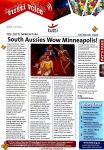 "Tutti Arts - Tutti Voice Newsletter December 2009" Tutti Arts - Tutti Voice Newsletter December 2009 - reads, in part "It is great to be back in South Australia with the Tutti team who made the trip to Minnesota. Northern Lights, Southern Cross was a marvellous experience complete with huge challenges and moments of exhilaration, and it was wonderful working both with Interact and at the ultra-modern and very accessible Guthrie Theater. We were delighted that our South Aussie patron's film The Boys are Back opened around the same time and that both Scott and Tutti won critical acclaim from the Minneapolis press. In fact, Northern Lights, Southern Cross broke all box office records for the Guthrie and attracted a broad mainstream, Native American, and African American audience. Dozens remained behind after every performance for post-show discussions looking at themes of trauma and healing central to the show and by closing night Northern Lights, Southern Cross had truly succeeded in raising awareness about barriers that exclude. We also knew that audiences everywhere are hungry for original work created through the melting pot of radical inclusion."
-
 "Tutti Arts - Tutti Voice Newsletter December 2010" Tutti Arts - Tutti Voice Newsletter December 2010 - profile of artist James Kurtz, 2010 events, updates from President and General Manager
-
“Arts Access Australia launches Meeting Place” Arts Access Australia launched Meeting Place in 2012, an annual forum where artists and industry leaders meet to discuss arts and disability and to network. The forum includes keynotes, panels, and workshops.
-
“The Victorian Government commissions ‘Picture This: Increasing the Cultural Participation of People with a Disability in Victoria’” In 2008, ‘Picture This: Increasing the Cultural Participation of People with a Disability in Victoria’ was published. The report was commissioned by the Victorian Government, specifically the Victorian Office for Disability in partnership with Arts Victoria and Disability Services Division and written by Kim Dunphy and Petra Kuppers. It focussed on methods to increase participation by people with disability in the arts as artists and audience members.
-
“Activism leads to a Disability Royal Commission” Decades of activism led to a 2019 Senate motion calling for a Disability Royal Commission. The first public hearing of the Royal Commission took place on 16th September, 2019 at Brisbane’s Convention and Exhibition Centre. The Commission resulted in a report in 12 volumes. Several volumes include Volume 3: Nature and extent of violence, abuse, neglect and exploitation, Volume 6: Enabling autonomy and access, Volume 7: Inclusive education, employment and housing, Volume 9: First Nations people with disability, and Volume 10: Disability services. Overall, the Commission presented “222 recommendations on how to improve laws, policies, structures and practices to ensure a more inclusive and just society that supports the independence of people with disability and their right to live free from violence, abuse, neglect and exploitation.” In 2023, the final report of the Royal Commission into Violence, Abuse, Neglect and Exploitation of People with Disability was published with 220 recommendations for a more inclusive nation to reduce exploitation, violence, abuse and neglect of people with disabilities.
-
"Queensland Government releases Arts & Disability Plan 2024-2026" Reads, in part "The Queensland Government acknowledges the rights of people with disability to participate equally in the state’s cultural life and to have the opportunity to develop and use their creative, artistic and intellectual potential, as recognised in the United Nations Convention on the Rights of Persons with Disability."
-
“Arts Project Australia is founded in 1974” In 1974, Myra Hilgendorf OAM founded Arts Project Australia, an organisation whose aim is for artists with an intellectual disability to have their work presented in a professional manner. In 1984, Arts Project moved to Hawthorn, Melbourne and started a studio workshop program. The organisation became an Incorporated Association in 1986. In 1994, Arts Project Australia artists exhibited their work internationally. Exhibitions occurred at MADMuseé and Centre d’Art Differencié in Belgium. Artist Julian Martin was selected for the Moët & Chandon Touring Exhibition. Arts Project published an education/slide kit in 1994 called ‘Between the Lines: Visual Arts and Intellectual Disability’. The organisation first published ‘Outline: News from Arts Project Australia’ in 1996. Arts Project Australia was recognised by the National Gallery of Australia in 2013 for having international significance.
-
“The Australian Government’s Creative Nation policy released in 1994” ‘Creative Nation’ was released in 1994. This was the first ever cultural policy formally developed by an Australian Government. Alongside a number of art forms, the policy included establishments like libraries in its definition of culture and pledged $250 million in funding to cultural organisations.
- Jane Trengove
- Alan Constable
- Claire Teisen
- Helen Bowman
- Irene Dunsmuir
- John Northe
- John McKay Northe
- Julian Martin
- Mary Brogan
- Nerida Weller
-
 “Arts Access Victoria EASE Entertainment Access Service Newsletter Summer 1993-1994" Arts Access Victoria EASE Entertainment Access Service Newsletter Summer 1993-1994 - EASE Managers and Promoters forum, Melbourne Theatre Company 1994 Season
-
"Bree Hadley (2017) Disability, Sustainability, Austerity: The Bolshy Divas Arts-Based Protests Against Policy Paradoxes. Centre for Sustainable Practice in the Arts Journal 18 Spring. http://www.sustainablepractice.org." "In this short article, I want consider some of the ways theatrical artists, activists and advocates in Australia are tackling the paradoxical relationship between sustainability and austerity discourses, and, as a result, some changes this may be starting to produce in disabled people’s aesthetic prerogatives. For the last 30 years, artists, activists and scholars in Australia and beyond have avoided casting disability in terms of trauma, crisis, catastrophe and disaster. Accounts of the way disability theatre challenges stereotypes , as well as analysis of disability signifiers in screen, stage, and social performance , have expressed concern about deploying disability as a metaphor for disaster, or defining disabled people as monstrous, tragic, stoic, or inspirational, the way the medical model of disability traditionally defines us. Instead, modern disabled artists and the scholars who analyse them have advocated for work that deploys live art, performance art, and performative intervention in public space to challenge stereotypes, oppressive institutional systems, and other factors the social model of disability sees as the cause of disability oppression .In the last few years, though, there has been an increase in work that does associate disability with trauma, tragedy and disaster, in what seems to be a response to austerity, accountability and economic sustainability agendas that call for cuts to disability services spending to make our societies more sustainable going forward."
-
"Morwenna Collett, Gill Nicol (2024) Building Strong Foundations: Research on arts and disability needs and opportunities, Creative Australia, 2024." "This report is a summary of an arts and disability needs and audit conducted in 2023 for Creative Australia. Through desktop research and consultation with d/Deaf and disabled artists and creative workers, peak bodies and broader arts and cultural organisations, this research provides insights into needs and opportunities in the arts and disability ecology in Australia."
-
"Radha O'Meara, Laura Dunstan, Anna Debinski, Catherine Ryan (2023). Disability and Screen Work in Australia: Report for Industry 2023. In Disability and Screen Work in Australia: Report for Industry. Melbourne Disability Institute, University of Melbourne." Disability is a key vector of inequality in Australian society. The screen industry has the potential to create meaningful change, in our workplaces and working practices, for our colleagues and our audiences. We need to pay more attention to disability and take more action to include disabled people in our industry. Disability equity, inclusion and accessibility training tailored to the screen industry can make a significant impact. Consultation, innovation and funding can transform industrial structures to create a more inclusive and sustainable industry for all screen workers. We must normalise talking about and providing access requirements to support disabled workers. The findings of this research reflect the need to build greater understanding, transparency and accountability in order to fully include disabled workers in the Australian screen industry.