
Items
Search full-text
“Commonwealth Disability Strategy launched in December 1994”
- Eddie Paterson
- John Tonso
-
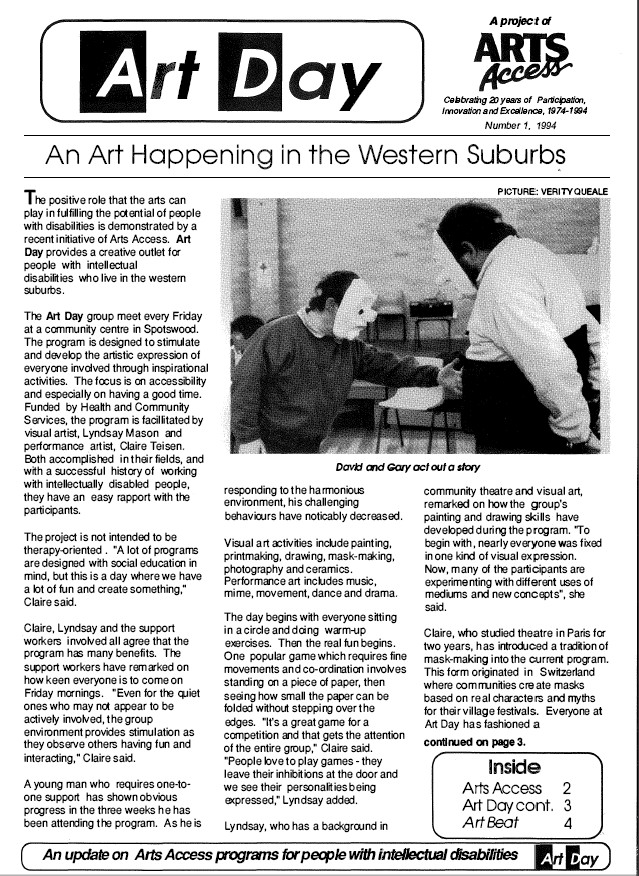 “Arts Access Arts Access Art Day Number 1 1994” Arts Access Arts Access Art Day Number 1, 1995 – Description of Arts Access programs for people with intellectual disabilities, Description of the Artistic Program, the Resource and training unit and the EASE program, Art Beat - Performance Art Options for People with Intellectual Disabilities – workshops, Big Bag rock band and Back to Back theatre company - Barbara Doherty, Carol Downey, Claire Teisen, David (no last name listed), Dean Michael, John Tonso, Kerrie (no last name listed), Lyndsay Mason, Maria (no last name listed), Sonia Teuben
-
 "High Beam Festival Program 2000" High Beam Program 2000 reads "High Beam 2000 will he launched with an opening parade and concert that promises to he LOUD. IARGE and LAVISH! Weaving a rhythmical and colourful journey along King William Street through to Elder Park where the entertainment will begin. AS 22% of South Australia’s population have a disability, High Beam 2000 Festival presents an inspiring and unique opportunity for all South Australians to discover the wealth of talent within our midst and from abroad."
-
”Hadley, Bree, Paterson, Eddie, & Little, Madeleine (2022) Quick Trust and Slow Time: Relational Innovations in Disability Performing Arts Practice. International Journal of Disability and Social Justice, 2(1), pp. 74-94.” "Despite a range of policies, plans, protocols and funding programmes to support disabled artists and collaborations between mainstream producers and disabled artists, the statistics – at least in our context in Australia – suggest most disability art still occurs outside and alongside an industry that struggles to include these artists. In this article, we draw upon findings from a series of workshops with disabled artists around Australia, conducted as part of the ARC funded Disability in the Performing Arts in Australia: Beyond The Social Model project – known colloquially to its collaborators and participants as ‘The Last Avant Garde’ project (https://lastavantgarde.com.au) – to propose a new approach. We find that while provision of logistical access (ramps, hearing loops, interpreters) and ideological access (stories, characters, discourse and language) is critical, so is methodological access, which embodies disability culture in training, rehearsal and production processes. Disabled artists use crip culture, along with relational space and time to negotiate what happens in disability arts and culture production practices and work through desire, fear, vulnerability and reciprocity to rapidly establish trusting collaborations."
-
"Bree Hadley, Gerard Goggin, Petra Kuppers, Colette Conroy, Meagan Shand, Donna McDonald, Martin Paten, Norm Horton, Sarah Moynigan, Veronica Pardo, Caroline Bowditch, Morwenna Collett, Kerry Comerford, David Doyle, Pat Swell, Clark Crystal, Peter Stuart (2019) The NDIS and disability arts in Australia: Opportunities and challenges. Australasian Drama Studies, 74, pp. 9-38." "In Australia, disabled people’s participation in the arts has historically been afforded by means of direct-to-organisation grants that arts, community services or disability services arms of government award to arts organisations, charities or disability service organisations, who then deliver programmes. The introduction of the National Disability Insurance Scheme (NDIS) is creating wide-reaching changes for disability arts practice in Australia. We undertake a first step in addressing the need for research into how the NDIS will alter the landscape of disability arts practice in Australia. We highlight a set of questions that all performing and creative arts industry stakeholders will need to respond to, in order to ensure that the excellent work done in disability arts in Australia to date can continue in the new climate that the NDIS brings."
-
"Bree Hadley (2014) Disability, Public Space Performance, and Spectatorship: Unconscious Performers. London: Palgrave Macmillan." "Why would disabled people want to re-engage, re-enact and re-envisage the everyday encounters in public spaces and places that cast them as ugly, strange, stare-worthy? In Disability, Public Space Performance and Spectatorship: Unconscious Performers, Bree Hadley examines the performance practices of disabled artists in the US, UK, Europe and Australasia who do exactly this. Operating in a live or performance art paradigm, artists like James Cunningham (Australia), Noemi Lakmaier (UK/Austria), Alison Jones (UK), Aaron Williamson (UK), Katherine Araniello (UK), Bill Shannon (US), Back to Back Theatre (Australia), Rita Marcalo (UK), Liz Crow (UK) and Mat Fraser (UK) all use installation and public space performance practices to re-stage their disabled identities in risky, guerilla-style works that remind passersby of their own complicity in the daily social drama of disability. In doing so, they draw spectators' attention to their own role in constructing Western concepts of disability. This book investigates the way each of us can become unconscious performers in a daily social drama that positions disability people as figures of tragedy, stigma or pity, and the aesthetics, politics and ethics of performance practices that intervene very directly in this drama. It constructs a framework for understanding the way spectators are positioned in these practices, and how they contribute to public sphere debates about disability today."
-
"Rachel Carling-Jenkins, Mark Serry (2014) Disability and social movements: learning from Australian experiences. Burlington : Ashgate Publishing Company" Reads, in part "This book provides the reader with a ground-breaking understanding of disability and social movements. By describing how disability is philosophically, historically, and theoretically positioned, Carling-Jenkins is able to then examine disability relationally through an evaluation of the contributions of groups engaged in similar human rights struggles. The book locates disability rights as a new social movement and provides an explanation for why disability has been divided rather than united in Australia.."
-
"Queensland Government (2024) Arts and Disability Plan. 25 September 2024. https://www.arts.qld.gov.au/projects-and-initiatives/arts-and-disability-plan-web" Reads, in part "The Queensland Government acknowledges the rights of people with disability to participate equally in the state’s cultural life and to have the opportunity to develop and use their creative, artistic and intellectual potential, as recognised in the United Nations Convention on the Rights of Persons with Disability."
-
"Christopher Newall (1996). The Disability Rights Movement in Australia: A note from the trenches. Disability & Society, 11(3), 429–432. https://doi.org/10.1080/09687599627705" Reads, in part “A recent visitor to Australia from the UK commented to me on their return ‘I looked in vain for the disability rights movement. Can you tell me where they are?’ In essence, the Australia disability rights movement is currently fragmented, predominantly organised around disease labels and seems to have lost ground, compared with the self-help initiatives fostered around the time of the International Year of the Disabled Persons in 1981.”
-
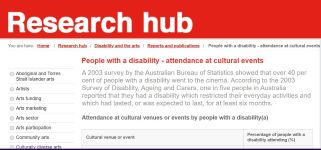 “Australia Council - People with a disability - attendance at cultural events 2008" Australia Council - People with a disability - attendance at cultural events 2008 - reads, in part "A 2003 survey by the Australian Bureau of Statistics showed that over 40 per cent of people with a disability went to the cinema. According to the 2003 Survey of Disability, Ageing and Carers, one in five people in Australia reported that they had a disability which restricted their everyday activities and which had lasted, or was expected to last, for at least six months."
-
 "Australia Council - Annual Report 1997-98" Australia Council Annual Report 1997-98 - discusses letter from chair of council, functions, profile, organisation chart, corporate overview, year in review, arts funding, main activities of Council and its Boards, and includes professional development activities, financial statements and lists of grants made including grants for programs, projects, information and advocacy with producing a set of Disability Fact Packs exploring the importance of accessibility for arts and cultural organisations and a guide to marketing arts to disabled audience
-
 "Australia Council - Annual Report 2015-16" Australia Council - Annual Report 2015-16 - discusses year in review, strategy, funding, and key facts, including "18% identified as Aboriginal or Torres Strait Islander 6% identified as experiencing disability", and running Sync Leadership Program for artists with disability
-
"Liz Ferrier (2000) Vulnerable Bodies: Creative Disabilities in Contemporary Australian Film. In Ian Craven ed. Australian Cinema in the 1990s. Routledge. https://doi.org/10.4324/9780203045022" Reads, in part "The internationally-acclaimed film Shine is one of a number of contemporary Australian movies which portray embattled artists or performers. Reminiscent of earlier works such as Starstruck (1982), Man of Flowers (1983), Malcolm (1986) and Sweetie (1989), and several more recent productions – Proof (1991), Strictly Ballroom (1992), Bad Boy Bubby (1994), The Adventures of Priscilia, Queen of The Desert (1994), Muriel's Wedding (1994), Cosi (1996), Lilian's Story (1996), and Jane Campion's New Zealand/Australian films, An Angel at My Table (1990) and The Piano (1993) – it depicts a disadvantaged individual overcoming setbacks through the passionate and eccentric expression of his creativity. The film and the cycle to which it belongs offers a peculiar vantage point from which to examine the problems and possibilities of Australian cinema in the 1990s."
-
“The Commonwealth Disability Services Act of 1986 replace the Handicapped Persons Assistance Act of 1974” In 1983, The Hawke Labour Government evaluated the initiatives created under the Handicapped Persons Assistance Act of 1974. The HPAA was replaced in 1986 by the Commonwealth Disability Services Act of 1986. Among other changes, this Act represents the shift in nomenclature from 'handicap' to ‘disability’.
- Weave Movement Theatre
- Melbourne Symphony Orchestra
- Dinny Downie
- Jeff Stewart
- Jenny McCarthy
- Maria Filippow
- Rhonda Whitaker
- Rhonda Whittaker
- Urban Theatre Projects
- Force Majeure