Items
Search full-text
“Screen Australia launches an access coordinator training program”
-
“Screen Australia launches an access coordinator training program” Screen Australia launched an access coordinator training program in 2023. “The Access Coordinator role is intended for people from the Deaf/Disabled and/or Neurodivergent (DDN) communities who are committed to improving disability representation and removing barriers to inclusion.” Screen Australia partnered with the following organisations for the initiative: the New Zealand Film Commission, Screen Queensland, Screen Tasmania, Screen Territory, Screenwest, VicScreen, the South Australian Film Corporation, Screen ACT, Screen NSW, and the Australian Film Television Radio School.
-
 "Interview with Patricia Wozniak" Patricia Wozniak is a neurodivergent visual arts coordinator at Tutti Arts and is a disability arts advocate and ally. Interview Summary Patricia Wozniak, a visual arts coordinator at Tutti Arts with 14-15 years of experience, initially volunteered while studying for her master's and found joy and liberation in making art with the organisation. Tutti Arts has grown from offering two days to five days of visual arts each week and supports artists to enjoy creating, access quality materials, and earn income. While faced with challenges like NDIS funding intricacies and the need for easy-to-understand contracts, Patricia emphasizes the importance of artist-driven practice and equal opportunities. She observes a shift toward digital art and commercial endeavours among artists and asserts the vitality of educating artists about their rights and the political aspect of disability art in cultivating change and expression of identity.
 -
"Radha O'Meara, Laura Dunstan, Anna Debinski, Catherine Ryan (2023). Disability and Screen Work in Australia: Report for Industry 2023. In Disability and Screen Work in Australia: Report for Industry. Melbourne Disability Institute, University of Melbourne." Disability is a key vector of inequality in Australian society. The screen industry has the potential to create meaningful change, in our workplaces and working practices, for our colleagues and our audiences. We need to pay more attention to disability and take more action to include disabled people in our industry. Disability equity, inclusion and accessibility training tailored to the screen industry can make a significant impact. Consultation, innovation and funding can transform industrial structures to create a more inclusive and sustainable industry for all screen workers. We must normalise talking about and providing access requirements to support disabled workers. The findings of this research reflect the need to build greater understanding, transparency and accountability in order to fully include disabled workers in the Australian screen industry.
-
“Screen Australia commissions the reports ‘Seeing Ourselves’ (2016) and ‘Seeing Ourselves 2’ (2023)” In 2016, Screen Australia commissioned a report "Seeing ourselves: Reflections on diversity in Australian TV drama". The report highlighted the lack of characters on TV with a disability. When characters with a disability were part of the story they were played by actors without a disability and were portrayed as either unemployed or retired. Screen Australia commissioned a follow-up report in 2023 called "Seeing Ourselves 2 - Diversity, equity and inclusion in Australian TV drama". This report shows that, while diversity is a global conversation and there is an increase of disability representation, it remained significantly lower than the actual disabled population.
-
“Screen producer, editor, and accessibility consultant Stephanie Dower is interviewed for Screen Queensland On Air, in an episode called How They See Us: Disability in the Screen Industry” Stephanie Dower was interviewed in 2020 for Screen Queensland On Air, in an episode called How They See Us: Disability in the Screen Industry. Dower is an editor, producer, and writer for screen. She has also worked with Get Skilled Access and as an accessibility consultant for Queenslanders with Disability Network.
-
“2023 Screen industry report ‘Disability and Screen Work in Australia’ finds disabled people fulfil a range of roles in the screen industry, despite facing prejudice and exclusion, and should be treated as experts of their access requirements” ‘Disability and Screen Work in Australia: Report for Industry’ (2023) was compiled by researchers Radha O’Meara, Laura Dunstan, Anna Debinski and Catherine Ryan. The study was supported by Melbourne Disability Institute and A2K Media. The authors summarise that disabled people fulfil a range of roles in the screen industry, despite facing prejudice and exclusion, and should be treated as experts of their access requirements. They find that “Disabled people experience a more precarious, lower paid, and less powerful position in the screen industry than their non-disabled counterparts.” O’Meara and her colleagues call for widespread change in the industry to expand access.
- Screen Australia
-
“Sydney Film Festival launches Screenability program in 2017” Sydney Film Festival launched its Screenability program in 2017. The international program was intended to offer a platform for screen practitioners with disability. Sofya Gollan was Screenability’s inaugural programmer and remained in the role until 2021.
- Arts Project Australia
- Accessible Arts
- Film Australia
- Film Finance Corporation Australia (FFC)
- Film Australia Limited
- Australian Film Commission (AFC)
- Australia Council
- Creative Australia
- Arts Access Victoria
- Arts Access Society Inc. (Victoria)
- Australia Council for the Arts
-
 "Accessible Arts - Annual Report 1990" Accessible Arts - Annual Report 1990 - Accessible Arts Aims, Priorities for 1991, Coordinator’s and Treasuer’s Report, Excepts from 1990 program reports
 -
“Arts Access Australia launches its ‘Don’t Play Us, Pay Us’ campaign in response to 'cripping up'” In 2012, Arts Access Australia launched its ‘Don’t Play Us, Pay Us’ campaign in response to 'cripping up,' where non-disabled performers play disabled characters on stage or screen.
-
"Screen Australia (2023) Seeing Ourselves 2: Diversity, equity and inclusion in Australian TV drama. Screen Australia" Reads, in part "Screen Australia has released new research into diversity on Australian screens, titled Seeing Ourselves 2: Diversity, Equity and Inclusion in Australian TV Drama. A follow up to the landmark 2016 study, Seeing Ourselves 2 examines the diversity of main characters in 361 scripted Australian TV and online dramas broadcast between 2016 and 2021, how this compares to the Australian population, and what has changed since the previous Seeing Ourselves report."
-
"Screen Australia (2016) Seeing ourselves: Reflections on diversity in Australian TV drama. Screen Australia" Reads, in part "Whose stories are our TV dramas exploring? Screen Australia has benchmarked current levels of diversity in Australian TV drama and explore the challenges and opportunities involved in making TV drama more broadly representative of Australian society."
-
 "REWIND - Strategies for _Integration - A training seminar presented by Accessible Arts Inc - 1992" REWIND - Strategies for _Integration - A training seminar presented by Accessible Arts Inc - 1992 - reads, in part "Accessible Ans Inc. is an organisation which encourages and promotes the development of opponunities for people with disabilities to have access to and participation in all creative artforms. Accessible Arts began, in 1985, as an arts project for people with disabilities at Community Activities Network. In 1989 Accessible Arts became an independent, non-profit organisation incorporated as an Association. During 1990 Accessible Arts was financially supported by the State and Federal Governments to establish a statewide service for people with disabilities. The change from activities project to a statewide service has been significant. The organisation has compiled a state profile on what art facilities are available to people with disabilities in New South Wales; provides a consultancy service for artists, people with disabilities, disability services and arts organisations; assists the general community to initiate their own art programs and projects through the establishment of regional networks; provides training programs in the area of art and disability; produces publications; and, acts as an advocacy/educational body for the promotion of access and equity in the arts. The Rewind Seminar was initiated after expressions of interest and concern were directed to Accessible Arts about the need for strategies to effectively involve people with disabilities in arts practice."
 -
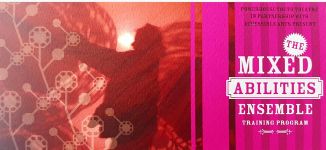 "Accessible Arts and Powerhouse Youth Theatre - The Mixed Abilities Ensemble Training Program - Promotional Card" Accessible Arts and Powerhouse Youth Theatre - The Mixed Abilities Ensemble Training Program 2008 - Promotional Card - reads, in part "In this 15 week course you will work with highly experienced and professional tutors to develop your skills in movement, voice, performance and theatre making. This training program is open to people with and without a disability."