Items
Search full-text
“Screen Australia launches an access coordinator training program”
- Maxine Ryder
- John Stevens
- Emily Dober
- Emily Daber
- David Doyle
- Tina Douglas
- Mandy Laming
- Amanda Laming
- Jane Trengove
- Noel Spurr
-
“Disability in the Arts, Disadvantage in the Arts, Australia (DADAA), based in Western Australia, is established in 1994” The National Participate Conference, hosted by Arts Access Victoria in 1990, set the scene for the emergence of the DADAA network. This came after several years of conversations among Western Australian artists about starting an organisation; the organisation was officially established in 1994. “In 1986, a small group of artists with disability met to discuss starting their own WA-based arts organisation. It is from this meeting that DADAA slowly grew, from a pilot project it became an organisation in its own right in 1994: taking the name Disability in the Arts, Disadvantage in the Arts, Australia – DADAA.”
-
"Juliet London and Des Walsh (1995) Arts & Disability: Report Australia Council: Surry Hills." Juliet London and Des Walsh - Arts & Disability, Australia Council 1995 - Reads, in part "The Australian Bureau of Statistics estimates that 18 per cent of the Australian population has a disability. There is a basic lack of data on participation in the arts by artists with a disability. No figures were available on the number of people with disabilities applying for grants from the Australia Council or from State or Territory arts agencies. The current dearth of statistical information needs to be overcome by systematic and sustained research."
-
 "Australia Council - Annual Report 2012-13" Australia Council Annual Report 2012-2013 – discusses year in review, report from the CEO, Strategic priorities, funding overview, statement of outcome, about the Australia Council including The Governing Council and the Board, Structure of the Australia Council; financial review and discussion of Access Champions group focused on key actions from the 2011–13 Disability Action Plan, including programs for increased participation by artists with disabilities and to develop technical capacity and digital literacy for both operational and artistic activities, funding for exhibition of artists with disability work, premises and Australia Council website accessibility, and participation at national and international arts and disability forums.
 - Sue O'Dwyer
- Suzanne O'Dwyer
- Greg Sneddon
- No Strings Attached
- No Strings Attached Theatre of Disability
-
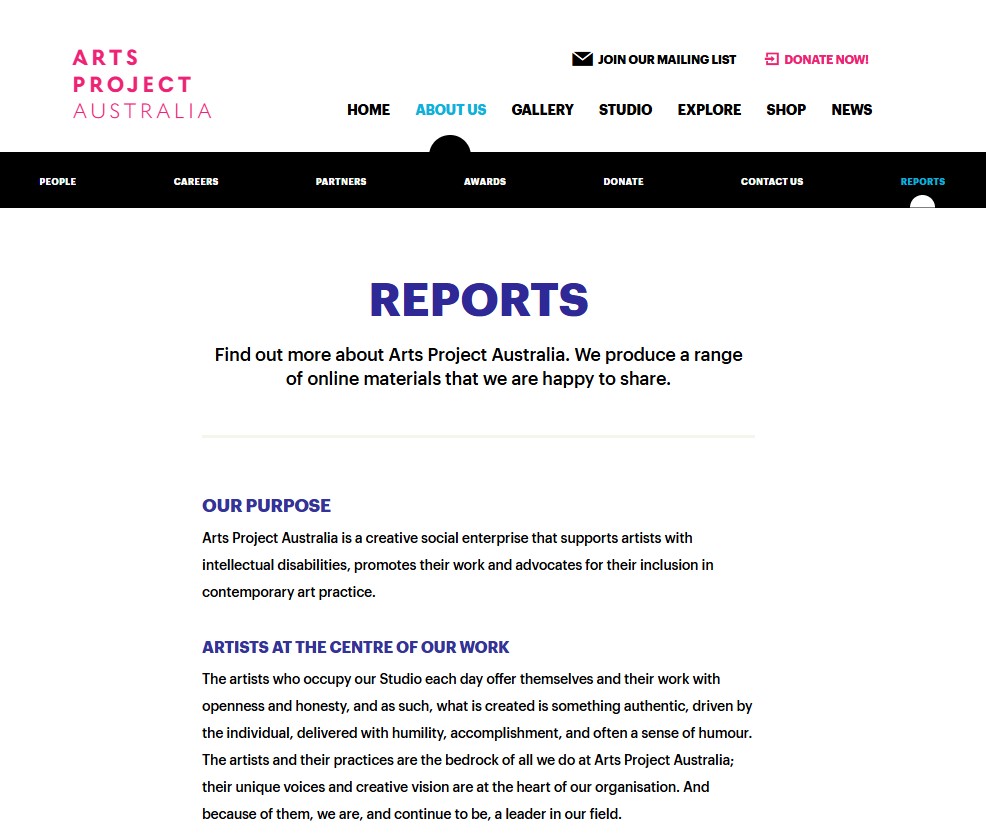 "Arts Project Australia - Publications, captured 2022" Arts Project Australia - Publications - Includes information about SINCERELY YOURS ZINE 2022, ART ET AL. BROADSHEET ISSUE 1 2021 (inclusive, curated international art platform that commissions and presents collaborations between artists from supported studios, artist peers and arts professionals), ANTIDOTE 2021, REACHING POTENTIAL (REPORT 2021 (including exhibition essay by Dr Marion Piper Words Make Worlds), A SENSE OF PLACE 2003 (including The Significance of Space, The Meaning of Place by Dr Cheryl Daye and Kitty Ginter), VALERIO CICCONE: PERIPHERAL OBSERVER 2012 (including Peripheral Observer catalogue essay ‘This is me – some thoughts on the art of Valerio Ciccone’ by curator Glenn Barkley pp. 8-10), VIDEO DOCTOR 2013 (including essay by Geoff Newton), SO FAR… eight artists / eight stories 2014, IT TAKES MORE THAN 140 CHARACTERS TO WRITE A NOVEL (2015 (Including exhibition essay by curator Dr Vincent Alessi), AUTO BODY WORKS 2018, FEM-aFFINITY 2019 (including FEM-aFFINITY catalogue essay If Collaboration is the Method, Activism is the Intention by curator Dr Catherine Bell pp. 19-24), POP UP STALL: The Festival of the Photocopier Zine Fair
 -
"The Australia Council establishes the Community Arts Committee in 1973 and the Community Arts Board in 1978" The Australia Council established the Community Arts Committee in 1973 and the Community Arts Board in 1978. The purpose of the latter was to encourage wider participation in the arts, especially for groups with little social capital. The Board was “the first funding body to identify the community arts phenomenon and respond with definition and policy." This occurred under the directorship of Rosalie Bower, the first director of the Community Arts Board, who wrote in a paper entitled 'The Case for a Community Arts Centre': “The activities within a centre should be accessible to children, aged people, the physically handicapped, ethnic groups and those whose time is severely restricted by work and family ties. The activities supplied by the centre should be conducted free from competitive elements which otherwise might discourage people from participation, and they must be inexpensive and accessible at almost any time. They must not pre-suppose education or income levels which would cut them off from any section of the community.'" (Australia Council 1979/1980 Annual Report, page 32)
-
"Australia Council for the Arts (2018) Arts and Disability a Priority as Australia Council Commits
Significant New Funding. 24 September 2018." Reads, in part "The Australia Council has committed $750k over three years to support sustainable careers and to recognise the artistic excellence of artists with disability."
-
"South Australia : disability fact pack for arts and cultural organisations - DADAA National Network and Australia Council (1998)" Disability fact pack for arts and cultural organisations in South Australia
-
"Western Australia : disability fact pack for arts and cultural organisations - DADAA National Network and Australia Council (1998)" Disability fact pack for arts and cultural organisations in Western Australia
- Supported Employment Program
- Harold (Jimmy) Fuller