
Items
Search full-text
“Screen Australia launches an access coordinator training program”
-
 "Australia Council - Annual Report 2009-10" Australia Council Annual Report 2009-2010 – discusses year in review, letter from chairman, vision, list of council staff, message from the CEO, Strategic priorities, funding overview, statement of outcome, about the Australia Council including governance, boards, organisation, accountability, workplace; financial review and discussion of the Commonwealth Disability Strategy with how the Disability Action Plan 2008–2010 addresses Australia Council roles of policy adviser, purchaser, provider and employer.
 - Barbara Doherty
- John Paxinos
- Isi Plack
- Emma Bennison
-
“Arts Access Australia CEO encourages other non-disabled CEOs of disability organisations to step down” In 2012, Kate Larsen stepped down from role as CEO of Arts Access Australia. In a Ramp Up article, she explained “Now, I love my job. I'm good at it. I think that I've been useful here. But on the same day I accepted the position last February I also did something else. I gave notice of my resignation, and undertook to hand over the organisation by the end of 2012. The reason? Because I believe that Arts Access Australia should be led by a person with disability.” Upon her resignation, she encouraged other non-disabled CEOs of disability organisations to step aside to make space for disabled people to take up these leadership roles.
-
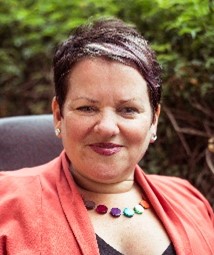 "Interview with Caroline Bowditch" Caroline Bowditch is an Australian artistic director, leader, performer, presenter, instructor, disability advocate and was the CEO of Arts Access Victoria. Interview Summary Caroline Bowditch, the CEO and Artistic Director of Arts Access Victoria, shared her journey as a performance artist and her experiences working within the Disability Arts community, highlighting her creative process and the challenges faced by disabled artists in Australia. Despite significant support and successful projects in the UK, she expressed concern over the limited progression and exposure of Disability Arts in Australia, noting a lack of ambition and opportunity deterring artists from aiming for larger, mainstream stages. Bowditch emphasized the importance of integrating access as a core component of artistic work and changing the aesthetic by including diverse bodies and perspectives. She also discussed tackling intersectionality within Disability Arts, reflecting on her own experiences as a visibly disabled and queer woman, and contemplating the future of Disability Arts, the desire for cultural equity, and the impact of potential shifts in societal barriers.
 -
“Carriageworks ‘New Normal’ program plan to commission ten new works presents three performances - Lady Eats Apple (Back to Back Theatre, 2017), Off the Record (Force Majeure, Dance Integrated Australia, 2016), Simple Infinity (Urban Theatre Projects, 2016)" New Normal is Carriageworks “national strategy for the development of disability arts practice.” Carriageworks state an aim to “commission ten new major works across contemporary performance, music, dance and visual arts.” As part of the program, Back to Back Theatres’ Lady Eats Apple (2017), Force Majeure and Dance Integrated Australia’s Off the Record (2016), and Urban Theatre Projects’ Simple Infinity (2016) each presented at Carriageworks. Since then, there has been no update on Carriageworks’ goal, suggesting the program may have fallen short of its initial objectives.
- Professor Colin Rhodes
- Colin Rhodes
- Catherine Bell
- Linden - Centre for Contemporary Arts
- Linden Gallery
- Linden Arts Centre
-
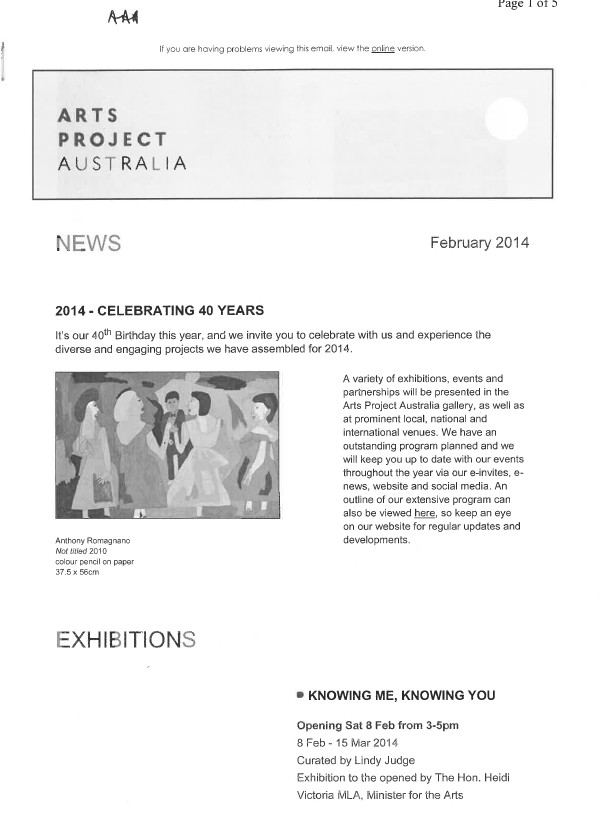 "Arts Project Australia - ENews - 20140205" Arts Project Australia - ENews - 20140205
 - Shirley Warke
- Suzanne Brown
- Rob McHaffie
- Michael Amond
- Glenn Dalton
- Elyss McCleary
-
"The Australian Elizabethan Theatre Trust begins operations in 1954" The Australian Elizabethan Theatre Trust began operations in 1954. The key role of the trust was to support the arts in Australia leading to the independent companies of: Opera Australia, The Australian Ballet Foundation, National Institute of Dramatic Art (NIDA), and Bell Shakespeare Company. At this time there was little involvement of people with disabilities in the arts.
-
“Assistance to Composers Advisory Board created by the Commonwealth government.” In 1967, the Commonwealth government created the Assistance to Composers Advisory Board with an aim to advise on funding needs for music composition and promotion of Australian composers. The Board was to judge work based on “musical distinction or excellence of its kind, and on the promotion of Australian composers both in Australia and abroad”. The Board’s functions were later absorbed by the Australia Council.
-
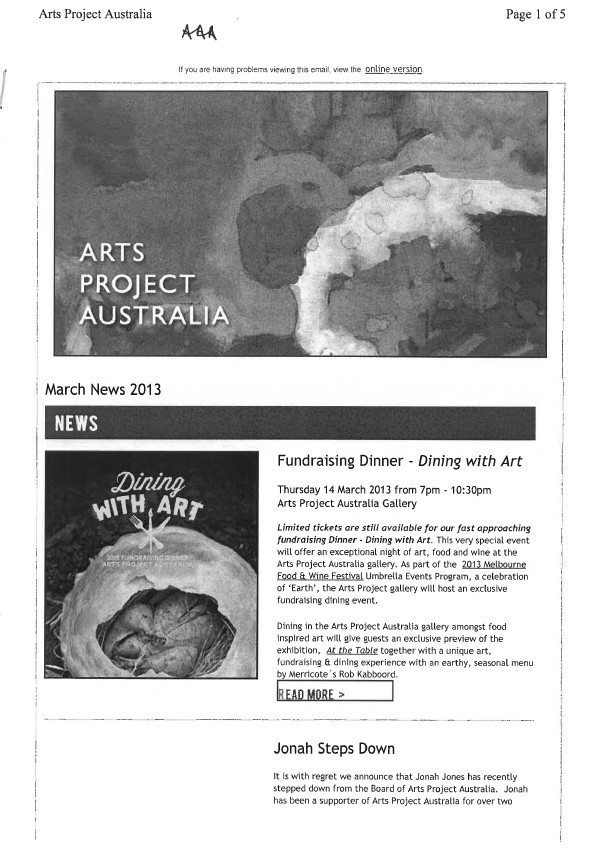 "Arts Project Australia - ENews - 20130308" Arts Project Australia - ENews - 20130308
 - Tegrin