Items
Search full-text
“Screen Australia launches an access coordinator training program”
- Alex Litsoudis
- Anthony Gomez
- Anna Yen
- Anna Mannix
- Anitra Nelson
- Angharad Wynne-Jones
- Alycia Johnston
- Alicia Jane Steele
- Alexandra Hudson
- Alex Skaftouros
- Alex Chomicz
- Adolfo Aranjues
- Adam McBride
-
"Liz Ferrier (2000) Vulnerable Bodies: Creative Disabilities in Contemporary Australian Film. In Ian Craven ed. Australian Cinema in the 1990s. Routledge. https://doi.org/10.4324/9780203045022" Reads, in part "The internationally-acclaimed film Shine is one of a number of contemporary Australian movies which portray embattled artists or performers. Reminiscent of earlier works such as Starstruck (1982), Man of Flowers (1983), Malcolm (1986) and Sweetie (1989), and several more recent productions – Proof (1991), Strictly Ballroom (1992), Bad Boy Bubby (1994), The Adventures of Priscilia, Queen of The Desert (1994), Muriel's Wedding (1994), Cosi (1996), Lilian's Story (1996), and Jane Campion's New Zealand/Australian films, An Angel at My Table (1990) and The Piano (1993) – it depicts a disadvantaged individual overcoming setbacks through the passionate and eccentric expression of his creativity. The film and the cycle to which it belongs offers a peculiar vantage point from which to examine the problems and possibilities of Australian cinema in the 1990s."
- "Simon Darcy, S., Hazel Maxwell, Simone Grabowski, Jenny Onyx (2019). Artistic Impact: From Casual and Serious Leisure to Professional Career Development in Disability Arts. Leisure Sciences, 44(4), 514–533. https://doi.org/10.1080/01490400.2019.1613461"
-
"Bree Hadley (2016) Cheats, charity cases and inspirations: disrupting the circulation of disability-based memes online. Disability and Society, 31(5), pp. 676-692." "With the increasing part online self-performance plays in day-to-day life in the twenty-first century, it is not surprising that critiques of the way the daily social drama of disability plays out in online spaces and places have begun to gain prominence. In this article, I consider memes as a highly specific style or strategy for representing disability via social media sites. I identify three commonly circulating categories of meme – the charity case, inspiration and cheat memes – all of which offer representations that people with disabilities find highly problematic. I then investigate the ways in which disabled people have begun to resist the representation and circulation of these commonly circulating categories of memes, via the production of counter or parodic memes. I focus, in particular, on the subversive potential of these counter memes, within disability communities online and within broader communities online."
-
"Bree Hadley (2018) Disability, disabled dance audiences and the dilemma of neuroaesthetic approaches to perception and interpretation. In Wood, K, Brown, A, Waelde, C, Harmon, S, Blades, H, & Whatley, S (Eds.) Dance, disability and law: Invisible difference. Intellect Ltd, United Kingdom, pp. 293-315.” "In this chapter, I want to consider one emerging approach to spectatorship – the neuroaesthetic approach – through the lens of disability spectatorship. In the twenty-first century, neuroaesthetics is gaining traction amongst scholars looking to provide accounts of spectatorship in less story-based performing arts such as classical and contemporary dance, as well as in more story-based practices in drama, theatre and performance. ‘It would be fair to say that neuroaesthetics has become a hot field’, as Alva Noë puts it (2011). To date, though, the assumptions that underpin neuroaesthetic approaches to spectatorship have not been brought together with the assumptions that underpin the equally emergent field of disability spectatorship studies. As Carrie Sandahl (2002: 18) has noted, different cognitive, sensory and corporeal abilities result in a range of different phenomenologies, perceptual processes and perceptual preferences that can in turn produce different styles of engagement with experiences, events and objects. These differences impact on how people with disabilities produce and perceive aesthetic performances – somatically, syntactically, symbolically and socially, as disabled people hear with their eyes, see with their fingers, or perceive phenomena vicariously via the intervention of technologies or translators. Accordingly, disability spectatorship, and more detailed attention to the presence of distinctive cognitive, sensory and corporeal processes amongst disabled spectators, has the potential to complicate, extend and challenge assumptions embedded in emerging neuroaesthetic approaches to spectating."
-
"Bree Hadley (2019) Disability arts in an age of austerity. In Hadley, B & McDonald, D (Eds.) The Routledge handbook of disability arts, culture, and media. Routledge, United Kingdom, pp. 347-361." "Is the current “age of austerity” (Summers 2009) impacting on art, culture, and media practices by and about people with disabilities, and, in particular, on art-based protest practices by people with disabilities? In recent years, much has been written about austerity as neo-liberal economic, political, social, and ideological agenda (Harvey 2005; Barnett 2010; Seymour 2014). Much has been written about the way groups effected by local and global governmental shifts towards austerity are protesting, presenting themselves, and being represented by others (Fritsch 2013; Goodley, Lawthom, & Runswick-Cole 2014; Runswick- Cole & Goodley 2015; della Porta 2015; Kokoli & Winter 2015; Beresford 2016; Dodd 2016; Giugni & Grasso 2016; Berry 2017). The question of whether disabled artists are adapting their practices to address these changing cultural circumstances has received less attention (Hadley 2017) and is thus the topic I focus on in this chapter."
-
"Bree Hadley (2019) Advocacy, allies, and 'allies of convenience' in performance and performative protest. In Grehan, H (Ed.) The Routledge companion to theatre and politics (Routledge Theatre and Performance Companions). Routledge, United Kingdom, pp. 85-88.” "Though allies have always played a role in the production of political performance, analysis of the work of disabled artists, women artists, queer artists, and artists of colour has yet to be combined with analysis of the work of allies addressing the same issues. In this chapter, I consider the practice of allies in a specific context, social media performance, as a newly emerging platform for political activism. After tracing the way allies are typically involved in political performance about, with, and by marginalised people and communities, I point to complexities arising when activists, campaigners, entertainers, and pranksters use new online platforms in performance that purport to support the same cause.
- "Bree Hadley (2021) What's in a name? The politics of labeling in disability performance. In Rai, Shirin, Gluhovic, Milija, Jestrovic, Silvija, & Saward, Michael (Eds.) The Oxford Handbook of Politics and Performance. Oxford University Press, New York, NY, pp. 531-543.”
-
"Bree Hadley (2022) A ‘Universal Design’ for audiences with disabilities? In Reason, Matthew, Connor, Lynne, Johanson, Katia, & Walmsley, Ben (Eds.) Routledge Companion to Audiences and the Performing Arts. Routledge, Abingdon, Oxon, pp. 177-189.” “Understanding of how to create inclusive performance experiences for spectators with disabilities remains nascent in research, policy, and practice. In this chapter, I survey the state of knowledge in this field – or, as it turns out, fields, given that specialist knowledge of sign language interpretation for d/Deaf spectators, audio description for blind spectators, and relaxed performance for neurodiverse spectators, has developed separately, without intersection. I then investigate recent efforts to create inclusive aesthetics that incorporate accessibility features into performance work, as an integral part of the aesthetic, rather than as interpretations, captions, or descriptions alongside the work. I examine why this ‘Universal Design’ approach has been embraced with enthusiasm, both by disabled producers and spectators, and by non-disabled producers and spectators.”
-
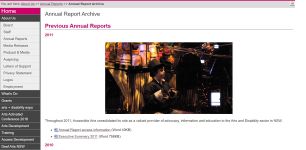 "Accessible Arts - Annual Report Archive 2005-2011" Accessible Arts - Annual Report Archive 2005-2011
 -
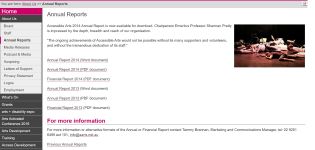 "Accessible Arts - Annual Reports 2013-2014" Accessible Arts - Annual Reports 2013-2014
 -
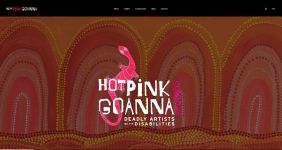 "Hot Pink Goanna Studios - Deadly With Disabilities, Website captured 2024" Hot Pink Goanna Studios: Deadly With Disabilities, website captured 2024 - with About, Gallery, Commisions, and Prints sections - reads, in part "Hot Pink Goanna was developed by Uncle Paul Constable Calcott a proud Wiradjuri man and artist living with a disability on Gubbi Gubbi Country. Hot Pink Goanna showcases the works of Uncle Paul and other First Nations artists living with a disability."
 -
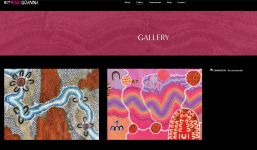 "Hot Pink Goanna Studios - Deadly With Disabilities, Gallery captured 2024" Hot Pink Goanna Studios: Deadly With Disabilities, Gallery captured 2024 - featuring imagews of works by Paul Constable Calcott