
Items
Search full-text
“Screen Australia launches an access coordinator training program”
-
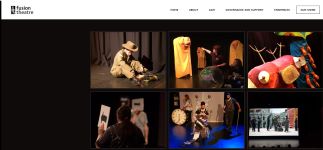 "Fusion Theatre Our Works, captured 2022" Fusion Theatre Our Work, captured 2022 - links to pages about past works, including A Long Way From Home, After the Beginning of Everything, The Beginning of Everything, A Place Called Maze, Microcosma, No Strongs Attached, Inside Out, The Color Project, Mind the Light, Facets of Us
 -
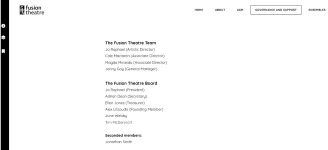 "Fusion Theatre Governance and Support, captured 2022" Fusion Theatre Governance and Support page, captured 2022 - Board, governance, and funding arrangements
 -
 "Fusion Theatre Diversity Workshop, captured 2022" Fusion Theatre Diversity Workshop page, captured 2022 - reads, in part "Fusion Theatre Diversity Workshop is a professional learning experience that explores themes of inclusion, diversity and social justice. Through applied theatre, drama, and stories, participants are provided with opportunities to reflect on how they might identify barriers to inclusion and contribute to a more inclusive society."
 -
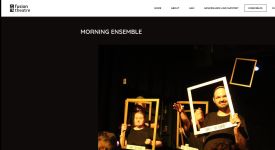 "Fusion Theatre Ensembles, captured 2022" Fusion Theatre Ensembles, captured 2022 - information about morning ensemble, evening ensemble, and ‘Movement in Conversation’ described as "and occasional project that Fusion Theatre offers in association with the Asylum Seeker Resource Centre (ASRC), and other local groups"
 -
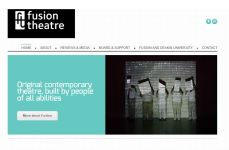 "Fusion Theatre Website, captured 2013" "Fusion Theatre Website, captured 2013 - reads, in part "Original contemporary theatre, built by people of all abilities", with links to About, Reviews and Media, Board and Support, Fusion and Deakin University pages
 -
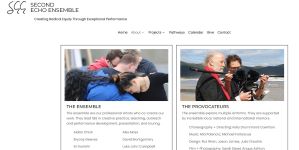 "Second Echo Ensemble - People, captured 2024" Second Echo website 'People' page, captured 2024, with information about Ensemble, Provocateurs, and Board, and crew
 -
 "Second Echo Ensemble - Website, captured 2024" Second Echo website, captured 2024 - reads, in part, ‘We celebrate diversity’ ‘We challenge assumptions’ ‘We make things happen’, with links to About, Projects, and Pathways pages
 -
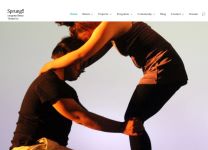 "Sprung!! Integrated Dance Theatre - Website, captured 2019" Sprung!! Integrated Dance Theatre Website, captured 2019 - About, Projects, Programs, Community
 -
 "Sprung!! Integrated Dance Theatre - Blog captured 2019" Sprung!! Integrated Dance Theatre Website, captured 2019 - News (French Cafe community dance project, 'Share House' plays at Brisbane Anywhere Festival May, Sprung!! makes finals for an Australian Dance Award, Sprung!! Appoints a new Business Manager)
 -
 "Blue Roo Theatre Company - News" Blue Roo Theatre Company news, captured 2021, including Covid 19 impacts in rehearsals, and links to strategic and annual plans
 -
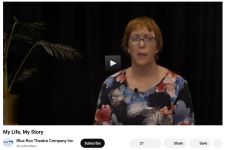 "Blue Roo Theatre Company - You Tube - My Life, My Story Creative Development (2020)" Blue Roo Theatre Company - You Tube - creative development of first digital production My Life, My Story (2020) - reads, in part "My Life, My Story is a timely, poignant and uplifting narrative highlighting the personal journeys of four inclusive artists, from community isolation to public recognition for their creative abilities, determination and joyfulness."
 -
 "Blue Roo Theatre Company - Artistic Team, 2021" Blue Roo Theatre Company Committee, Artistic Team and Performers, 2021
 -
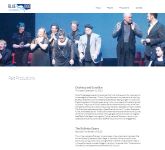 "Blue Roo Theatre Company - Productions" Blue Roo Theatre Company Productions 2009-2017, including Orpheus and Eurydice with Opera Queensland (2016), The Bulimba Opera with Opera Queensland (2015), a new touring Commedia dell’Arte production Hotel Pantelone (2015), a street theatre ensemble A Waddle of Ducks (2015), Song Circle with Opera Queensland (2014), parody, satire and music performance Darcy O and the Browbeat Factory (2013), small scale touring Commedia dell’Arte group production Capitano Pretends Again (2013), Flood Country (2012), The Last Night at the Grand (2011), Sugar Cane Ball (2010), and Lily Pilly Letters (2009)
 -
 "YouTube - Take Up Thy Bed and Walk - presented by Vitalstatistix and Gaelle Mellis" YouTube of 'Take Up Thy Bed and Walk' (2013) by Vitalstatisix and Gaelle Mellis - "Take Up Thy Bed & Walk is a subversive performance about women, disability & fiction."
 -
”Bree Hadley, Janice Rieger, Katie Ellis, Eddie Paterson (2024) Cultural safety as a foundation for allyship in disability arts. Disability & Society, 39(1), pp. 213-233.” "In this article, we argue that cultural safety, respect, and trust is a precursor to good allyship in the creative industries. We outline factors that influence feelings of safety or non-safety for disabled arts and media makers, and the way the legacy of the medical model makes it difficult for many arts and media workers to appreciate and enact enablers of safety as part of an allyship relationship."
-
"Bree Hadley, Janice Rieger (2021) Co-designing choice: objectivity, aesthetics and agency in audio-description. Museum Management and Curatorship, 36(2), pp. 189-203.” "The ‘Vis-ability’ exhibition, presented at the QUT Art Museum in 2019 was an exhibition curated with clear social inclusion goals from the outset. Through it, the museum sought to develop innovative, cost effective, and readily replicable techniques to allow blind and low vision visitors and artists to engage with the institution and its collections. The results affirm the benefits of offering blind and low vision visitors a spectrum of engagement choices, and also affirm that blind and low vision artists and visitors have capacity to make a critical contribution in co-designing that spectrum of choices. This exhibition and its use of multisensorial elements offers a useful prompt to museums to engage this community more fully in co-designing inclusion in the future."
-
”Hadley, Bree, Batch, Morgan, & Whelan, Michael (2021) The entitled ally: Authorship, consultation, and the 'right' to stage autistic people's stories. Disability and Society, 36(9), pp. 1489-1509.” "Theatre has a long tradition of presenting disabled characters as plot devices to tell someone else’s story. A recent production, All in a Row, resulted in heated debate around this issue. This article examines not the play itself, but the conflict between those who objected to the play’s representation of autism, and its creators, who defended their choices by citing their disability-adjacent identities and processes of consultation. For critics, the fact that the creators did not take the community’s concerns seriously was a source of trauma. This article uses this conflict to draw out lessons about how we might better negotiate the right to tell disability stories and strengthen frameworks to support that negotiation. We propose a decision tree diagram to assist artists in understanding the meaning, role, and most importantly the potential consequences of consultation – up to and including a community saying ‘no’ to an artist’s planned representation."
-
"Bree Hadley, Donna McDonnald (2019) Introduction: disability arts, culture, and media studies - mapping a maturing field. In Hadley, B & McDonald, D (Eds.) The Routledge handbook of disability arts, culture, and media. Routledge, United Kingdom, pp. 1-18.” Reads, in part "In this book, an internationally recognised collection of established and emerging scholars, artists, and activists from across the US, UK, Europe, Asia, and Australasia come together to trace the development of disability arts, culture, and media studies in recent decades, flag current interests, and forecast future concerns."
-
"Bree Hadley, Donna McDonald, Sarah Austin, Kath Duncan, Gerard Goggin, Lachlan MacDowall, Veronica Pardo, Eddie Paterson, with collaborators Dave Calvert, Jori De Coster, Shawn Goh, Alice Fox, Ann M. Fox, Andy Kempe, Petra Kuppers, Justin Lee, Alex Lubet, Sarah Meisch Lionetto, Ann Millett-Gallant, Laura Misener, Bronwyn Preece, Megan Strickfaden, Joanne Tay, Matthew Reason, Nancy Quinn, and Sarah Whatley (2019) Conclusion: practicing interdependency, sharing vulnerability, celebrating complexity - the future of disability arts, culture, and media research. In Hadley, B & McDonald, D (Eds.) The Routledge handbook of disability arts, culture, and media. Routledge, United Kingdom, pp. 362-372." "In this chapter, the authors conclude The Routledge Handbook of Disability Art, Culture, and Media studies by reflecting on the past, present, and potential future of disability art practice debated throughout the book. Based on research currently underway in the work of many of the Australian contributors, and including reflections from the global contributors, this concluding chapter reflects on what the disability arts, culture, and media practice and research of the future might look like, do, and achieve in the public sphere."
-
"Katie Ellis, Gerard Goggin, Beth Haller, Rosemary Curtis ed. (2019) Routledge Companion to Disability and Media. London & New York: Routledge." Reads, in part "An authoritative and indispensable guide to disability and media, this thoughtfully curated collection features varied and provocative contributions from distinguished scholars globally, alongside next-generation research leaders."
-
"Kate Maguire-Rosier (2016). Moving “Misfits.” Australasian Drama Studies, (69), 29–55. https://search.informit.org/doi/10.3316/informit.590682266081795" Reads, in part "In Dianne Reid's recent work Dance Interrogations (a Diptych), performed as part of the 2015 Melbourne Fringe Festival by Reid and collaborating artist Melinda Smith, spectators had no seats but rather roamed, observing two mature dancers. In this article, I explore Reid and Smith's live performance, a combination of structured movement improvisation and screendance, as a provocation of the relationship between movement and agency. I address the theatrical event through the multifaceted lens of the performers' experiences, spectators' responses and my own observations."
-
"Katie Ellis, Tama Leaver, Mike Kent, M, eds. (2023). Gaming Disability: Disability Perspectives on Contemporary Video Games. London and New York: Routledge." This book explores the opportunities and challenges people with disabilities experience in the context of digital games from the perspective of three related areas: representation, access and inclusion, and community. Drawing on key concerns in disability media studies, the book brings together scholars from disability studies and game studies, alongside game developers, educators, and disability rights activists, to reflect upon the increasing visibility of disabled characters in digital games.
-
"Katie Ellis (2008) Disabling Diversity: The Social Construction of Disability in 1990s Australian National Cinema" Reads, in part "This book critically examines numerous 1990s Australian films with reference to socio-political influences to approach disability as a problem with society rather than as one within a damaged body."
-
"Chris Brophy, Kim Dunphy, Nick Hill, Petra Kuppers, Indrani Parker, John Smithies, John Toumbourou (2008) Picture This: Increasing the cultural participation of people with a disability in Victoria, Office for Disability in partnership with Arts Victoria and Disability Services Division" Reads, in part "The Cultural Development Network undertook a research project examining ways that the participation of people with a disability in the arts, as artists and as audience members, can be increased. The project was commissioned by the Office for Disability and partners, Arts Victoria and Department of Human Services. The report and literature review have now been published."
-
"Katherine Gale (2013) Review - Take Up Thy Bed and Walk, Arts Hub" Review of 'Take Up Thy Bed and Walk' (2013) by Vitalstatisix and Gaelle Mellis - reads, in part "The latest Vitalstatistix Theatre Company production asks subtle questions about society’s perception of people with disabilities."