Items
Search full-text
“The Australian Government’s Creative Nation policy released in 1994”
- Doug Ewen
- Dinny Downie
- Creighton Burns AO
- Creighton Burns
- Cathy Smith
- Barbara Ball
- Antonella Calvano
- Annie Beeston
-
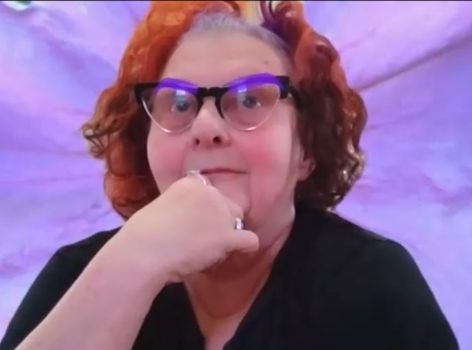 "Interview with Kath Duncan" Kath Duncan is a writer, a director, a provocateur, a visual artist, a comedian, a producer, a journalist, a radio broadcaster and disability advocate. Interview Summary Kath Duncan is an experienced and prominent figure in the disability arts community with a passion for experimental performance arts, having witnessed the beginnings of the disability arts movement in Australia and participated in its evolution. Her art is inherently political, shaped by her unique perspective as a congenital amputee. Kath firmly believes in the inherent creative revolutions and endless inspiration within all impairments. Kath highlights the ongoing struggles within the disability arts sector, including high unemployment rates for disabled individuals, systemic barriers, and the need for disabled leadership in arts organizations. While cherishing the milestones and transformative experiences she's had, Kath calls for significant systemic changes, emphasizing the importance of team playing and collective work to support and grow the disabled artist community.
 -
 "Bree Hadley, Katherine Dionysius, Sarah Boulton (2019) Vis-Ability: Audio descriptions. In Vis-ability: Artworks from the QUT Art Collection. QUT Art Museum, Brisbane, Qld, pp. 45-53." "Bringing together a selection of recent acquisitions from the QUT Art Collection ,Vis-ability has been conceived as a project to broaden understanding of the lived experiences of people who are blind and people with low vision. Drawing on research in QUT's Creative Industries Faculty, Vis-ability proposes alternative ways of engaging with the collection, considering how technologies can deepen our understanding of vision and challenging our sight-driven experience of art. In this essay, QUT artist scholar and audio description author Associate Professor Bree Hadley, curator Katherine Dionysius, and blind artist and exhibition guide Sarah Boulton examine the principles, processes, and challenges of producing audio descriptions and associated engagement strategies to enable creative new forms of audio encounter with visual art works."
 -
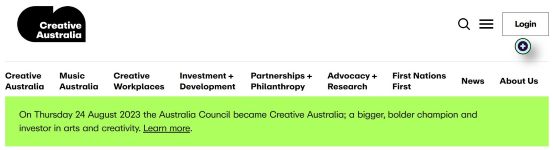 "CreativeAustralia/AustraliaCouncil - Website - NameChange 2023" The website reads “On Thursday 24 August 2023 the Australia Council became Creative Australia; a bigger, bolder champion and investor in arts and creativity”
 -
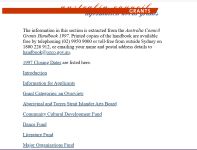 “Australia Council - Grants, captured 1997” Australia Council (Creative Australia) grants captured December 1997. Website reads “extracted from the Australia Council Grants Handbook 1997” and includes Grant Categories: an Overview, Aboriginal and Torres Strait Islander Arts Board, Community Cultural Development Fund, Dance Fund, Literature Fund, Major Organisations Fund, Music Fund, New Media Arts Fund, Theatre Fund, Visual Arts/Craft Fund, Awards
 -
”Bree Hadley, Janice Rieger, Sarah Barron, Sarah Boulton, Catherine Parker (2023) Codesigning Access: A New Approach to Cultures of Inclusion in Museums and Galleries. In Cachia, Amanda (Ed.) Curating Access: Disability Art Activism and Creative Accommodation. Routledge, Abingdon, Oxon, pp. 183-195.” "In museums and galleries, access is often designed and implemented by staff and informed by regulations and guidelines. Codesign approaches have the potential to shift this understanding away from designing access “for” visitors and toward access as a creative process developed “with” visitors. This chapter focuses on the exhibition and practice-led research project Vis-ability: Artworks from the QUT Art Collection, which was presented at the Queensland University of Technology (QUT) Art Museum in Australia in 2019. Vis-ability represented the culmination of five years of international research into access in museums and galleries for visitors who are blind or have low vision."
-
"Sarah Austin, Chris Brophy, Lachlan MacDowell, Edward Paterson, and Winsome Roberts (2015) Beyond Access: The Creative Case for Inclusive Arts. Melbourne: Arts Victoria." Reads, in part "Beyond Access sought to create an evidence base for the creative case for inclusive arts practice to support greater recognition for artists with a disability by transforming and extending notions of what art is and who produces it."
-
"Amanda Cachia (2022) Curating Access: Disability Art Activism and Creative Accommodation. London: Routledge" Reads, in part "This book is an interdisciplinary collection of twenty-four essays which critically examine contemporary exhibitions and artistic practices that focus on conceptual and creative aspects of access."
-
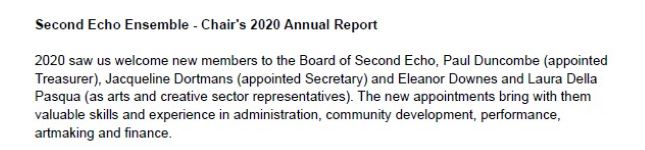 "Second Echo Ensemble - Chair's, Creative Producer's and Financial Reports 2020" Second Echo Ensemble Chair’s, Creative Producer’s and Financial Reports for 2020, including reports on work during the year (Let Me Dry Your Eyes, The CHAIN, What Makes You Beautiful), and reflections on the impact of Covid 19 Pandemic
 -
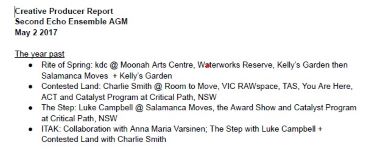 "Second Echo Ensemble - Creative Producer's Report 2017" Second Echo Ensemble Creative Producer’s Reports for 2017, including reports on work during the year (Performances of ‘Rite of Spring’, ‘Contested Land’), and plans for the future
 -
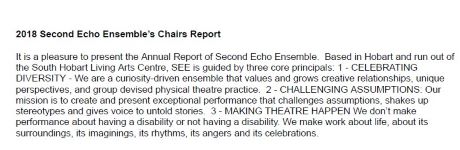 "Second Echo Ensemble - Chair's, Creative Producer's and Financial Reports 2018" Second Echo Ensemble Chair’s, Creative Producer’s and Financial Reports for 2018, including reports on work during the year (Contested Land, By My Hand, Let Me Dry Your Eyes, The Beauty Project)
 -
Theatre performance ‘Take Up Thy Bed & Walk’ integrates ‘aesthetic access’” The 2012 performance ‘Take Up Thy Bed & Walk’ designed by Gaelle Mellis and produced by Vitalstatistix proved that accessibility measures could be aesthetic. As Creative Australia describes it “is credited as Australia’s first performance work incorporating ‘aesthetic access’. It embedded the performer’s physicality and communication styles – and those of potential audiences – at the centre of the creative process. The work integrated audio description, captioning, sign language and interactivity uniquely into the core of the work.” Gaelle Mellis has said of the performance that “aesthetic access can be used in ways that add layer, texture, meaning and richness to a work. Art, at its simplest, is primarily about communication. Aesthetic access, at its simplest, is a form of communication that communicates to everyone.”
- Ruth Rentschler
- David Throsby
- Charlie Smith
- Boram Lee
- Crossroad Arts
- Janice Florence