Items
Search full-text
“The Australian Government’s Creative Nation policy released in 1994”
- Miriam Bass
- Pascale Sameli
- Peter Hengstberger
- Peter Hungstberger
- Rhonda Whitaker
- Rhonda Whittaker
- Ross Moore
- Sally Marsden
- Srecko Radman
- High Beam Festival
-
 "Shine - IMDB" Reads, in part "David Helfgott, a gifted pianist, struggles through childhood as his dysfunctional father abuses him and his siblings. Years later, he suffers a mental breakdown but manages to return as a legend."
-
"National Inquiry into the Human Rights of People with Mental Illness Report launched in 1993" The National Inquiry into the Human Rights of People with Mental Illness Report was launched 20th October, 1993. This led to deinstitutionalisation.
-
"The first Arts Activated conference takes place" Accessible Arts NSW started biennial Arts Activated conferences in 2007 "to inform, connect and activate people and organisations involved with Australia’s arts and disability sector" https://aarts.net.au/arts-activate/
-
"The United Nations makes comments on the rights of people with disabilities." In 1951, the United Nations made comments on the rights of people with disabilities."The focus of the United Nations on disability issues shifted in the late 1950s from a welfare perspective to one of social welfare."
-
"The Commonwealth Rehabilitation Service (CRS) established in 1941." Following the first and second world wars, there was better recognition of veteran disability and the Commonwealth Rehabilitation Service (CRS) was established.
-
"Royal Commission on Human Relationships" In 1977, the Royal Commission on Human Relationships noted the legal and human rights of handicapped children and adults.
-
"Declaration on the Rights of Disabled Persons adopted in 1975" The 1960s and 1970s saw major changes in people’s attitudes towards disability. Stemming from the growth of the human rights movement and the introduction of normalisation theory internationally, Australia signed key human rights declarations of people with disabilities, the Declaration on the Rights of Disabled Persons (adopted in 1975). The Declaration argued that disabled people deserve to live lives “as normal and full as possible”.
-
“WHO International Classification of Impairment, Disabilities and Handicaps (1976)” International classification of impairments, disabilities, and handicaps: a manual of classification relating to the consequences of disease, published in accordance with resolution WHA29.35 of the Twenty-ninth World Health Assembly, May 1976
-
“Arts Access Australia releases the report Making the Journey: Arts & Disability in Australia” In 2005, Arts Access Australia commissioned a survey of the disability arts sector nationally. This survey resulted in the report, Making the Journey: Arts & Disability in Australia. The report was written by Mary Hutchison. It details 12 case study disability arts organisations.
-
“Australia signs the UN Convention on the Rights of People with Disability” In 2007, Australia signed the UN Convention on the Rights of People with Disability. The CRPD seeks to “promote, protect and ensure the full and equal enjoyment of all human rights and fundamental freedoms by all persons with disabilities”. The Convention came into effect in Australia on 16 August 2008.
-
“2023 Screen industry report ‘Disability and Screen Work in Australia’ finds disabled people fulfil a range of roles in the screen industry, despite facing prejudice and exclusion, and should be treated as experts of their access requirements” ‘Disability and Screen Work in Australia: Report for Industry’ (2023) was compiled by researchers Radha O’Meara, Laura Dunstan, Anna Debinski and Catherine Ryan. The study was supported by Melbourne Disability Institute and A2K Media. The authors summarise that disabled people fulfil a range of roles in the screen industry, despite facing prejudice and exclusion, and should be treated as experts of their access requirements. They find that “Disabled people experience a more precarious, lower paid, and less powerful position in the screen industry than their non-disabled counterparts.” O’Meara and her colleagues call for widespread change in the industry to expand access.
-
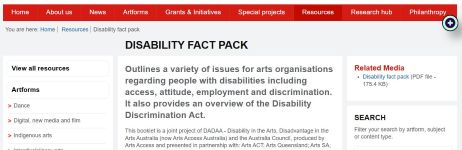 "Australia Council - Disability Fact Pack 1998" The website reads “Outlines a variety of issues for arts organisations regarding people with disabilities including access, attitude, employment and discrimination” - Noelene Gration
-
 “Australia Council - Artists with Disability Program 2014” The website reads “The Artists with Disability Program provides funding for Australian artists with disability (including Deaf artists) to create, develop, present, produce, exhibit and/or tour their work”
-
 "Australia Council - Awards - National Arts and Disability Awards 2019-2021" The website reads “The Australia Council National Arts and Disability Awards 2019-21 celebrate the work and achievements of both established and young artists, and the significant contribution of artists with disability to the vibrancy of Australian arts”
-
 "Interview with Jodee Mundy OAM" Jodee Mundy OAM is a Disabled creative director, performer, writer, activist, creative producer, executive producer, commissioner, interpreter, film, festival maker and cultural leader. Interview Summary Jodee Mundy OAM, is an artist and festival director who identifies as Coda (child of Deaf adults) and lives with chronic illness reflects on the historical and ongoing challenges faced by Deaf and Disabled artists in Australia. Her work is deeply political, aiming to tell untold stories and bring visibility to marginalized communities. Despite significant achievements, Jodee stresses the need for structural support and inclusivity within the industry, especially given the limitations of hybrid access models post-pandemic. Jodee's personal journey, including her recent incurable cancer diagnosis, shapes her advocacy for a culture of care and well-being in the arts. Jodee leads Alter State, Australia’s Disability- led arts festival presented by Arts Centre Melbourne and Arts Access Victoria.