Items
Search full-text
“The Australian Government’s Creative Nation policy released in 1994”
- Bryon Jones
- Bryn Jones
- Australian Capital Territory
-
“In 2003, a demonstration outside Canberra’s Parliament House protests changes to Centrelink guidelines” In 2003, the Totally and Permanently Incapacitated Disabled Soldiers Association staged a protest outside Parliament House in Canberra, over changes to Centrelink guidelines that could have cost them up to $200 per week in income. “He said in Parliament that our payments are adequate, he's somebody who has never had the time to speak to us,” Association President John Ryan remarked of then Prime Minister John Howard.
-
"Sally Northfield (2014) Canvassing the Emotions: Women, Creativity and Mental Health in Context" PhD Thesis Victoria University, Melbourne, https://vuir.vu.edu.au/29985/, Australia, https://vuir.vu.edu.au/29985/1/NORTHFIELD%20Sally-thesis_nosignature.pdf " Reads, in part, "A multimedia movement-theatre show, incorporating dance, video- and slide- projections, a life-sized puppet and an original soundtrack. A diary come to life, portraying the true story of an Australian dancer who – after paralysing one of his arms in a motorcycle accident – journeys through the worlds of medicine, rehabilitation and disability, in recovery of self-expression. He finds new angles on perceiving the body, and new ways to move. "Body image" and concepts of "normality" are questioned."
-
"Kath Duncan, Gerard Goggin (2002). 'Something in Your Belly': Fantasy, Disability and Desire in My One Legged Dream Lover. Disability Studies Quarterly 22 (4), pp: 127-144." In this article we explore fantasy, disability and desire in the groundbreaking 1998 Australian TV documentary My One-Legged Dream Lover. Based upon self-reflexive documentary conventions, the video uncovers journalist-cum-freak raconteur Kath Duncan's explorations into the world of amputee fetish. Duncan is a double congenital amputee. She says," I've tried most things men, women, sex toys, unusual locations, dominance and submission games but I wanted to know what it was like to be desired because of my impairments." Gerard Goggin is a temporarily able-bodied (or TAB) academic with his own history of queer desire and a personal investment in exploring issues of difference. Duncan's and Goggin's collaboration includes accessing each other's edgier fantasies, aiming to give voice to some of the negotiations, anxieties, pleasures, and risks we have taken, speaking across the chasm of our personal histories, different genders and respective bodies.
-
 "Stepping Out - 1980" Australian Screen entry/clip for 'Stepping Out' 1980 - reads, in part "Romayne, a Sunshine Home drama group member, introduces us to the idiosyncrasies of some of the other members." - Press kit from Ronin Films available at http://web.archive.org/web/20231102095120/https://www.roninfilms.com.au/get/files/18222/stepping-out-original-1981-press-kit.pdf
 -
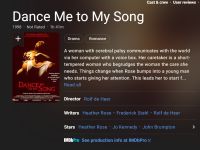 "Dance Me To My Song - IMDB" Dance me to my song' Internet Movie Database (IMDB) entry - reads, in part "A woman with cerebral palsy communicates with the world via her computer with a voice box. Her caretaker is a short-tempered woman who begrudges the woman the care she needs"
 -
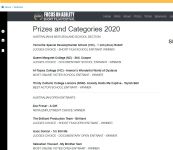 "Focus on Ability, Short Film Festival winners list 2020" Focus on Ability Short Film Festival, captured 2025 - webpage listing 2020 award winners - includes IAUSTRALIAN & NEW ZEALAND SCHOOL SECTION (Yarraville Special Developmental School (VIC) - ' I Am (Also) Robot'; Al-Taqwa College (VIC) - Ammar's Wonderful World of Dyslexia; Anxiety Holds Me Captive - Taylah Bell), AUSTRALIAN OPEN ENTRANTS (Zoe Fraser - A Gift; The Brilliant Production Team – Brilliant; Isaac Doman - I'm Still Me; Sebastian Youssef - My Brother Sam; Vanessa Star - One Size Fits All; Zoe Fraser - A Gift; Jared Hargreaves - The Girl; Sally Newman - Heart Strings)
 -
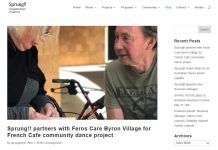 "Sprung!! Integrated Dance Theatre - Blog captured 2019" Sprung!! Integrated Dance Theatre Website, captured 2019 - News (French Cafe community dance project, 'Share House' plays at Brisbane Anywhere Festival May, Sprung!! makes finals for an Australian Dance Award, Sprung!! Appoints a new Business Manager)
 -
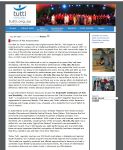 "Tutti Arts - Website - History, captured 2008" Tutti Arts Website History captured 2008 - reads, in part "“Founded by South Australian playwright/composer Pat Rix, Tutti began as a small singing group for people with an intellectual disability at Minda Inc in August 1997."
 -
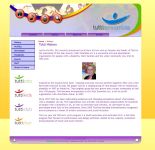 "Tutti Arts - Website - History, captured 2007" Tutti Arts Website History captured 2007 - reads, in part "Led by Pat Rix, SA’s recently announced Local Hero for her work as founder and leader of Tutti in the Australian of the Year Awards, Tutti Ensemble Inc is a successful arts and educational organisation for people with a disability, their families and the wider community now into its 10th year. Inspired by the musical term tutti - meaning everyone will now perform together after only a few have been allowed to play, Pat began Tutti as a singing group of nine people with an intellectual disability in 1997 at Minda Inc. That original group has now grown into a music community of well over 150 people. Tutti became incorporated as the Tutti Ensemble Inc, a not for profit organisation with charitable status, in 2001."
 -
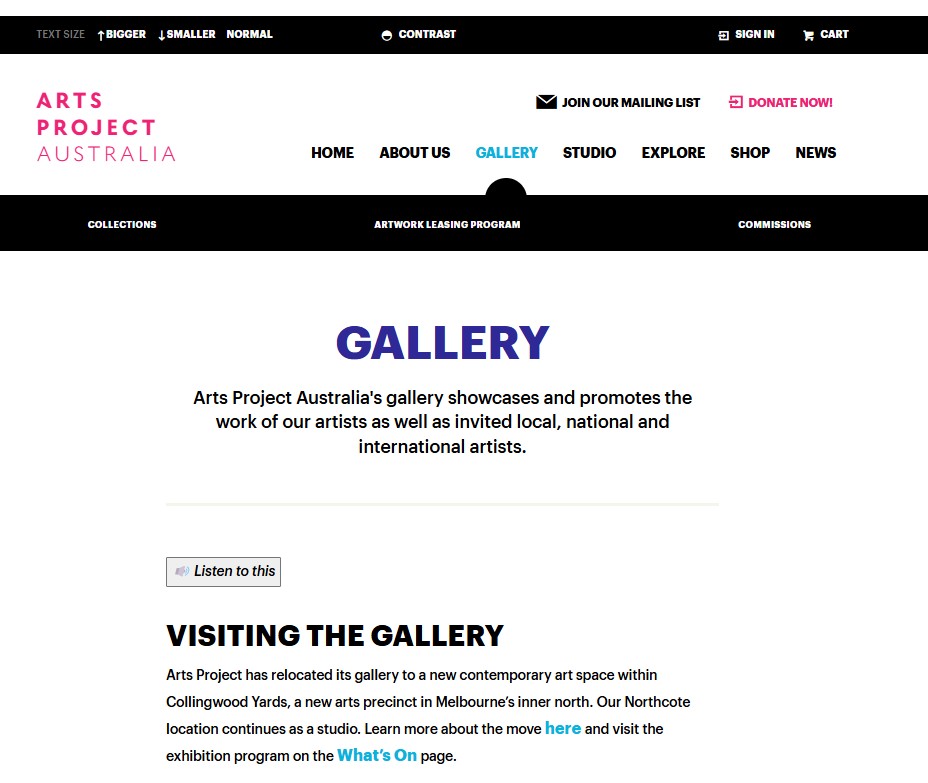 "Arts Project Australia - Gallery, captured 2022" Arts Project Australia - Gallery - website captured 2022 - reads, in part "HOW APA REPRESENTS AND SUPPORTS ITS ARTISTS Arts Project Australia advocates, supports and promotes studio artists within the broader contemporary arts sector nationally and internationally. The gallery promotes the work of its diverse group of emerging, mid-career and established Australian artists who work in the studio through the Collingwood gallery and national and international exhibitions, art prizes, and awards."
 -
 "Arts Project Australia - Love from the Studio, captured 2022" Arts Project Australia - Love from the Studio aarticles and interviews with artists - reads, in part "A series of stories bringing you behind the scenes of Arts Project Australia. "
 -
“7-part series ‘Fair Go’ produced by Film Australia” In 1981, Film Australia produced a 7-part series, called Fair Go, on Australians with mental and physical disabilities and how it impacted their lives and the lives of their families. “Each program is presented from the viewpoint of the person with the disability and demonstrates the practical implications of coping with a disability in daily life at home, in the community, in the workplace or at school.” Film Australia was consolidated into Screen Australia in 2008.
-
“The paralympic arts festival, Invincible Summer, is held in conjunction with the 2000 Paralympic games” In 2000, Sydney held the Paralympic games. The paralympic arts festival, Invincible Summer, featured comedy, dance, film, art, music, theatre, and street performance, featuring collaborations between artists with and without disabilities.
-
“ABC appoints Stella Young as editor of Ramp Up” In 2010, ABC announced the appointment of Stella Young as editor of its first (and short-lived) dedicated disability platform, ABC Ramp Up. Shawn Burns’s 2014 article in The Conversation laments the closure of the initiative and the loss of a vital platform for better disability representation in Australian media. The URL link to the Ramp Up page now opens with the following statement: “This website is no longer being updated but remains online as an archive of three and a half years of discussions and conversations regarding disability in Australia.”
-
"Bree Hadley, Eddie Paterson, Madeleine Little, Kath Duncan (2024) How Disability Performance Travels in Australia: The Reality Under the Rhetoric. In Czymoch, Christiane, Maguire Rossier, Kate, & Schmidt, Yvonne (Eds.) How Does Disability Performance Travel?: Access, Art, and Internationalization. Routledge, Abingdon, Oxon, pp. 62-76.” "The last three decades has witnessed the development of a distinct narrative about how disability performance has become a much celebrated component of the Australian theatre landscape. A central aspect of this narrative is the critical importance of festivals, events, and other industry initiatives that allow disabled performers to travel - both conceptually and corporeally - to meet and be mentored by other artists, and to present their work to new and more mainstream audiences, in new spaces and places, around the country, and around the world. In this chapter, we draw on historical data, collected as part of an AusStage ARC LIEF project designed to database information about disability drama, theatre, performance, and dance over the past 100 years, as well as the Last Avant Garde ARC Linkage project on disability performance in Australia, to unpack areas where the reality seems to challenge some of the dominant rhetoric."
-
"Bree Hadley, Donna McDonald, Sarah Austin, Kath Duncan, Gerard Goggin, Lachlan MacDowall, Veronica Pardo, Eddie Paterson, with collaborators Dave Calvert, Jori De Coster, Shawn Goh, Alice Fox, Ann M. Fox, Andy Kempe, Petra Kuppers, Justin Lee, Alex Lubet, Sarah Meisch Lionetto, Ann Millett-Gallant, Laura Misener, Bronwyn Preece, Megan Strickfaden, Joanne Tay, Matthew Reason, Nancy Quinn, and Sarah Whatley (2019) Conclusion: practicing interdependency, sharing vulnerability, celebrating complexity - the future of disability arts, culture, and media research. In Hadley, B & McDonald, D (Eds.) The Routledge handbook of disability arts, culture, and media. Routledge, United Kingdom, pp. 362-372." "In this chapter, the authors conclude The Routledge Handbook of Disability Art, Culture, and Media studies by reflecting on the past, present, and potential future of disability art practice debated throughout the book. Based on research currently underway in the work of many of the Australian contributors, and including reflections from the global contributors, this concluding chapter reflects on what the disability arts, culture, and media practice and research of the future might look like, do, and achieve in the public sphere."
-
"Bree Hadley (2014) Disability, Public Space Performance, and Spectatorship: Unconscious Performers. London: Palgrave Macmillan." "Why would disabled people want to re-engage, re-enact and re-envisage the everyday encounters in public spaces and places that cast them as ugly, strange, stare-worthy? In Disability, Public Space Performance and Spectatorship: Unconscious Performers, Bree Hadley examines the performance practices of disabled artists in the US, UK, Europe and Australasia who do exactly this. Operating in a live or performance art paradigm, artists like James Cunningham (Australia), Noemi Lakmaier (UK/Austria), Alison Jones (UK), Aaron Williamson (UK), Katherine Araniello (UK), Bill Shannon (US), Back to Back Theatre (Australia), Rita Marcalo (UK), Liz Crow (UK) and Mat Fraser (UK) all use installation and public space performance practices to re-stage their disabled identities in risky, guerilla-style works that remind passersby of their own complicity in the daily social drama of disability. In doing so, they draw spectators' attention to their own role in constructing Western concepts of disability. This book investigates the way each of us can become unconscious performers in a daily social drama that positions disability people as figures of tragedy, stigma or pity, and the aesthetics, politics and ethics of performance practices that intervene very directly in this drama. It constructs a framework for understanding the way spectators are positioned in these practices, and how they contribute to public sphere debates about disability today."
-
"Commonwealth of Australia (2014) National Arts Disability Strategy Evaluation 2009–2012. Canberra: Meeting of Cultural Ministers: National Arts and Disability Implementation Working Group." Reads, in part "The first evaluation was completed in October 2013 and explores the Strategy's outcomes from October 2009 to December 2012. The Evaluation Report includes input from the Australian, state and territory governments, following targeted consultation with arts and disability stakeholders. The Evaluation Report was endorsed by cultural ministers in October 2014."
-
"Anthea Skinner, Jess Kapuscinski-Evans (2021) Facilitate This! Reflections from Disabled Women in Popular Music. Journal of Popular Music Studies 1 June 2021; 33 (2): 3–14. doi: https://doi.org/10.1525/jpms.2021.33.2.3" Reads, in part "This article is a reflection by the authors on the impact that their identities as disabled women have had on their ongoing music careers. Skinner and Kapuscinski-Evans make up two-thirds of the Australian crip-folk trio, the Bearbrass Asylum Orchestra (the term “crip” is a cultural reappropriation of “cripple”). The Bearbrass Asylum Orchestra is a band that performs as part of the Disability Music Scene in Melbourne, Australia, using folk music to portray their experiences as people with disabilities. In this article Skinner and Kapuscinski-Evans discuss the formation of and philosophy behind the band, as well as the impact that growing up as disabled women had on their musical education, careers, and influences."
-
"Maree Roche, Ben Whitburn (2019) Mate, You’re Crippin’ Us Out: Biopolitics of the Arts Curriculum in Australia and the Swinging Identities of Dis/abilities. Journal of Literary & Cultural Disability Studies.13(3). https://doi.org/10.3828/jlcds.2019.25" Reads, in part "The article explores arts curriculum in Australia as developed in the contexts of schooling, community organizations, and higher education for people with disabilities and mental health concerns. Motivated to explore whether or not students provided access to modified arts curriculum are engaging in education or receiving therapy, the aim is to address a dichotomy that is seemingly present in educational institutions, but extends well beyond the school gate and informs organizational responses to arts in the lives of people with disabilities. Resourced with the theoretical contributions of dis/ability studies for its concern for the biopolitics of disability, the authors weave personal experiences through the discussion of participation in arts throughout their lives. The article concludes with a theoretical discussion of how arts provision in the Australian context might develop the social and political value of art in the lives of people with dis/abilities and for all, on the basis that its educative value is emphasized over its therapeutic one."
-
"Anthony White (2021). Anthony Mannix's mixed realities. Art Monthly Australasia, (327), pp. 80-87." The Australian artist Anthony Mannix has produced a large body of work, mostly in the form of artist books. His art has featured in dozens of exhibitions; has been the subject of catalogues, journal articles and a PhD thesis; and has entered national and international collections. One of his most recent works, the dazzling, vibrantly decorated 2020 cover of I Am Cut Viciously, features a harrowing self-portrait of the artist. The work depicts Mannix with injuries he sustained while in 'a psychotic state' during a period in 1986 when he was homeless and living in the Royal National Park, New South Wales. As an artist with experience of complex mental health issues, or what he prefers to describe as 'mixed realities', Mannix has often been categorised as an 'outsider' artist.
-
"Ellan A. Lincoln-Hyde (2018) Opera, Publicity, Disability : A Case Study of the Public Persona of Marjorie Lawrence, Master of Music/Musicology, Melbourne Conservatorium of Music, The University of Melbourne" Reads, in part "This thesis is an investigation of the public life of the Australian dramatic soprano Marjorie Florence Lawrence (b. Deans Marsh, Victoria 1907 – d. Little Rock, Arkansas 1979). Lawrence, who begun her professional stage career in Monte Carlo in 1932, was permanently paralysed from the waist down in 1941 after contracting poliomyelitis (at the time better known as infantile paralysis, now commonly referred to as polio)."