
Items
Search full-text
“The Australian Government announced a National Autism Strategy in 2022”
- Wayne Marnell
- WeiZen Ho
- Wendy Martin
- William Bannon
- William Gregory
- William Murray
- William Webster
- Will McConnell
- Wren Richards
- Yasmin Gurreeboo
- Yoni Prior
- Zia Gui Sadeqi
- Zoe Barry
- Zoe Scoglio
-
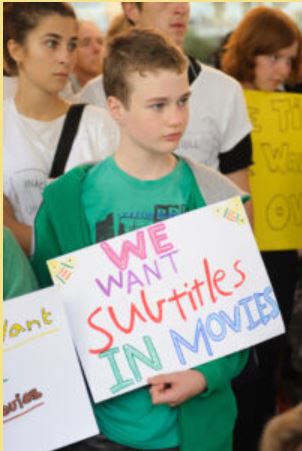 “Arts Access Victoria – Art Everywhere (2010-2015)" Between 2010 and 2015, Arts Access Victoria (AAV) received $2.5 million to support audio description and captioning in film as part of its worth with The Other Film Festival, launched Write-ability with Writers Victoria, the mobile, accessible arts space Nebula in Melbourne’s Federation Square in 2012, and collaborated in research such as the ‘Beyond Access’ project with University of Melbourne and Dance Haptics with Deakin University.
- Eric Cunningham Dax
-
 “Arts Access Victoria - Nebula - Promotional Flyer" Arts Access Victoria - Nebula - Information about Nebula, the first fully accessible portable arts space developed for disabled artists in Australia, with flexibility to provide workshop, gallery, or performance space anywhere in Victoria
-
 “Arts Access Victoria - Nebula - Promotional Poster - 2020" Arts Access Victoria - Nebula - Promotional Poster - 2020 - Information about Nebula, the first fully accessible portable arts space developed for disabled artists in Australia, with flexibility to provide workshop, gallery, or performance space anywhere in Victoria
-
"International Year of the Disabled Person (IYDP)" In 1976, the General Assembly proclaimed 1981 would be the Year of the Disabled Person. The 1981 International Year of the Disabled Person inspired an increase in awareness and disability arts. While UN theme was “full participation and equality” the theme in Australia was “Break down the Barriers”, raising the prole and issues of people with disabilities. The international year of the disabled persons was a catalyst for connecting Australian disability activists to each other and the international disability rights movement (Royal Commission, 2021, p. 6). Australia saw an increase in disability-themed theatre from 1981 to 1984; however, these performances were largely staged with non-disabled casts. Records of these productions can be found on the AusStage database.
-
"Back to Back Theatre established" The theatre company Back to Back was established in 1987. They are a drama group comprising artists with intellectual disabilities who have since toured both nationally and internationally in mainstream Australian theatre.
-
"Victoria's Disability Resources Centre (DRC) created" 1981 saw a number of Disability Activists create the first Australian Disability Resources Centre (DRC) for Victorians with disabilities.
-
"Dr G. Yunupingu plays keyboards, guitar and percussion on Yothu Yindi's 'Treaty'" Geoffery Gurrumul Yunupingu, an indigenous Australian from the Gumati Clan on Echo Island, was a blind musician, singer and song writer. As a child taught himself to play a guitar "upside down". He started as a guitarist, key board player and percussionist for the pop/rock band Yothu Yindi who had the international hit "Treaty" in 1991.
-
"Soprano Marjorie Lawrence performs in her wheelchair in the 1940s" In the 1940s, Australian soprano Marjorie Lawrence contracted polio and performed in her wheelchair, both nationally and internationally, showing veterans life after disability was possible. Platforms were modied for her wheelchair so she could perform.
-
"Disability activist Geoff Bell leads significant advocacy” In the 1970s, Geoff Bell was a disability activist who, after a diving accident left him quadriplegic at age 21, was placed in a nursing home. Not accepting nursing homes as appropriate residences for young people, he wrote to the then Minister for Social Security Bill Hayden. The letter was presented to parliament. In April 1978, Geoff Bell led ten members of the Disabled People’s Action Forum as they blockaded the entrance to a Medibank claims office for an hour. The protest was held outside Medibank to raise awareness of the architectural barriers to conducting personal business when Medibank was supposed to be of service. Signs held by the members read “We don’t need a stairway to paradise, We want ramps to independence".
-
“Genni Batterham stages a protest at the opening of Bondi Junction railway station 1979, makes film in 1980” When Bondi Junction railway station opened in 1979, Genni Batterham staged a protest about the lack of accessible transportation options for individuals with disabilities. After receiving a multiple sclerosis diagnosis in 1978, Genni became severely disabled very quickly. She did everything in her power to stop the disease's progression and was furious at being "consigned to the world of the disabled." The 1979 Bondi Junction protest was an important moment in the history of the Disability Rights Movement in New South Wales. The Premier, Neville Wran, later said that the experience led him to developing the Disability Taxi Service, the first public transport system designed for people with disability to be launched in Australia. Batterham then made the film ‘Pins and Needles’ (1980) with her husband Kim. Under the direction of Barbara Chobocky and with funding from the Australian Film Commission's Women's Film Fund, the film was screened in five different countries, took home first place at the 1980 Canadian Film Festival, and took home second place at the 1980 New York Film Festival. Genni and Kim would then collaborate on three further films about the phases of her life: Where's the Give and Take? (1981), Artreach (1982), and Riding the Gale (1987).