Items
Search full-text
“The 1985 New Directions Report is released”
- Adrian Norman
- Adrian Jones
- Adrian Gore Symes
- Emily Crockford
-
 "Australia Council - Arts and disability a priority as Australia Council commits significant new funding" Australia Council - Arts and disability a priority as Australia Council commits significant new funding - reads, in part "The Australia Council has committed $750k over three years to support sustainable careers and to recognise the artistic excellence of artists with disability."
 -
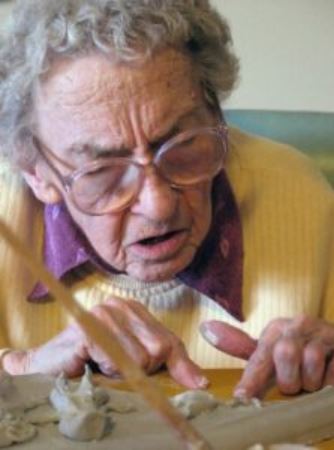 “Arts Access Victoria – A New Millennium (early – mid 2000s)” Arts Access Victoria – A New Millennium (early – mid 2000s)– online artist’s register, “Artability” festival, Deaf Arts Network started in 2001, new programs including regional areas, audio description of first TV production, AAV hosted Inclusion International World Congress, The Other Film Festival started,
 - "DADAA Inc. (2014). An evaluation of a year-long mentoring program for artists with disability in western Australia. Perth, Western Australia: Department of Family and Community Services."
-
"Queensland Government (2024) Arts and Disability Plan. 25 September 2024. https://www.arts.qld.gov.au/projects-and-initiatives/arts-and-disability-plan-web" Reads, in part "The Queensland Government acknowledges the rights of people with disability to participate equally in the state’s cultural life and to have the opportunity to develop and use their creative, artistic and intellectual potential, as recognised in the United Nations Convention on the Rights of Persons with Disability."
- "Australian Institute of Health and Welfare (1993) Australia's welfare 1993: services and assistance. Canberra: AGPS."
-
 "DADAA - Bridging the Gap: Process Evaluation" Bridging The Gap: Process Evaluation - Reads, in part "Results from early formative evaluation indicated that relationships among core partners were a key strategy in the success of Bridging the Gap. Based on this, the Project Reference Group was selected as a focus of the process evaluation."
 -
 "Access Arts Annual Reports 2005-2011" Access Arts Annual Reports, 2005-2011
 -
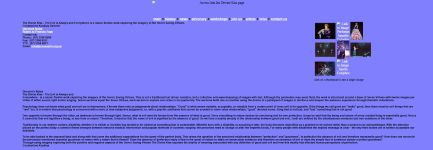 "Access Arts - The Divine Kiss, website captured 2004" Access Arts - The Divine Kiss, website captured 2004"- reads, in part "The Divine Kiss - The Evil is Always and Everywhere - is a music theatre work exploring the imagery of the Seven Saving Virtues. This is not a traditional text driven narrative, but a collection and superimposing of images with text. Although the perimeters may seem fluid, the work is structured around a base of Seven Virtues with twelve images per virtue of either sound, light and/or singing. Seven sections equal the Seven Virtues, each section to explore one virtue in its quarternity. The sections build one on another using the device of a palimpset of images to reinforce and deepen the audience experience through thematic reiterations."
 -
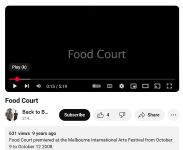 "Back to Back Theatre - You Tube - Food Court (2008), uploaded 2016" Back to Back Theatre You Tube - Food Court (2008) - reads, in part "Set in the lush minimalism of an illuminated white void, the story of one woman’s humiliation is played out in a psychological space constructed from light and sound. Luminously fragile, FOOD COURT is a near death experience in a suburban wonderland where a small fatality of dignity takes place between The Asian Hut and The Juice Bar."
 -
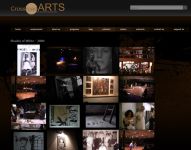 "Crossroad Arts Program Shades of White 2000" Crossroad Arts program images - Shades of White 2000
 -
 "The Clothesline - Intimacy: Torque Show & Michelle Ryan Celebrate Love, Dance, Fragility, Courage and The Ability To Live Life To Your Physical Best – Interview" The Clothesline (2015) 'Intimacy: Torque Show & Michelle Ryan Celebrate Love, Dance, Fragility, Courage and The Ability To Live Life To Your Physical Best – Interview'
 -
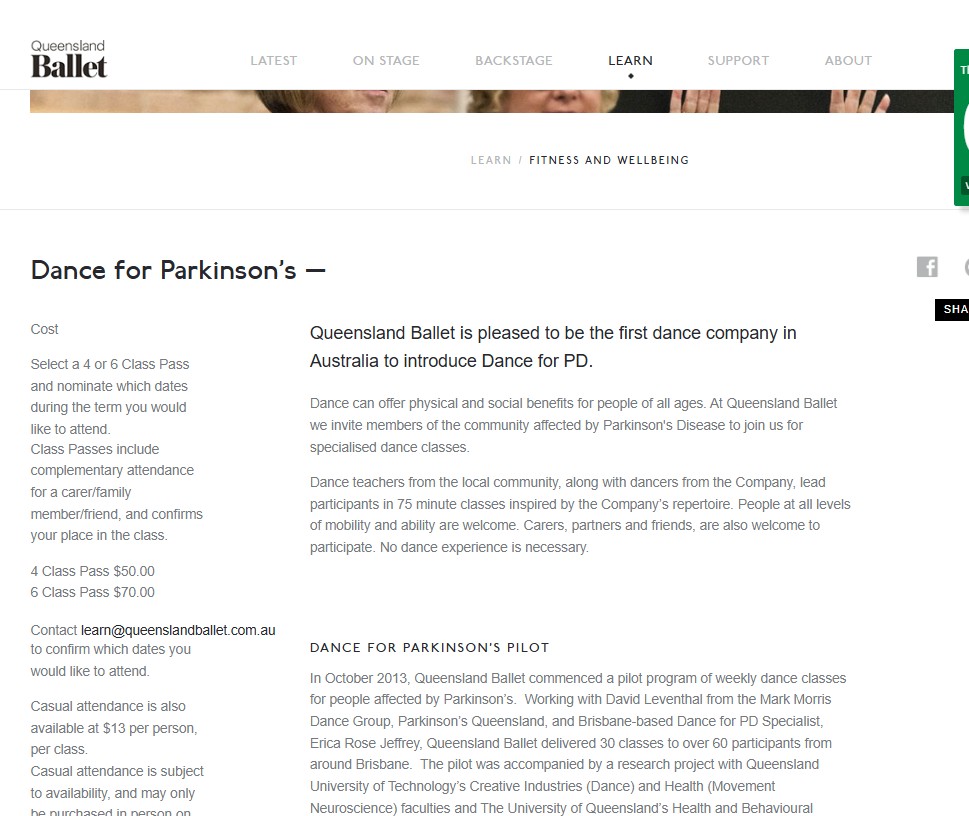 "Queensland Ballet - Dance for Parkinsons" Queensland Ballet 'Dance for Parkinsons' 2015 - reads, in part "Dance can offer physical and social benefits for people of all ages. At Queensland Ballet we invite members of the community affected by Parkinson's Disease to join us for specialised dance classes."
 -
"Arts Access Victoria established in 1973 and provides valuable resources and conferences throughout the decades" In 1973, Judy Morton successfully applied for funding to start a 6-month pilot program and Arts Access Victoria was established the following year. However, due to lack of government funding and despite public appeal, programs were suspended in 1977. Fortunately, operation resumed in 1979 and AAV was formally constituted with a small School Commission fund as Arts Access Society Inc. Arts Access Victoria had both organisational and financial growth in the mid to late 1980s. This led to a diversification of arts projects and the beginning of long-term artistic programs which remain as the core programs of AAV. Arts workshops also began in regional Victoria during this time. In 1988, Arts Access was approached to run a national conference focusing on the arts and disability. Two years later, they convened P-art-ICIPATE '90 and subsequently published ‘P-art-ICIPATE '90: a conference report’. They also published ‘Inner Words Outer Spaces’, edited by Bev Roberts (1995), ‘Arts Alive: An Information Leaflet about the Ways the Arts Can Work for Older People’ (1995), ‘Accessible Theatresports’ (1996), and Bev Roberts's ‘Work Guide: How to Establish an Artist in Community Project’ (1996). In 1998, Arts Access (Victoria) assumed responsibility for its own financial management and administration. In 1999, Arts Access Victoria presented Verve!, a national symposium on arts and disability.
-
"The Australia Council establishes the Community Arts Committee in 1973 and the Community Arts Board in 1978" The Australia Council established the Community Arts Committee in 1973 and the Community Arts Board in 1978. The purpose of the latter was to encourage wider participation in the arts, especially for groups with little social capital. The Board was “the first funding body to identify the community arts phenomenon and respond with definition and policy." This occurred under the directorship of Rosalie Bower, the first director of the Community Arts Board, who wrote in a paper entitled 'The Case for a Community Arts Centre': “The activities within a centre should be accessible to children, aged people, the physically handicapped, ethnic groups and those whose time is severely restricted by work and family ties. The activities supplied by the centre should be conducted free from competitive elements which otherwise might discourage people from participation, and they must be inexpensive and accessible at almost any time. They must not pre-suppose education or income levels which would cut them off from any section of the community.'" (Australia Council 1979/1980 Annual Report, page 32)
-
“The Victorian Government commissions ‘Picture This: Increasing the Cultural Participation of People with a Disability in Victoria’” In 2008, ‘Picture This: Increasing the Cultural Participation of People with a Disability in Victoria’ was published. The report was commissioned by the Victorian Government, specifically the Victorian Office for Disability in partnership with Arts Victoria and Disability Services Division and written by Kim Dunphy and Petra Kuppers. It focussed on methods to increase participation by people with disability in the arts as artists and audience members.
-
“Creative Australia releases reports on arts participation, including d/Deaf, Disabled and Neurodivergent artists and audiences” A series of reports about arts and disability in Australia published in the mid-to-late-2010s are summarised on the Creative Australia website. Sources for the summary include Connecting Australians: Results of the National Arts Participation Survey (June 2017), Making Art Work: An Economic Study of Professional Artists in Australia (2017), Creating Pathways: Insights on support for artists with disability (2018), and Arts and Disability in Australia: Meeting of Cultural Ministers (2018). The overview of this research series demonstrates that disabled Australians’ participation in the arts had increased as access had grown, though equity for disabled artists, especially those with intersecting marginalised identities, continued to face barriers. It reports that work by disabled artists is innovative and transformative.
-
"Bree Hadley (2022) Disability and the Arts, Creative, and Cultural Industries in Australia. Australian Academy of Humanities" "This week saw the release of Ensuring Occupations are Responsive to People with Disabilities, a landmark report by the Australian Council of Learned Academies (ACOLA) commissioned by the Australian Government Department of Social Services. As part of the Academy of Humanities’ support for the project, Professor Bree Hadley provided a study of disability in the arts, creative, and cultural industries for the project, and Professor Gerard Goggin was a member of the Expert Reference Group. In this week’s Five-Minute Friday Read, they explain why disability training needs fundamental reform now."
-
"Sarah Austin, Chris Brophy, Lachlan MacDowell, Edward Paterson, and Winsome Roberts (2015) Beyond Access: The Creative Case for Inclusive Arts. Melbourne: Arts Victoria." Reads, in part "Beyond Access sought to create an evidence base for the creative case for inclusive arts practice to support greater recognition for artists with a disability by transforming and extending notions of what art is and who produces it."
-
"David Throsby, Katya Petetskaya (2017) Making Art Work: An Economic Study of Professional Artists in Australia, Australia Council for the Arts, 2017." Reads, in part "Making Art Work: An Economic Study of Professional Artists in Australia by David Throsby and Katya Petetskaya is the sixth in a series carried out independently over thirty years by Professor Throsby at Macquarie University, with funding from the Australia Council. The series tracks trends in the lives and working conditions of Australian artists over 30 years and identifies challenges and opportunities for artists’ careers into the future."
-
"David Throsby, Katya Petetskaya (2024) Artists as Workers: An Economic Study of Professional Artists in Australia, Creative Australia, 2024." "Artists as Workers: An Economic Study of Professional Artists in Australia, by David Throsby and Katya Petetskaya, is the seventh in a landmark study, carried out independently over the last four decades by Professor Throsby and colleagues at Macquarie University, with support from Creative Australia (previously the Australia Council for the Arts). Conducted at roughly six–year intervals, the series tracks the working conditions of artists, providing information about their artistic practice, income, career development and pathways, and their broader working lives. The latest survey was in the field late 2022 and early 2023 and examines activity in the 2021-22 financial year. This edition therefore captures the conditions for artists in the wake of COVID-19 and coincides with the Australian Government’s January 2023 announcement of its five-year national cultural policy Revive: A place for every story, a story for every place."
-
 "Victoria : disability fact pack for arts and cultural organisations - DADAA National Network and Australia Council (1998)" Disability fact pack for arts and cultural cultural organisations in Victoria