Items
Search full-text
“The 1985 New Directions Report is released”
- Abigail Clarke
- Abbie Twiss
- Abbie Storry
- Abbie Madden
- Abbey Demasi
- Abbe Peters
- Aaron Martin
-
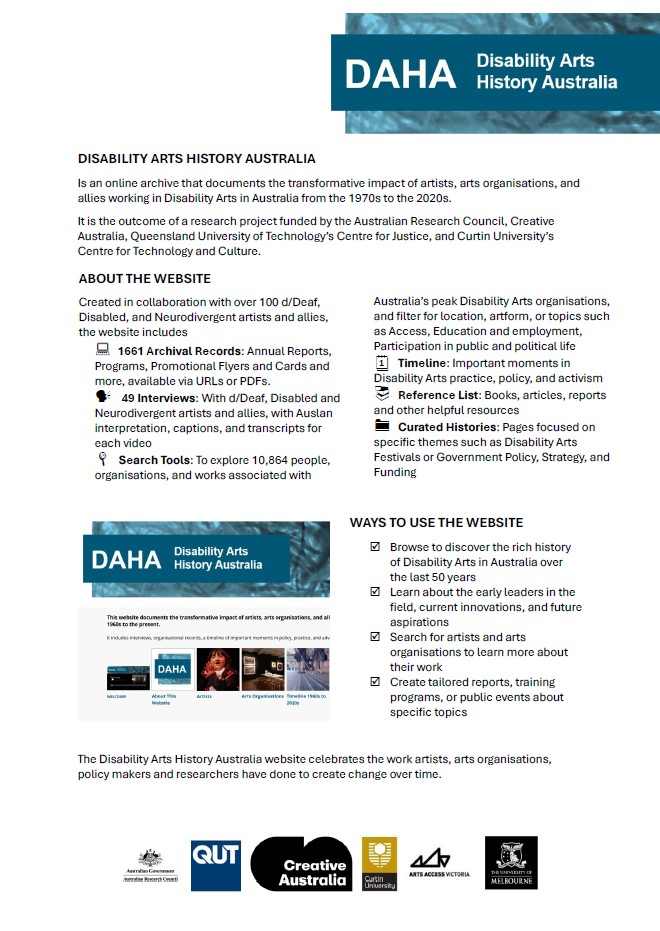 Disability Arts History Australia Launch 2025 - 3 Page Information Sheet
 -
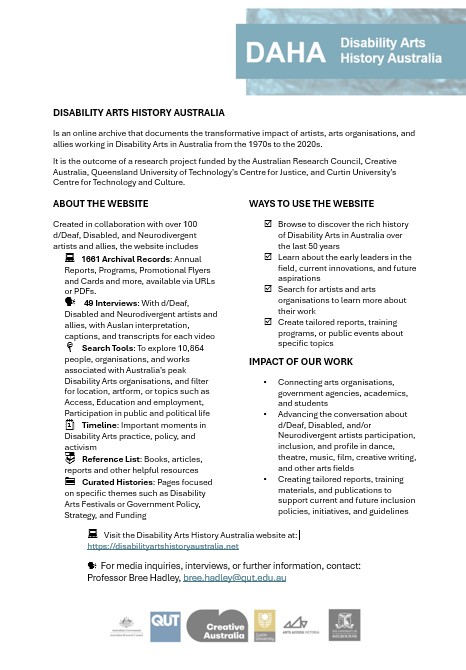 Disability Arts History Australia Launch 2025 - 1 Page Information Sheet
 -
“Genni Batterham stages a protest at the opening of Bondi Junction railway station 1979, makes film in 1980” When Bondi Junction railway station opened in 1979, Genni Batterham staged a protest about the lack of accessible transportation options for individuals with disabilities. After receiving a multiple sclerosis diagnosis in 1978, Genni became severely disabled very quickly. She did everything in her power to stop the disease's progression and was furious at being "consigned to the world of the disabled." The 1979 Bondi Junction protest was an important moment in the history of the Disability Rights Movement in New South Wales. The Premier, Neville Wran, later said that the experience led him to developing the Disability Taxi Service, the first public transport system designed for people with disability to be launched in Australia. Batterham then made the film ‘Pins and Needles’ (1980) with her husband Kim. Under the direction of Barbara Chobocky and with funding from the Australian Film Commission's Women's Film Fund, the film was screened in five different countries, took home first place at the 1980 Canadian Film Festival, and took home second place at the 1980 New York Film Festival. Genni and Kim would then collaborate on three further films about the phases of her life: Where's the Give and Take? (1981), Artreach (1982), and Riding the Gale (1987).
-
"Bree Hadley (2020) Allyship in disability arts: Roles, relationships, and practices. Research in Drama Education, 25(2), pp. 178-194.” "In this article, I propose that investigation of allies, ally skills, and allyship in disability arts is overdue. I articulate some of ways in which non-arts approaches to allyship need to be adapted to meet the needs of disabled artists, given the aesthetic as well as professional and social dimensions of allyship distinctive to disability arts. In doing so, I highlight the need for new theory, terminology, and frameworks to define the different approaches to allyship, developed by different artsworkers, operating in different roles, across the different domains of disability arts and/or arts and disability practice."
-
”Bree Hadley, Donna McDonnald (Eds.) (2019) The Routledge Handbook of Disability Arts, Culture, and Media. Routledge International Handbooks. Routledge, London; New York.” “In the last 30 years, a distinctive intersection between disability studies – including disability rights advocacy, disability rights activism, and disability law – and disability arts, culture, and media studies has developed. The two fields have worked in tandem to offer critique of representations of disability in dominant cultural systems, institutions, discourses, and architecture, and develop provocative new representations of what it means to be disabled. Divided into 5 sections:- Disability, Identity, and Representation; Inclusion, Wellbeing, and Whole-of-life Experience; Access, Artistry, and Audiences; Practices, Politics and the Public Sphere; Activism, Adaptation, and Alternative Futures - this handbook brings disability arts, disability culture, and disability media studies – traditionally treated separately in publications in the field to date – together for the first time.”
-
"Sarah Austin, Kath Duncan, Gerard Goggin, Lachlan MacDowall, Veronica Pardo, Eddie Paterson, Jax Jacki Brown, Morwenna Collett, Fiona Cook, Bree Hadley, Jess Kapuscinski-Evans, Donna McDonald, Julie McNamara, Gayle Mellis, Kate Sulan (2019). The last avant garde? In B. Hadley, D. McDonald ed. The Routledge Handbook of Disability Art, Culture, and Media. London & New York: Routledge, 251-262." "“The Australian Research Council project Disability and the Performing Arts in Australia: Beyond the Social Model – known to collaborators as the last avant garde – is mapping disability performing arts in Australia. We open up this chapter, and our ongoing research project, with the words of the late Tobin Siebers. In researching disability and performance here in Australia, we also acknowledge that since Siebers’ 2010 text, we have seen new experiments and emerging companies pushing the bounds of how bodies feel – in a sector which embraces differences in bodies, but also in thinking, in neurodiversities, in being, in articulating, in appearing, in sensing, in intersectionalities, and in the experiences for audiences. As such, this chapter aims to explore ‘disability aesthetics’ not as a set of specific techniques, themes, or politics, but in order to position disability at the centre of ‘future conceptions of what art is’ and what it can be.”
-
 "Igneous - Body In Question" Reads, in part, "A multimedia movement-theatre show, incorporating dance, video- and slide- projections, a life-sized puppet and an original soundtrack. A diary come to life, portraying the true story of an Australian dancer who – after paralysing one of his arms in a motorcycle accident – journeys through the worlds of medicine, rehabilitation and disability, in recovery of self-expression. He finds new angles on perceiving the body, and new ways to move. "Body image" and concepts of "normality" are questioned."
 - Force Majeure
- Urban Theatre Projects
-
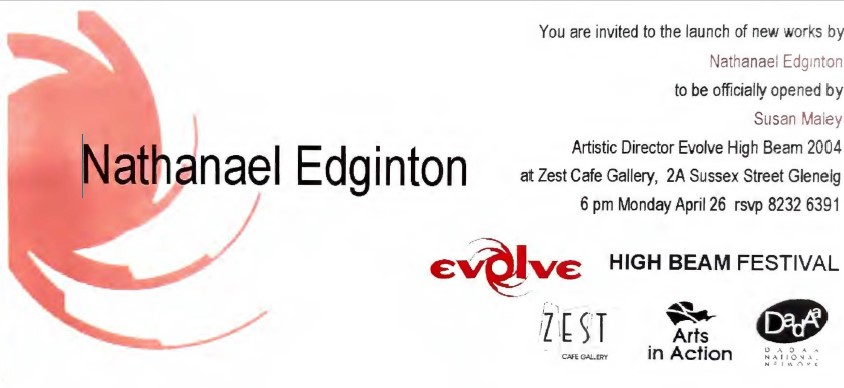 "New works by Nathaniel Edington and Too Many Legs by Bryan Tingey and Freight by DADAA" Flyer reads "You are invited to the launch of new works by Nathanael Edginton," and "Adelaide artist Bryan Tingey presents a new body of work that exhibits the varied influences of philosophy, history and psychology informing his work and his experimentation with the artforms of graffiti and , iconography and hieroglyphics. Freight is the latest shipment of outsider art on the move from WA. The exhibition showcases the work of three Western Australian artists working in textiles, photography and digital media."
 - Zoe Coombs Marr
- Rose Dennis
- Katie Ellis
- Gerard Goggin
- Danielle Micich
-
“The South Australian Film Corporation announces their disability screen strategy” The South Australian Film Corporation launched their disability screen strategy. First, their Diversity and Inclusion Strategy 2022-2032, which they say “breaks new ground nationally,” defines quantifiable 10-year targets. In addition, the SAFC has developed a Disability Equality Plan, Targeted Diversity Attachments, the FULL TILT Short Documentary Initiative, and Film Lab: New Voices, a feature film development program presented by SAFC with Adelaide Film Festival and Mercury CX.
-
"Katie Ellis (2019) Disability and Digital Television Cultures Representation, Access, and Reception. London & New York: Routledge." Reads, in part "Disability and Digital Television Cultures offers an important addition to scholarly studies at the intersection of disability and media, examining disability in the context of digital television access, representation and reception."
-
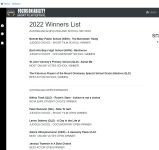 "Focus on Ability, Short Film Festival winners list 2022" Focus on Ability Short Film Festival, captured 2025 - webpage listing 2022 award winners - includes AUSTRALIAN & NEW ZEALAND SCHOOL SECTION (Bonnet Bay Public School (NSW) - The Marrakesh Treaty; East Hills Boys High School (NSW) – Resilience; St John Vianney's Primary School (QLD) - About Me; The Fabulous Players of the Mount Ommaney Special School Drama Elective (QLD)), AUSTRALIAN OPEN ENTRANTS (Nikhia Trask (QLD) - Rylan's Story - Autism is not a choice; Peter Renzullo (WA) - Note To Self; Lenny Seberry (QLD) - A Day in the Life of; Satara Uthayakumaran (NSW) - A Heavenly Piece of Art; Jessica Trueman in A Bold Choice; Ashleigh Smart - Not Your Average Joe; The Rogues Den Studios – Filmception; Emma Barry - Wait, What?)