Items
Search full-text
“The 1985 New Directions Report is released”
-
“Protesters gather in Lismore (NSW) to oppose proposed cuts to services” In 2004, 300 disabled persons, along with their relatives and carers, gathered in Lismore to protest proposed cuts to adult, training, learning, and support programs, among other services. These were a part of a series of demonstrations against the state government that included hundreds of demonstrators in Newcastle and resulted in the state government reversing its position on modifications to the Post-Schools Options Disability Program.
-
“Sit Down Shutup and Watch, a screen festival for people with learning disabilities, is launched in 2014” In 2014, Tutti Arts launched Sit Down Shutup and Watch (SDSW). SDSW is a collective led by people with learning disabilities; They present a biennial international screen festival which features the work of disabled creators. The committee also hosts workshops and online resources.
-
“The documentary series ‘You Can't Ask That’ premieres in 2016” The ABC started a documentary series in 2016 called ‘You Can't Ask That,’ which asks "outrageous, uncomfortable and shocking questions to uncover the truth behind some of the most marginalised and misunderstood Australians." The series has featured episodes focused on people with short stature, Downs syndrome, schizophrenia, and autism, Deaf people, blind people, and wheelchair users.
-
“Research project ‘Disability and the Performing Arts in Australia: The Last Avant Garde’ investigates the creative and aesthetic strategies of the Australian disability arts sector” A research project beginning in 2016, ‘Disability and the Performing Arts in Australia: The Last Avant Garde,’ investigated the creative and aesthetic strategies of the Australian disability arts sector. The project sought to map “disability arts practice across the nation” by examining “the role of artistic experimentation,” “co-design[ing] accessible strategies,” and raising “critical recognition, employment and funding opportunities for artists.” The project team describes themselves as a collective “of deaf and disabled and non-disabled researcher artists, performers, writers, arts managers and theatre makers.” The work was the result of a collaboration between Arts Access Victoria, University of Melbourne, and University of Sydney. The Australia Research Council provided funding for the research.
-
“Auslan features intermittently on Australian television throughout the 1990s, 2000s, and 2010s” Auslan appeared intermittently on Australian television throughout the 1990s, 2000s, and 2010s. Ana Maria Belo has curated a video compilation of scenes featuring Auslan. Belo calls it “a very brief history lesson on Deaf Actors on Australian Television before Social Media.” As she explains, “this is not a complete list of performances, but a nod to the actors who blazed a mighty trail for those of us who attempt to follow.”
-
“Disabled actor and writer Heather Rose stars in ‘Dance Me to My Song’ (1998)” The 1998 film ‘Dance Me to My Song’ stars Heather Rose, who also co-wrote the film. It is about a woman with cerebral palsy, whose carer resents the job. The dramatic tension rises when the two women both take an interest in the same man. The Rolf de Heer-directed film is significant for casting a disabled actor at a time when authentic disability representation was rare, not to mention Rose’s contribution to the screenplay. ‘Dance Me to My Song’ was selected to feature in the Cannes International Film Festival in May 1998. The documentary ‘Heather Rose Goes to Cannes’ (1998, Christopher Corin) follows Rose’s journey from Adelaide to Cannes.
-
“Screen producer, editor, and accessibility consultant Stephanie Dower is interviewed for Screen Queensland On Air, in an episode called How They See Us: Disability in the Screen Industry” Stephanie Dower was interviewed in 2020 for Screen Queensland On Air, in an episode called How They See Us: Disability in the Screen Industry. Dower is an editor, producer, and writer for screen. She has also worked with Get Skilled Access and as an accessibility consultant for Queenslanders with Disability Network.
-
”Hadley, Bree, Paterson, Eddie, & Little, Madeleine (2022) Quick Trust and Slow Time: Relational Innovations in Disability Performing Arts Practice. International Journal of Disability and Social Justice, 2(1), pp. 74-94.” "Despite a range of policies, plans, protocols and funding programmes to support disabled artists and collaborations between mainstream producers and disabled artists, the statistics – at least in our context in Australia – suggest most disability art still occurs outside and alongside an industry that struggles to include these artists. In this article, we draw upon findings from a series of workshops with disabled artists around Australia, conducted as part of the ARC funded Disability in the Performing Arts in Australia: Beyond The Social Model project – known colloquially to its collaborators and participants as ‘The Last Avant Garde’ project (https://lastavantgarde.com.au) – to propose a new approach. We find that while provision of logistical access (ramps, hearing loops, interpreters) and ideological access (stories, characters, discourse and language) is critical, so is methodological access, which embodies disability culture in training, rehearsal and production processes. Disabled artists use crip culture, along with relational space and time to negotiate what happens in disability arts and culture production practices and work through desire, fear, vulnerability and reciprocity to rapidly establish trusting collaborations."
-
"Bree Hadley, Donna McDonnald (2019) Introduction: disability arts, culture, and media studies - mapping a maturing field. In Hadley, B & McDonald, D (Eds.) The Routledge handbook of disability arts, culture, and media. Routledge, United Kingdom, pp. 1-18.” Reads, in part "In this book, an internationally recognised collection of established and emerging scholars, artists, and activists from across the US, UK, Europe, Asia, and Australasia come together to trace the development of disability arts, culture, and media studies in recent decades, flag current interests, and forecast future concerns."
-
"Bree Hadley, Gerard Goggin, Petra Kuppers, Colette Conroy, Meagan Shand, Donna McDonald, Martin Paten, Norm Horton, Sarah Moynigan, Veronica Pardo, Caroline Bowditch, Morwenna Collett, Kerry Comerford, David Doyle, Pat Swell, Clark Crystal, Peter Stuart (2019) The NDIS and disability arts in Australia: Opportunities and challenges. Australasian Drama Studies, 74, pp. 9-38." "In Australia, disabled people’s participation in the arts has historically been afforded by means of direct-to-organisation grants that arts, community services or disability services arms of government award to arts organisations, charities or disability service organisations, who then deliver programmes. The introduction of the National Disability Insurance Scheme (NDIS) is creating wide-reaching changes for disability arts practice in Australia. We undertake a first step in addressing the need for research into how the NDIS will alter the landscape of disability arts practice in Australia. We highlight a set of questions that all performing and creative arts industry stakeholders will need to respond to, in order to ensure that the excellent work done in disability arts in Australia to date can continue in the new climate that the NDIS brings."
-
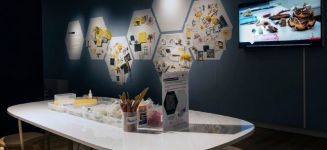 "Janice Rieger, Jasmien Herssens, Megan Strickfaden, Marianella Chamorro-Koc, Bree Hadley (2019) Vis-ability Exhibition." "The United Nations Convention on the Rights of Persons with Disabilities (UNCRPD, 2016) foregrounds the importance of cultural participation to realise human rights for people with disabilities. The creative industries play a critical role in supporting and shaping these social attitudes towards inclusion. Through the theoretical foundation of Design for All (EIDD Stockholm Declaration, 2004) new engagement processes involving a transdisciplinary team from Australia and around the world converged at QUT to co-design more equitable and collaborative forms of knowledge and practice around inclusion. International universities, the EU Commission and the European Institute for Design & Disability collaborated and presented Design for All for the first time in Australia, positioning QUT leadership in this field and as the first non-European member of EIDD-DfA. Co-design methods were employed through, Vis-ability workshops, Making Visible workshops, tactile artefacts and audio description work in the VisAbility Exhibition. Innovative practice was through the Inclusive Film Screening and Wondrous Googles technologies. An innovative model of engagement was created through the DfA Week program and events across sectors. Knowledge was disseminated through academic articles."
 -
"Bree Hadley (2014) Disability, Public Space Performance, and Spectatorship: Unconscious Performers. London: Palgrave Macmillan." "Why would disabled people want to re-engage, re-enact and re-envisage the everyday encounters in public spaces and places that cast them as ugly, strange, stare-worthy? In Disability, Public Space Performance and Spectatorship: Unconscious Performers, Bree Hadley examines the performance practices of disabled artists in the US, UK, Europe and Australasia who do exactly this. Operating in a live or performance art paradigm, artists like James Cunningham (Australia), Noemi Lakmaier (UK/Austria), Alison Jones (UK), Aaron Williamson (UK), Katherine Araniello (UK), Bill Shannon (US), Back to Back Theatre (Australia), Rita Marcalo (UK), Liz Crow (UK) and Mat Fraser (UK) all use installation and public space performance practices to re-stage their disabled identities in risky, guerilla-style works that remind passersby of their own complicity in the daily social drama of disability. In doing so, they draw spectators' attention to their own role in constructing Western concepts of disability. This book investigates the way each of us can become unconscious performers in a daily social drama that positions disability people as figures of tragedy, stigma or pity, and the aesthetics, politics and ethics of performance practices that intervene very directly in this drama. It constructs a framework for understanding the way spectators are positioned in these practices, and how they contribute to public sphere debates about disability today."
-
"Australia Council for the Arts (2014) A Million Dollar Commitment to Artists with Disability. Australia Council for the Arts. 28 October 2014" Reads, in part "Australia Council Chief Executive Officer Tony Grybowski made the announcement today at the Arts Activated Conference in Chatswood, Sydney. Mr Grybowski said the decision to extend the dedicated arts and disability funding was made after a successful pilot was run earlier this year."
-
"Rachel Carling-Jenkins, Mark Serry (2014) Disability and social movements: learning from Australian experiences. Burlington : Ashgate Publishing Company" Reads, in part "This book provides the reader with a ground-breaking understanding of disability and social movements. By describing how disability is philosophically, historically, and theoretically positioned, Carling-Jenkins is able to then examine disability relationally through an evaluation of the contributions of groups engaged in similar human rights struggles. The book locates disability rights as a new social movement and provides an explanation for why disability has been divided rather than united in Australia.."
-
"Margaret Cooper (1999) The Australian Disability Rights Movement Lives. Disability & Society, 14(2), 217–226. https://doi.org/10.1080/09687599926280" Reads, in part "The Australian Disability Rights Movement is surviving despite funding threats to advocacy programmes. The integral relationship of advocacy funding to the Australian Disability Rights Movement is outlined. A brief history of the Australian Disability Rights' Movement is given, and whether this is a new social movement, or not, is discussed. The role of Women With Disabilities Australia is outlined."
-
"Kath Duncan, Gerard Goggin, Christopher Newell (2005) ‘Don’t Talk about Me... Like I’m Not Here': Disability in Australian National Cinema. Metro Magazine: Media & Education Magazine.146/147, pp. 152-159. https://search.informit.org/doi/10.3316/informit.043842788583710" Reads, in part "Disability is a central cultural identity and category in Australia, but this is not often realized. We seek to make a contribution to conversations and critical analyses of disability in Australian culture through an exploration of a privileged national cultural form, namely film. The trope of disability looms large in late twentieth century Australian cinema, and yet cultural comment on these ‘disabled’ scripts and performances has not yet considered a disabilities studies perspective. Accordingly, in this article we combine our different perspectives on disability and film into an account of how specific films use disability. In particular, we analyse key films from the 1990s as examples of powerful displays of bodies and personhood." References a range of films, including Proof (Jocelyn Moorhouse, 1991), Romper Stomper (Geoffrey Wright, 1992), Bad Boy Bubby (Rolf de Heer, 1993), Muriel's Wedding (PJ Hogan, 1994), Shine (Scott Hicks, 1996), Moulin Rouge! (Baz Luhrmann, 2001), My One Legged Dream Lover (writer Kath Duncan with dir. Penny Fowler-Smith, Christine Oslen 1998), Pins and Needles (writer Genni Batterham with dir. Barbara Chobocky, 1979), Riding the Gale (Genni Batterham with dir, Hugh Piper, 1987), Dance Me to My Song (writer Heather Rose with dir. Rolf De Heer, 1998), Heather Rose Goes to Cannes (Chris Corin, 1999), Myself When Fourteen, (Ivor, Arthur and Corinne Cantrill 1989),Film of Circles, Squares, Triangles, Lines and Dots (Arthur and Corinne Cantrill 1981), Rainbow Diary (Arthur and Corinne Cantrill 1984), House Gang (Mandy smith, 1997), Quentin Crashes Big Brother (Quentin Kenihan, 2002), Quentin, World at My Wheels (Quentin Kenihan, 2000), Ability Trek (Jacob Baldwin 1998)
-
"Anthony White (2021). Anthony Mannix's mixed realities. Art Monthly Australasia, (327), pp. 80-87." The Australian artist Anthony Mannix has produced a large body of work, mostly in the form of artist books. His art has featured in dozens of exhibitions; has been the subject of catalogues, journal articles and a PhD thesis; and has entered national and international collections. One of his most recent works, the dazzling, vibrantly decorated 2020 cover of I Am Cut Viciously, features a harrowing self-portrait of the artist. The work depicts Mannix with injuries he sustained while in 'a psychotic state' during a period in 1986 when he was homeless and living in the Royal National Park, New South Wales. As an artist with experience of complex mental health issues, or what he prefers to describe as 'mixed realities', Mannix has often been categorised as an 'outsider' artist.
-
"Katie Ellis, Gerard Goggin (2015). Disability media participation: Opportunities, obstacles and politics. Media International Australia, 154 (1), pp. 78-88." This article discusses participatory media from a critical disability perspective. It discusses the relative absence of explicit discussion and research on disability in the literatures on community, citizen and alternative media. By contrast, disability has emerged as an important element of participatory cultures and digital technologies. To explore disability participatory cultures, the article offers analysis of case studies, including disability blogs, ABC's Ramp Up website and crowd-funding platforms (such as Kickstarter).
-
"Katie Ellis (2008) Disabling Diversity: The Social Construction of Disability in 1990s Australian National Cinema" Reads, in part "This book critically examines numerous 1990s Australian films with reference to socio-political influences to approach disability as a problem with society rather than as one within a damaged body."
-
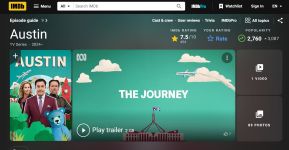 "Austin - IMBD" Austin' Internet Movie Database (IMDB) entry - reads, in part "When author Julian's offensive post goes viral, his career seems over until his neuro divergent son Austin suddenly arrives. Embracing Austin may be Julian's path to redemption if he and wife Ingrid can move past his mistakes."
 -
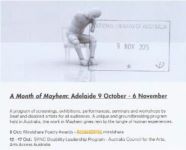 "A Month Of Mayhem" RealTime article on A Month of Mayhem, "A program of screenings, exhibitions, performances, seminars, and workshops by Deaf and colourblind artists for all audiences," presented by Access2Arts, in partnership with Adelaide Film Festival, Australian Network for Art and Technology (ANAT), Arts Access Australia, Unlimited UK, Tutti Arts, Sit Down Shut Up and Watch Film Festival
 -
"The Arts and Disability" This booklet/brochure provides images, descriptions of the work, and contact details and contact organisations for key organisations in South Australia including: Access2Arts; Company AT; Mindshare; No Strings Attached Theatre of Disability; Restless Dance Theatre; Sit Down, Shut Up and Watch Film and New Media Festival; Sisters of Invention, Tutti Arts; The Jame, The Mix, The Gig.
-
"The Arts and Disability" This booklet/brochure provides images, descriptions of the work, and contact details and contact organisations for key organisations in South Australia including: Access2Arts; Bearded Dragon Gallery; Beats Crew; Community Bridging Services (CBS) Inc.; Company AT; Lolly Jar Circus; No Strings Attached Theatre of Disability; Restless Dance Theatre; Sit Down, Shut Up and Watch Film and New Media Festival; Sisters of Invention, Tutti Arts.
-
"The Arts and Disability" This booklet/brochure provides images, descriptions of the work, and contact details and contact organisations for key organisations in South Australia including: Access2Arts; Bearded Dragon Gallery; Broughton Art Society; Community Bridging Services Inc. (CBS); Company AT; Learning Creative Skills; Lolly Jar Circus; mindshare; No Strings; Restless Dance Theatre; Sit Down, Shut Up and Watch Film and New Media Festival
-
"Australian Theatre of The Deaf - Castles in the Air - Poster" Poster for Australian Theatre of The Deaf show Castles in the Air - reads, in part "Castles in the Air' is a series of short stories, comedy skits, images and songs."