Items
Search full-text
ACT DisAbility Arts Festival
-
“Disabled People’s International (Australia) (DPIA) formed in 1983” The organisation Disabled People’s International (Australia) (DPIA) was formed in 1983. Thirteen disabled Australians who attended Disabled People’s International (DPI) first world assembly in Singapore in 1981, the International Year of the Disabled Person, returned home to set up the Australian branch two years later. The Women with Disabilities Australia online history reports that DPIA “from the outset, was dominated by disabled men. Only 3 of the 11 members of its governance structure were women, and there was no mention of women or gender in DPIA goals and objectives.” This led to the establishment of a women’s network within DPIA, known as the National Women’s Network (DPIA).
-
“WHO International Classification of Impairment, Disabilities and Handicaps (1976)” International classification of impairments, disabilities, and handicaps: a manual of classification relating to the consequences of disease, published in accordance with resolution WHA29.35 of the Twenty-ninth World Health Assembly, May 1976
-
"National Inquiry into the Human Rights of People with Mental Illness Report launched in 1993" The National Inquiry into the Human Rights of People with Mental Illness Report was launched 20th October, 1993. This led to deinstitutionalisation.
-
"Royal Commission on Human Relationships" In 1977, the Royal Commission on Human Relationships noted the legal and human rights of handicapped children and adults.
-
“The documentary series ‘You Can't Ask That’ premieres in 2016” The ABC started a documentary series in 2016 called ‘You Can't Ask That,’ which asks "outrageous, uncomfortable and shocking questions to uncover the truth behind some of the most marginalised and misunderstood Australians." The series has featured episodes focused on people with short stature, Downs syndrome, schizophrenia, and autism, Deaf people, blind people, and wheelchair users.
-
“The Australian Government announced a National Autism Strategy in 2022” In 2022, a National Autism Strategy was announced by the Australian Government. The Department of Social Services note that the strategy developed out of a “comprehensive co-design process.” Its objectives relate to social inclusion; economic inclusion; diagnosis, services and supports; and health and mental health. The strategy puts forth a “vision for a safe and inclusive society for all Autistic people. One where we support and empower Autistic people to thrive, in all aspects of life.”
-
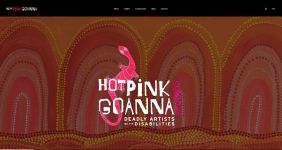 "Hot Pink Goanna Studios - Deadly With Disabilities, Website captured 2024" Hot Pink Goanna Studios: Deadly With Disabilities, website captured 2024 - with About, Gallery, Commisions, and Prints sections - reads, in part "Hot Pink Goanna was developed by Uncle Paul Constable Calcott a proud Wiradjuri man and artist living with a disability on Gubbi Gubbi Country. Hot Pink Goanna showcases the works of Uncle Paul and other First Nations artists living with a disability."
 -
 "It's Fine, I'm Fine - IMDB" It's Fine, I'm Fine' Internet Movie Database (IMDB) entry - reads, in part "A suburban psychologist and her patients explore love, loss, obsession, anxiety, and an uncertain future, while grappling with how to persist and find magic in the world."
 -
 "Australia Council - Annual Report 2015-16" Australia Council - Annual Report 2015-16 - discusses year in review, strategy, funding, and key facts, including "18% identified as Aboriginal or Torres Strait Islander 6% identified as experiencing disability", and running Sync Leadership Program for artists with disability
 -
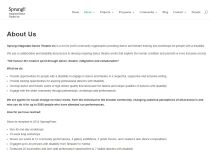 "Sprung!! Integrated Dance Theatre - About Us, captured 2019" Webpage reads, in part "Sprung Integrated Dance Theatre Inc is a not for profit community organisation providing dance and theatre training and workshops for people with a disability. We use a collaborative and disability-led process to develop inspiring dance theatre works that explore the human condition and promote a more inclusive society."
 -
“Angharad Butler-Rees, Bree Hadley(2023) Exploring the Role of the Disabled Body as a Vehicle and Art Form within Anti-Austerity Protest. In Zebracki, Martin & McNeill, Z. Zane (Eds.) Politics as Public Art: The Aesthetics of Political Organizing and Social Movements. Routledge, Abingdon, Oxon, pp. 116-132.” "The impact of neoliberal austerity policy is being felt by people with disabilities across the globe. This chapter attends to disability protest in response to austerity across two contexts—the United Kingdom and Australia. It examines how people with disabilities are choreographing their protest, the strategies they are using, and the outcomes they are seeking."
-
"Boram Lee, Ruth Rentschler, and Shin-Eui Park (2022) Connect2Abilities: Staging Virtual Intercultural Collaboration during COVID-19 in Amanda Cachia ed. Curating Access: Disability Art Activism and Creative Accommodation. London: Routledge, 45-58" Reads, in part "As a pilot project, Restless Dance Theatre in Adelaide, Australia and SNU MUSIC in Seoul, Korea collaborated to create a digital performing arts piece entitled Dialogue for Six Strings."
-
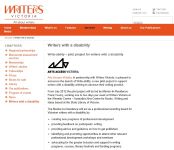 "Writeability website, captured 2013" Webpage reads, in part "Arts Access Victoria, in partnership with Writers Victoria, is pleased to announce the launch of Write-ability, a new pilot project to support writers with a disability wishing to advance their writing practice"
 -
"Bree Hadley, Janice Rieger, Eddie Paterson (2024) Reinhabiting, Reimagining, and Recreating Ableist Spaces: Embodied Criticality In Art. In Ellis, Katie, Kent, Mike, & Cousins, Kim (Eds.) The Routledge International Handbook of Critical Disability Studies. Routledge, pp. 48-58." "In this chapter we bring critical disability studies into dialogue with disability artworks that resituate critiques of inaccessibility and exclusion as complicated encounters with space, lived experience and embodiment. Drawing on Irit Rogoff’s (2003, 2006) notions of embodied criticality, and the pioneering work of performance studies scholar Petra Kuppers (2003, 2014), we argue for an embodied, embedded and creative form of critical disability studies – enacted through art. We examine two recent performance and installation works in hotels: Welcome Inn (2019) by British artist Christopher Samuel, and Intimate Space (2017) by Australian performance company Restless Dance Theatre."
-
”Hadley, Bree, Batch, Morgan, & Whelan, Michael (2021) The entitled ally: Authorship, consultation, and the 'right' to stage autistic people's stories. Disability and Society, 36(9), pp. 1489-1509.” "Theatre has a long tradition of presenting disabled characters as plot devices to tell someone else’s story. A recent production, All in a Row, resulted in heated debate around this issue. This article examines not the play itself, but the conflict between those who objected to the play’s representation of autism, and its creators, who defended their choices by citing their disability-adjacent identities and processes of consultation. For critics, the fact that the creators did not take the community’s concerns seriously was a source of trauma. This article uses this conflict to draw out lessons about how we might better negotiate the right to tell disability stories and strengthen frameworks to support that negotiation. We propose a decision tree diagram to assist artists in understanding the meaning, role, and most importantly the potential consequences of consultation – up to and including a community saying ‘no’ to an artist’s planned representation."
-
"Anthea Skinner, Grace Thompson, Katrina Skewes McFerran (2022). Professional Pathways for Musicians with Disability in Victoria, Australia. Musicology Australia, 44(1), 21–42. https://doi.org/10.1080/08145857.2022.2088930" Reads, in part "The work of disabled musicians has become the focus on of an increasingly large body of academic work; however, existing literature rarely provides details about the educational experiences of these musicians, or how disability impacted these experiences. This study interviewed eleven performing musicians living with disability in Australia to elucidate the barriers and enablers that they faced in their music educations and careers."
- FUSE Festival (Music Festival)
-
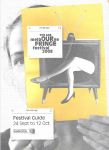 "Rawcus - The Heart of Another is A Dark Forrest - Melbourne Fringe Festival Program Entry" Melbourne Fringe Festival program entry for Rawcus work 'The Heart of Another is a Dark Forrest'
 - Kasimir Burgess
- Q Productions
- Michelle Stevens
- Mike McEvoy
- Joshua Lynzaat
- Jacob Baldwin
- Imogen Newhouse