Items
Search full-text
ACT DisAbility Arts Festival
-
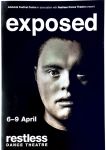 "Restless Dance - Exposed Program" Restless Dance Theatre Program 'Exposed' - reads, in part “Most of us are free to make choices about what parts of our life we keep private and what is public. But for some, this choice Is often not so straight forward We need to rely on others, sometimes strangers to help us with moments in life that you might take for granted And if we are lucky, we win have people around us who we trust. Trust is built slowly over time, relinquishing ourselves to the hands of others. With our backs to !he wall creating edges and boundaries, we build a community around us to keep our fragility protected is when we feel safe enough to let our guards down, we can show the little pieces of ourselves that are our most personal To be brave, yet vulnerable, is when we feel safe and not exposed.”
 - A-Z Disability Programme
- Intellectual Disability Services Council
- Disability Discrimination Law Advocacy
- The Disability Trust
- Nick Hughes
- Michael Noble
- WeiZen Ho
- Paul Calcott
- Uncle Paul Constable Calcott
- Paul Constable Calcott
- Melinda Smith
- Clark Crystal
- Breda Carty
-
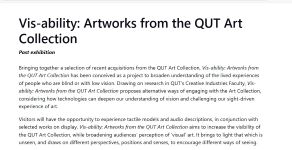 "VisAbility Exhibition" Reads, in part "Bringing together a selection of recent acquisitions from the QUT Art Collection, Vis-ability: Artworks from the QUT Art Collection has been conceived as a project to broaden understanding of the lived experiences of people who are blind or with low vision."
 -
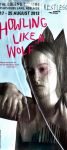 “Restless Dance – Howling Like A Wolf Promotional Card" Restless Dance 'Howling Like A Wolf' Promotional Card - reads, in part, “How do I know what you are thinking? Why are some of your facial expressions harder to read than others? How can I tell when you are lying to me? Why do I bite people I feel affection towards? Restless Dance Theatre's new work Howling Like A Wolf examines the science of non-verbal communication between humans.”
 -
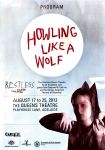 “Restless Dance – Howling Like A Wolf Program" Restless Dance Theatre 'Howling Like a Wolf' Program - reads, in part "In Howling Like A Wolf humans are both the observer and the observed. The work explores facial expressions, our body language and the way our brains process complex and subtle information. The performers have shared their experiences of connection and isolation, the joy and confusion of human interactions, and how we all prepare ourselves for "this terribly significant business of 'other people'."
 - Christopher Newell
- Amanda Cachia
-
"Janice Rieger and Megan Strickfaden(2019) “Dis/ordered assemblages of disability in museums.” In The Routledge Handbook of Disability Art, Culture, and Media, edited by Bree Hadley and Donna McDonald, 48–61. London & New York: Routledge." "Museums are spaces of power and care. They are institutions that present assemblages (Deleuze & Guattari 2002), which are reconstructions and representations of history and societal values, and thus are partial realities that curate human existence. These assemblages cannot ever represent the totality of human existence because it is never possible to do so, and yet these assemblages are embedded with power because choices are made about what ought or ought not be represented within museums (Ott 2013; Bennet 2017). The nature of partial realities is that, at their centre, these are still representations that tell stories of what one would imagine to be the most significant events related to a place (nation, city), with a particular focus on a societal event or issue (war, art, sports, nature, human rights, etc.) and peoples (e.g. immigrants, migrants, First Nations or Indigenous peoples, etc.). Persons attending museums rely on the expertise of historians, curators, archivists, conservators, and exhibition designers to present materials within the museum that focus upon and represent societal values. Most museum visitors are not aware of the power that museums hold, although more and more museum visitors push against narratives which they do not feel to be adequate representations of the places, events, issues, and peoples of society (Hooper-Greenhill 1992, 2000; Anderson 2004; Janes 2009, 2010). Where there is power, there is also care. Historians, curators, archivists, conservators, and exhibition designers take great care in how they assemble materials within museums."
-
"Katie Ellis (2008) Disabling Diversity: The Social Construction of Disability in 1990s Australian National Cinema" Reads, in part "This book critically examines numerous 1990s Australian films with reference to socio-political influences to approach disability as a problem with society rather than as one within a damaged body."
-
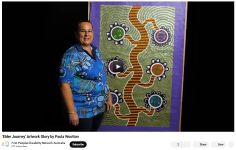 "NuunaRon Art Group - ‘Elder Journey’ Artwork Story by Paula Wootton" First Peoples Disability Network NuunaRon Art Group - ‘Elder Journey’ Artwork Story by Paula Wootton - reads, in part "The 'Culture is Inclusion' art exhibition showcases art work by the NuunaRon First Nations art group, with a lived experience of disability, telling their stories of resilience and strength through connecting to their culture"
 -
 "NuunaRon Queensland" Webpage for First Peoples Disability Network NuunaRon Art Group, with video introducing where Paul Constable Calcott introducing the group, reads in part "NuunaRon is a group for Aboriginal and Torres Strait artists and emerging artists living with disability."
 -
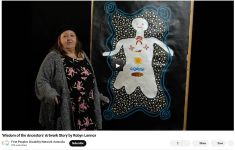 "NuunaRon Art Group - ‘Wisdom of the Ancestors’ Artwork Story by Robyn Lennox" First Peoples Disability Network NuunaRon Art Group - ‘Wisdom of the Ancestors’ Artwork Story by Robyn Lennox - reads, in part "The 'Culture is Inclusion' art exhibition showcases art work by the NuunaRon First Nations art group, with a lived experience of disability, telling their stories of resilience and strength through connecting to their culture"
 -
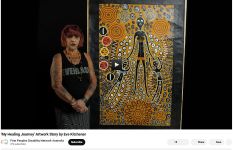 "NuunaRon Art Group - ‘My Healing Journey’ Artwork Story by Eve Kitchener" First Peoples Disability Network NuunaRon Art Group - ‘My Healing Journey’ Artwork Story by Eve Kitchener - reads, in part "The 'Culture is Inclusion' art exhibition showcases art work by the NuunaRon First Nations art group, with a lived experience of disability, telling their stories of resilience and strength through connecting to their culture"