
Items
Search full-text
Accessible Arts - Arts and Disability Expo
- Imagination Theatre
- Different Degrees Theatre
- Royal Rehab Choir
- Alison Bills
- Charlie McMahon
- Grace Burns
- John Kroon
- Kat Hastenteufe
- Roy Marchant
- Stefan Kater
- Susannah Thorne
- Vicki Southgate
- Katie Ellis
-
“Advocates fight for accessible public transport” In 1994, Maurice Corcoran (a wheelchair user) lodged a complaint about the South Australian government ordering 50 new buses that were not accessible. The Australian Human Rights Commission successfully negotiated for all new buses to be fitted with ramps. Then, in 1999, a protest about the lack of public transport options for people with disability saw Citizens for Accessible Public Transport block traffic in Sydney’s city centre.
-
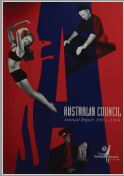 "Australia Council - Annual Report 1993-94" Australia Council Annual Report 1993-94 - discusses objectives, organisation chart, year in review, support for people with disabilities in Art and Working Life, artform development, main activities of Council and its Boards, and includes financial statements and lists of grants made including grants for programs, development of performance, visual art/crafts, media and multi arts, writers in community residence and local documentation projects as well as “Arts and Disability” research and collaboration in performance of “Love Dances (and other stories)”
-
“Commonwealth Disability Strategy launched in December 1994” The Commonwealth Disability Strategy was launched in December 1994. The strategy was meant to ensure compliance by Commonwealth Departments with the Disability Discrimination Act (DDA) (passed in 1992). The Museum of Australian Democracy at Old Parliament House reports that “Results have been uneven, especially in employment, but the Act has made some breakthroughs on education and disability access in new buildings.”
-
“Genni Batterham stages a protest at the opening of Bondi Junction railway station 1979, makes film in 1980” When Bondi Junction railway station opened in 1979, Genni Batterham staged a protest about the lack of accessible transportation options for individuals with disabilities. After receiving a multiple sclerosis diagnosis in 1978, Genni became severely disabled very quickly. She did everything in her power to stop the disease's progression and was furious at being "consigned to the world of the disabled." The 1979 Bondi Junction protest was an important moment in the history of the Disability Rights Movement in New South Wales. The Premier, Neville Wran, later said that the experience led him to developing the Disability Taxi Service, the first public transport system designed for people with disability to be launched in Australia. Batterham then made the film ‘Pins and Needles’ (1980) with her husband Kim. Under the direction of Barbara Chobocky and with funding from the Australian Film Commission's Women's Film Fund, the film was screened in five different countries, took home first place at the 1980 Canadian Film Festival, and took home second place at the 1980 New York Film Festival. Genni and Kim would then collaborate on three further films about the phases of her life: Where's the Give and Take? (1981), Artreach (1982), and Riding the Gale (1987).
-
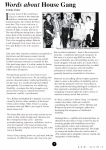 "Accessible Arts - ACE Arts Creativity Expression Accessible Arts - ACE Arts Creativity Expression - Antony Jones - Review: Words About House Gang - Iss15, Pg7" Accessible Arts - ACE Arts Creativity Expression - Antony Jones - Review: Words About House Gang- Iss15, Pg7 - reads, in part, "In every sense of the word House Gang is a sitcom in the American traditon. melodrama and simplecharacterisation, but without the blowwave hair. This is not a criticism, it could simply be no other way for 30 minutes of light, comedy television. The only difference being that in House Gang, three of the characters are played by people with intellectual disabilities: Trev is the struggling athlete; Belinda is self-obsessed, love-struck and out of love; and Robert is the soft, sensitive type."
-
 "Accessible Arts - Create Ability: A Conference on Creativity and Disability 1989 - Report" Accessible Arts - Create Ability: A Conference on Creativity and Disability 1989 - Report - Welcome Address- Michael Champion, Key Note Address: Vivienne Binns, Opening Up the Arts- Jeffrey St. John, The Philosophy of Arts Accessibility- Gay Hawkins, Community Attitudes to Integration (Summary) Barbara McEvoy, Tannia Vassallo, Models for Changing Community Attitudes- Jan Spencer, Locating Community Arts Activities and Setting Up an Arts Activity Group in a Community Centre- Judy Finlason, Resources for Community Arts Activities- Maria Guppy, Training the Community Artist to work with People with Disabilities- Annie Harvey, Gizmos, Gadgets and Ramps (Summary)- Bill Watson, Transport- a Moving Issue- Tim Sussman
-
“Arts Access Australia CEO encourages other non-disabled CEOs of disability organisations to step down” In 2012, Kate Larsen stepped down from role as CEO of Arts Access Australia. In a Ramp Up article, she explained “Now, I love my job. I'm good at it. I think that I've been useful here. But on the same day I accepted the position last February I also did something else. I gave notice of my resignation, and undertook to hand over the organisation by the end of 2012. The reason? Because I believe that Arts Access Australia should be led by a person with disability.” Upon her resignation, she encouraged other non-disabled CEOs of disability organisations to step aside to make space for disabled people to take up these leadership roles.
-
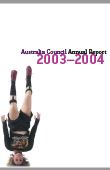 "Australia Council - Annual Report 2003-04" Australia Council Annual Report 2003-2004 - discusses letter from chair of council, letter from CEO, corporate overview, year in review, financial statements, analysis of funding analysis and grants list, including funding for conduct national research to identify ways of addressing barriers to access for audiences with disabilities and their carers, funding for the publication, “Don’t Give Up Your Day Job”, included survey questions specifically related to artists with disabilities, arts marketing and audience development and triennial grants to disability arts organisations in NSW, South Australia and Victoria as well as funding to conduct national research to identify ways of addressing barriers to access for audiences with disabilities and their carers and three year funding for Accessible Arts to continue Audience Development.
-
 "Australia Council - Awards - National Arts and Disability Awards 2019-2021" The website reads “The Australia Council National Arts and Disability Awards 2019-21 celebrate the work and achievements of both established and young artists, and the significant contribution of artists with disability to the vibrancy of Australian arts”
- Madeleine Little
-
"Katie Ellis, Tama Leaver, Mike Kent, M, eds. (2023). Gaming Disability: Disability Perspectives on Contemporary Video Games. London and New York: Routledge." This book explores the opportunities and challenges people with disabilities experience in the context of digital games from the perspective of three related areas: representation, access and inclusion, and community. Drawing on key concerns in disability media studies, the book brings together scholars from disability studies and game studies, alongside game developers, educators, and disability rights activists, to reflect upon the increasing visibility of disabled characters in digital games.
-
 "Australia Council - Annual Report 1999-2000" Australia Council Annual Report 1999-2000 - discusses letter from chair of council, corporate overview, year in review, financial statements, analysis of funding and grants for projects, programs, presentation and promotions, triennial grants to disability arts organisations in NSW, South Australia and Victoria and funding to Accessible Arts for audience development, as well as the New Media Arts Fund for Back to Back performance of “Soft”