
Items
Search full-text
Accessible Arts - Arts and Disability Expo
- Margaret Bridgman
- Gerard O’Dwyer
- Gail Louise
- Emily Dash
- Duncan Meerding
- Debbie Chilton
- Deb Chilton
- Dean Elliot
- David Finnigan
- Daniel Kojta
- Claire Havey
- Claire Harvey
- Antony Jones
-
“Sit Down Shutup and Watch, a screen festival for people with learning disabilities, is launched in 2014” In 2014, Tutti Arts launched Sit Down Shutup and Watch (SDSW). SDSW is a collective led by people with learning disabilities; They present a biennial international screen festival which features the work of disabled creators. The committee also hosts workshops and online resources.
- Beats Crew
- Igneous
-
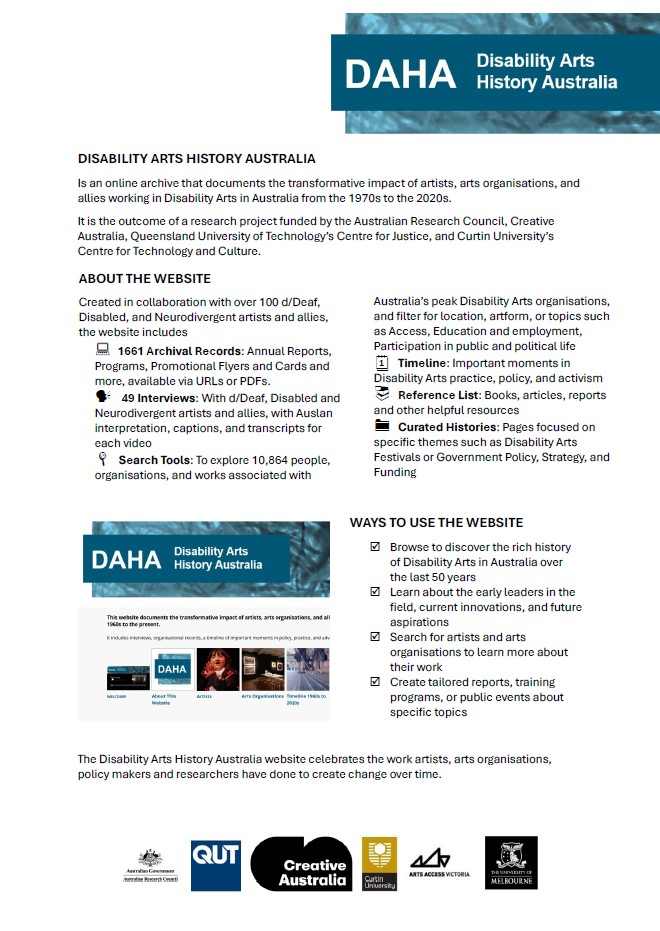 Disability Arts History Australia Launch 2025 - 3 Page Information Sheet
 -
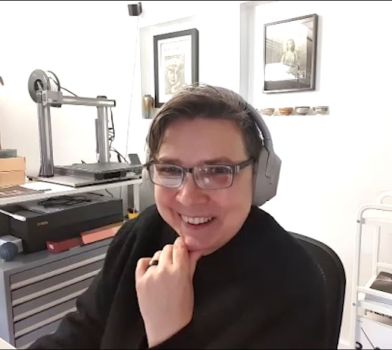 "Interview with Alison Bennett" Dr Alison Bennett is a senior lecturer in photography at RMIT School of Art specialising in expanded photography, webXR, queer and feminist creative practices. Interview Summary Alison Bennett, an artist and academic, spoke about her work in expanded photography, their experiences with autism, and the intersection of disability discourse with queer activism in their life and work. Their current project, vegetal/digital, arose from their experiences during the pandemic and connects audiences with plant sentience through interactive digital art. Alison also discussed the political nature of their work, aiming to shift ontological frameworks and exploring new modes of engagement through art. They reflected on the significant cultural changes regarding neurodiversity in the last few decades, highlighting the growing self-advocacy among autistic artists and their increasing impact in the arts.
 - Penrith Performing and Visual Arts
- Arts Mid North Coast
- Illawarra Performing Arts Centre
- Rachel Edward
- Wendy Miners
- Vivienne Rosen
-
Theatre performance ‘Take Up Thy Bed & Walk’ integrates ‘aesthetic access’” The 2012 performance ‘Take Up Thy Bed & Walk’ designed by Gaelle Mellis and produced by Vitalstatistix proved that accessibility measures could be aesthetic. As Creative Australia describes it “is credited as Australia’s first performance work incorporating ‘aesthetic access’. It embedded the performer’s physicality and communication styles – and those of potential audiences – at the centre of the creative process. The work integrated audio description, captioning, sign language and interactivity uniquely into the core of the work.” Gaelle Mellis has said of the performance that “aesthetic access can be used in ways that add layer, texture, meaning and richness to a work. Art, at its simplest, is primarily about communication. Aesthetic access, at its simplest, is a form of communication that communicates to everyone.”