
Items
Search full-text
Accessible Arts - Arts and Disability Expo
-
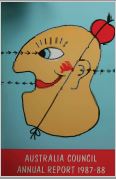 "Australia Council - Annual Report 1987-88" Australia Council Annual Report 1987-88- discusses functions and objectives, structures, process and membership of Council, Council Committees and members, board members, assessment panels, staff lists, organisation chart, main activities of Council and its eight Boards, and how council endorsed a code of practice for arts organisations working with people with disabilities, equal employment opportunities and includes financial statements and lists of grants made including grants for programs, projects, performances and promotion and reading for Royal Blind Society and Brail and Talking Book Library
-
 "Accessible Arts - Annual Report 2016"
-
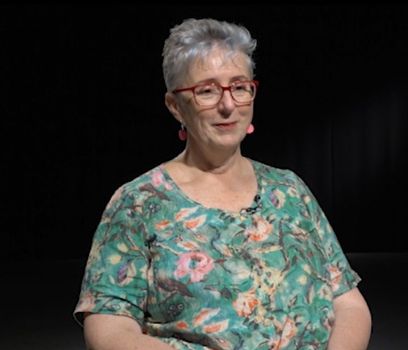 "Interview with Jenny Simpson" Jenny is CEO and Artistic Director of AWESOME Arts Australia while also a Musical Director of the Mighty Camelot Community Choir and a Sessional Academic at the Western Australian Academy of Performing Arts at Edith Cowan University. Interview Summary Jenny Simpson is the CEO and Artistic Director of AWESOME Arts Australia. She grew up in a musical family and always had an interest in the arts. After working in the corporate world, she decided to pursue a role in the arts to make a difference in the community. She has since focused on engaging young people with disabilities in the arts, and has worked on projects and festivals that promote inclusivity and accessibility. She believes that the perception of disability arts is changing and hopes to see more individuals with disabilities involved in arts management.
-
"Bree Hadley (2022) Disability and the Arts, Creative, and Cultural Industries in Australia. Australian Academy of Humanities" "This week saw the release of Ensuring Occupations are Responsive to People with Disabilities, a landmark report by the Australian Council of Learned Academies (ACOLA) commissioned by the Australian Government Department of Social Services. As part of the Academy of Humanities’ support for the project, Professor Bree Hadley provided a study of disability in the arts, creative, and cultural industries for the project, and Professor Gerard Goggin was a member of the Expert Reference Group. In this week’s Five-Minute Friday Read, they explain why disability training needs fundamental reform now."
-
“ABC appoints Stella Young as editor of Ramp Up” In 2010, ABC announced the appointment of Stella Young as editor of its first (and short-lived) dedicated disability platform, ABC Ramp Up. Shawn Burns’s 2014 article in The Conversation laments the closure of the initiative and the loss of a vital platform for better disability representation in Australian media. The URL link to the Ramp Up page now opens with the following statement: “This website is no longer being updated but remains online as an archive of three and a half years of discussions and conversations regarding disability in Australia.”
-
 "Accessible Arts - Annual Report - Yearly Report - 1992"
-
 "Accessible Arts - ACE Arts Creativity Expression -1997 Win - Iss1" Accessible Arts - ACE Arts Creativity Expression News Publication issue 1 Winter 1997 - information/reviews of Creative Writing, Music, Dance, Theatre and Performance programs,opportunities, resources, resources, Accessible Arts AGM
-
 "Accessible Arts - ACE Arts Creativity Expression -2002 Mar - Iss7" Accessible Arts - ACE Arts Creativity Expression News Publication Issue 7 March 2001 - about Accessible Arts (including membership), information/reviews of Creative Writing, Music, Dance, Theatre and Performance programs,opportunities, resources
-
"A number of theatre companies are established in the 2000s" A number of theatre companies were established in the 2000s, particularly towards the end of the decade. Some key companies in disability theatre or inclusive arts practice to emerge in the 2000s are: Second Echo Ensemble (2005, integrated, often producing work in partnership with the Tasmanian Theatre Company), Ever After Theatre Company (2006, performers with disability), Rollercoaster Theatre Company (2007, performers with disability), DirtyFeet (2008, inclusive), and Blue Roo Theatre (2009, performers with disability).
-
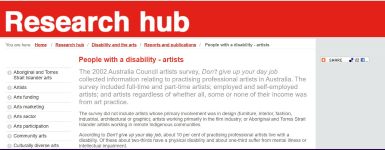 “Australia Council - People with a disability - artists 2003” Sourced from 'Australia Council- Don’t give up your day job: An Economic Study of Professional Artists in Australia' (Throsby and Hollister 2003) based on 2002 Survey - The website reads “The 2002 Australia Council artists survey, Don't give up your day job collected information relating to practising professional artists in Australia…..According to Don't give up your day job, about 10 per cent of practising professional artists live with a disability.”
-
"Gerard Goggin, Christopher Newell (2003). Digital disability: The social construction of disability in new media. Rowman and Littlefield." Media representation of and for the disabled has been recharged in recent years with the expansion of new media worldwide. Interactive digital communications--such as the Interact, new varieties of voice and text telephones, and digital broadcasting--have created a need for a more innovative understanding of new media and disability issues. This engaging analysis offers a global perspective on how people with disabilities are represented as users, consumers, viewers, or listeners of new media, by policymakers, corporations, programmers, and the disabled themselves.
-
“The Australian Government launches a new national cultural policy, Revive: a place for every story, a story for every place” The Australian Government launched a new national cultural policy, Revive: a place for every story, a story for every place. Revive comprises 5 pillars: First Nations First, A Place for Every Story, Centrality of the Artist, Strong Cultural Infrastructure, and Engaging the Audience. The policy allocates $5 million for an Arts and Disability Associated Plan, under Australia’s Disability Strategy 2021–31 “to enable people with disability to access and participate fully in the cultural and creative life of Australia.” This replaces the National Arts and Disability Strategy.
-
"The Australia Council establishes the Community Arts Committee in 1973 and the Community Arts Board in 1978" The Australia Council established the Community Arts Committee in 1973 and the Community Arts Board in 1978. The purpose of the latter was to encourage wider participation in the arts, especially for groups with little social capital. The Board was “the first funding body to identify the community arts phenomenon and respond with definition and policy." This occurred under the directorship of Rosalie Bower, the first director of the Community Arts Board, who wrote in a paper entitled 'The Case for a Community Arts Centre': “The activities within a centre should be accessible to children, aged people, the physically handicapped, ethnic groups and those whose time is severely restricted by work and family ties. The activities supplied by the centre should be conducted free from competitive elements which otherwise might discourage people from participation, and they must be inexpensive and accessible at almost any time. They must not pre-suppose education or income levels which would cut them off from any section of the community.'" (Australia Council 1979/1980 Annual Report, page 32)
-
“Deaf activist and artist Asphyxia creates a music course and accessible music app for D/deaf people” Asphyxia, a profoundly Deaf Australian activist, artist, author and composer created a music course (2020) for people who are D/deaf and Hard of Hearing to write their own music. In 2023, Asphyxia also created an app called Amplio to make music more accessible to D/deaf people.
- Bundanon Trust
- Sarah-Vyne Vassallo
-
“Kate Larsen (2012) Disability Leadership: If You're Gonna Talk the Talk .... ABC: Ramp Up, March 30. https://www.abc.net.au/ram pup/articles/2012/03/30/3467 452.htm.” Reads, in part "Now, I love my job. I'm good at it. I think that I've been useful here. But on the same day I accepted the position last February I also did something else. I gave notice of my resignation, and undertook to hand over the organisation by the end of 2012. The reason? Because I believe that Arts Access Australia should be led by a person with disability."
-
 "Accessible Arts - ACE Arts Creativity Expression - Helen Connors - Article: Why Do All The Bad Guys Have A Disability - Iss17, 1997, Pg11-13" Accessible Arts - ACE Arts Creativity Expression - Helen Connors - Article: Why Do All The Bad Guys Have A Disability - Iss17, 1997, Pg11-13
-
 "Australia Council - Creating Pathways: Insights on support for artists with disability - 2018" Reads, in part "This report brings together findings and insights from a range of research undertaken in 2017–18 to inform the Council’s approach to future support for artists with disability."
-
 "Incite Arts - Creating Accessible and Inclusive Events" Information about InCite Arts, the stArts with D performing arts ensemble, Unbroken Land platform for collective community storytelling, and Southern Ngaliya Intergenerational Warlpiri Women’s song and dance programs, and how InCite Arts creates accessible, inclusive, disability-led and community-engaged programs
- Matt Shilcock
-
 "Australia Council - Annual Report 2012-13" Australia Council Annual Report 2012-2013 – discusses year in review, report from the CEO, Strategic priorities, funding overview, statement of outcome, about the Australia Council including The Governing Council and the Board, Structure of the Australia Council; financial review and discussion of Access Champions group focused on key actions from the 2011–13 Disability Action Plan, including programs for increased participation by artists with disabilities and to develop technical capacity and digital literacy for both operational and artistic activities, funding for exhibition of artists with disability work, premises and Australia Council website accessibility, and participation at national and international arts and disability forums.
-
 "Accessible Arts - ACE Arts Creativity Expression - Microgroove Program - Iss22, Pg3-7" Accessible Arts - ACE Arts Creativity Expression - Microgroove Program - Iss22, Pg3-7 - reads, in part "Accessible Arts presents Microgrove as an opportunity for: • artists • performers • teachers • disability workers • gallery, museum and performance venue staff • students • art and cultural officers and • people interested in the arts"
- Company AT
- Company @