
Items
Search full-text
Accessible Arts - Arts and Disability Expo
-
"Soprano Marjorie Lawrence performs in her wheelchair in the 1940s" In the 1940s, Australian soprano Marjorie Lawrence contracted polio and performed in her wheelchair, both nationally and internationally, showing veterans life after disability was possible. Platforms were modied for her wheelchair so she could perform.
-
“Disabled actor and writer Heather Rose stars in ‘Dance Me to My Song’ (1998)” The 1998 film ‘Dance Me to My Song’ stars Heather Rose, who also co-wrote the film. It is about a woman with cerebral palsy, whose carer resents the job. The dramatic tension rises when the two women both take an interest in the same man. The Rolf de Heer-directed film is significant for casting a disabled actor at a time when authentic disability representation was rare, not to mention Rose’s contribution to the screenplay. ‘Dance Me to My Song’ was selected to feature in the Cannes International Film Festival in May 1998. The documentary ‘Heather Rose Goes to Cannes’ (1998, Christopher Corin) follows Rose’s journey from Adelaide to Cannes.
-
“Production company A2K Media founded in 2007, as a 'a Disabled-led production company, creating connections that entertain, educate, and empower'” A2K Media is “a Disabled-led production company, creating connections that entertain, educate, and empower.” In 2024, A2K launched their Disability Justice Lens course, which teaches screen professionals how to bring disabled people onto their productions and make their workplaces more accessible and empowering.
-
“The National Disability Strategy 2010–2020 is launched and, later, Australia’s Disability Strategy 2021-2031” The Australian Government launched the National Disability Strategy 2010–2020 in 2011. All levels of government were involved in a united national approach to improving life for people with disabilities, their families and carers. The National Disability Insurance Scheme (NDIS) was an outcome of this process. In 2021, the Disability Strategy Advisory Council was established and the most recent iteration of the strategy, Australia’s Disability Strategy 2021-2031, outlines a vision for a more inclusive and accessible Australian society where all people with disability can fulfil their potential as equal members of the community.
-
"Bree Hadley (2015) Participation, politics and provocations: People with disabilities as non-conciliatory audiences. Participations: journal of audience and reception studies, 12(1), pp. 154-174.” "Disability has always had a prominent place on the theatrical stage. Throughout the C19th, C20th and C21st to date, disabled characters have been used to signify corruption, innocence or suffering, and, of course, as salutary examples of how to overcome such suffering. In the past three decades, the work of disability scholars, activists and artists has also provided opportunities for people with disabilities to produce their own plays, performances or installations challenging these stereotypes. Interestingly, though both the body of literature on theatre makers with disabilities and the body of literature on theatre audiences has grown apace over the past decade, there is still surprisingly little written on people with disabilities as theatre audiences. In this article, I draw on observations made during five years of practical, empirical and theoretical research into disability theatre to discuss how people with disabilities work as a distinctive sub-group of spectators, with distinctive spectatorial processes, modalities and preferences, within contemporary theatre audiences. I begin with the factors that make attending theatre difficult for people with disabilities. I note that people with disabilities respond to the challenges they face in attempting to become active audiences of contemporary theatre in three common ways. I then unpack what these spectatorial modalities teach us about people with disabilities as audiences, other marginalised groups as audiences, as well as about audiences, audiencing and the part audiences play in theatre practice more generally."
-
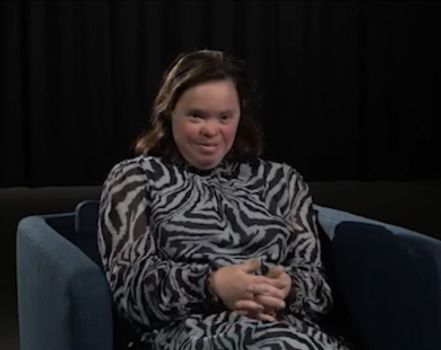 "Interview with Tina Fielding" Tina is a writer, actor, film maker and disability advocate Interview Summary Tina is an actress with Down Syndrome who identifies strongly with her art form, viewing her disability as an ability that enhances her talent and quality in storytelling through acting. She enjoys the process of acting and finds joy in watching her family perform, which inspired her to pursue the craft; however, she acknowledges that there are difficult moments that can be challenging but ultimately rewarding. Her artistic journey has involved working with various local companies in Perth and her work has evolved by adapting to new roles, with the aim of authenticity in her performances. Tina's influence and acknowledgment in the field are growing, noted by positive media attention, and she encourages other artists with disabilities to embrace and identify with their unique abilities.
 - Sydney 2002 Gay Games and Cultural Festival
- Museums and Galleries Foundation
- Kristy Sweeney
- Jennifer Stockins
- David Morgan
- Bowman Yu
- Bianca Wright
- Andrew Arestides
- Tin Sheds Gallery
- Matt Viney
- Matthew Viney
- Kelly Walker
- Jonathan Brent
- John Havilah
- Evan Wills
- David Gillham
- Bex Hirman
- Bex Hirdman
- Andrea Myers