Items
Search full-text
Accessible Arts - Arts and Disability Expo
- Ben Katz
- Barbara Ceeny
- Audrey O’Connor
- Anthony Camarelli
- Anthea Williams
- Anne Graham
- Anna Jacobson
- Anna Barnes
- Anita Canning
- Alun Leach-Jones
-
“Activism leads to a Disability Royal Commission” Decades of activism led to a 2019 Senate motion calling for a Disability Royal Commission. The first public hearing of the Royal Commission took place on 16th September, 2019 at Brisbane’s Convention and Exhibition Centre. The Commission resulted in a report in 12 volumes. Several volumes include Volume 3: Nature and extent of violence, abuse, neglect and exploitation, Volume 6: Enabling autonomy and access, Volume 7: Inclusive education, employment and housing, Volume 9: First Nations people with disability, and Volume 10: Disability services. Overall, the Commission presented “222 recommendations on how to improve laws, policies, structures and practices to ensure a more inclusive and just society that supports the independence of people with disability and their right to live free from violence, abuse, neglect and exploitation.” In 2023, the final report of the Royal Commission into Violence, Abuse, Neglect and Exploitation of People with Disability was published with 220 recommendations for a more inclusive nation to reduce exploitation, violence, abuse and neglect of people with disabilities.
-
 "DADAA - The Lost Generation Project" DADAA - The Lost Generation Project 2007 - reads, in part "The project was conceived from a partnership between DADAA and the WA Disability Services Commission, which began in 2002. After working on 15 small projects, the partners decided to develop a large-scale project in 2007 to continue developing arts and cultural interventions with and for people with intellectual disability living in supported accommodation across the Perth metropolitan area. The project's rich CACD strategy has seen numerous successful workshops, exhibitions and related projects come to fruition in partnership with local governments and other community arts organisations.?
 -
“Salubrious Productions (QLD) established in 1999” Salubrious Productions (Queensland) was established in 1999. Salubrious is an agency for disabled artists, representing musicians, writers and composers, theatre performers and actors, visual artists, and technicians in the creative industries. The agency continues operation today. Their website describes them as follows: “Salubrious Productions is a Brisbane-based entertainment and production agency. We represent a core of more than 200 diverse acts and artists and draw further from a large network of professional artists throughout Queensland and Australia.”
-
 "Australia Council - Annual Report 2009-10" Australia Council Annual Report 2009-2010 – discusses year in review, letter from chairman, vision, list of council staff, message from the CEO, Strategic priorities, funding overview, statement of outcome, about the Australia Council including governance, boards, organisation, accountability, workplace; financial review and discussion of the Commonwealth Disability Strategy with how the Disability Action Plan 2008–2010 addresses Australia Council roles of policy adviser, purchaser, provider and employer.
 -
“The Cunningham Dax Collection of artworks opens” In 1952, an English psychiatrist Dr Eric Cunningham Dax was appointed as the Chairman of the Mental Hygiene Authority in Melbourne. In the UK, Dr Dax had introduced art therapy in programs for patients in psychiatric care and introduced art programs to Victorian Hospitals. In 1959, Dr Dax organised the first art exhibition of psychiatric patients held at Gallery A, Flinders Lane. The Cunningham Dax Collection of artworks grew, and an official opening occurred in Faraday Street Gallery in the 1980s. “Two distinct eras are represented in the Cunningham Dax Collection; artworks produced within psychiatric hospitals from 1940s into 1970s and artworks donated to the Collection by artists and community groups from 1980s until the present.” Dr Dax had introduced art therapy in programs for patients in psychiatric care and introduced art programs to Victorian Hospitals. In 1981, the National Gallery of Australia received 68 paintings from the Dax Collection - these were returned in 1994.
-
“Bus Stop Films begins operation in 2009” Bus Stop Films began operations in 2009. In their own words, they “educate, create and advocate.” Their primary focus is teaching filmmaking to disabled adults, but they also offer workshops to others of marginalised identities. Bus Stop “makes films with, for and about people from diverse backgrounds and abilities.” Their website lists support workers in every Australian state and territory.
-
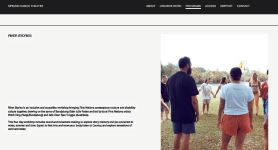 "Sprung!! Integrated Dance Theatre - River Stories" Page reads, in part, "River Stories is an inclusive and accessible workshop bringing First Nations contemporary culture and disability culture together, drawing on the yarns of Bundjalung Elder Julia Paden and led by local First Nations artists Mitch King (Yaegl/Bundjalung) and Jade Dewi Tyas Tunggal (Aust/Java)."
 - NuunaRon formerly with First Peoples Disability Network
- Blue Roo Theatre Company
-
“Sally Chance works with participants with disabilities, leading to the founding of Restless Dance Theatre” In 1989, UK-based community dance worker Sally Chance was invited to participate in the Come Out festival in Adelaide. She returned to South Australia the next year and begun the work with participants with disabilities which lead to the founding (alongside Tania Rose) of Restless Dance Theatre in 1991. Restless Dance Theatre continues to create and exhibit work by integrated ensembles. Their extensive performance history is available in the AusStage database. (see https://www.ausstage.edu.au/pages/organisation/7046)
-
"Back to Back Theatre established" The theatre company Back to Back was established in 1987. They are a drama group comprising artists with intellectual disabilities who have since toured both nationally and internationally in mainstream Australian theatre.
- Jeremy Hawkes
-
“Australian Caption Centre opened in 1982” The Australian Caption Centre was opened 13 September, 1982. A tour took place at the Australian Caption Centre in Sydney in the 1990s; the video (now available on YouTube) explains how the Centre worked. In 2005, the Centre sold its commercial operations including the captioning services to Red Bee Media and formed Media Access Australia.
-
"Australian Film Commission created" In 1975, the Australian Film Commission was created, providing grants for film and television projects.
-
“Essay collection ‘Growing Up Disabled in Australia’ is published in 2021” In 2021, Carly Findlay edited a book ‘Growing Up Disabled in Australia,’ a collection of more than 40 Australian writers with disabilities sharing their lived experiences.