Items
Search full-text
Accessible Arts - Arts and Disability Expo
- Gay Hawkins
- Bill Watson
- Barbara McEvoy
- Randolf Reinmann
-
"1963 and 1967 sees the introduction of the Disabled Persons Accommodation Act and Sheltered Employment (Assistance) Act, respectively." With increasing pressure to provide more services to people with disabilities, the 1960s was a decade of Commonwealth Government initiatives to support organisations providing work and accommodation to people with a disability, including the Disabled Persons Accommodation Act and Sheltered Employment (Assistance) Act.
-
"The report Shut Out: The Experience of People with Disabilities and their Families in Australia is published in 2009" In 2009, Shut Out: The Experience of People with Disabilities and their Families in Australia was published. This report was commissioned by the Australian Government as part of the National Disability Strategy. It was prepared by the National People with Disabilities and Carer Council.
-
“Handicapped Persons Assistance Act 1974” Compared to earlier decades, the mid-1970s saw an increase in political activity pertaining to individuals with disabilities. The Handicapped Persons Assistance Act (HPAA) of 1974 is one such example, which replaced several policies and funded non-government organisations that provided care and housing. In 1983, the Hawke Labour Government instigated an evaluation of the initiatives created under the HPAA. The HPAA was replaced in 1986 by the Commonwealth Disability Services Act of 1986.
- Megan Strickfaden
-
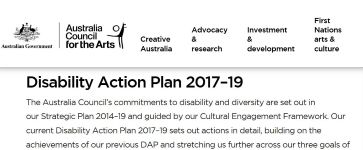 “Australia Council - Disability Action Plan 2017–19” The website reads “Our current Disability Action Plan 2017–19 sets out actions in detail, building on the achievements of our previous DAP and stretching us further across our three goals of accessibility, leadership and arts practice.”
 -
"Declaration on the Rights of Disabled Persons adopted in 1975" The 1960s and 1970s saw major changes in people’s attitudes towards disability. Stemming from the growth of the human rights movement and the introduction of normalisation theory internationally, Australia signed key human rights declarations of people with disabilities, the Declaration on the Rights of Disabled Persons (adopted in 1975). The Declaration argued that disabled people deserve to live lives “as normal and full as possible”.
-
“80 wheelchair users and allies halt Melbourne trams, demanding better access to public transportation” In a 2000 demonstration organised by the Catch a Tram group, 80 wheelchair users and their allies halted city trams in Melbourne during lunch hours, demanding better access to public transportation.
-
“In 2003, a demonstration outside Canberra’s Parliament House protests changes to Centrelink guidelines” In 2003, the Totally and Permanently Incapacitated Disabled Soldiers Association staged a protest outside Parliament House in Canberra, over changes to Centrelink guidelines that could have cost them up to $200 per week in income. “He said in Parliament that our payments are adequate, he's somebody who has never had the time to speak to us,” Association President John Ryan remarked of then Prime Minister John Howard.
-
"The United Nations makes comments on the rights of people with disabilities." In 1951, the United Nations made comments on the rights of people with disabilities."The focus of the United Nations on disability issues shifted in the late 1950s from a welfare perspective to one of social welfare."
-
“Lesley Hall leads a protest of the Miss Victoria Quest beauty contest” In 1981, Lesley Hall and a group of disability activists protested at the Miss Victoria Beauty Quest (a beauty pagent that was a fundraiser for the Spastic Society in Victoria). The focus on physical perfections was seen “as the norm all must attain if they are to be fully accepted into society”. The protests raised much media attention and marked the beginning of a shift in thinking about the place in Australian society of people with disabilities.
- Ruth Rentschler
- Jess Kapuscinski-Evans
-
"Bree Hadley, Clark Crystal (2017) Style, stage presence, and the poetic subversion of stereotypes: A case study of Blue Roo Theatre Company. Social Alternatives, 36(4), pp. 15-21." "In this article, we consider the work of Blue Roo Theatre Company (http://www.bluerootheatre.org.au/), a Brisbane-based theatre company which “creates contemporary performances lead by the artistry, experiences and imaginations of an ensemble of artists with diverse ability and impairment” (http://www.bluerootheatre.org.au/). Writing from a dual insider-outsider perspective – as a scholar of disability theatre and a creator of disability theatre in conversation – we discuss the work done in the training and rehearsal room in the lead up to Blue Roo Theatre Company’s performances, such as the company’s recent sell-out performance of Orpheus and Eurydice in collaboration with Opera Queensland at the Judith Wright Centre for Contemporary Arts, and the way it creates a distinctive performance style, poetics, stage presence, pleasure for the spectators who come along to witness the results of the work, and sense of community. We document moments in which facilitators, collaborators, co-creating artists, audiences and the media alike feel the physical, psychological, and aesthetic focus and force of voice, movement and character work by people with disabilities. We identify ways in which this stage presence can subvert dominant depictions of people with disabilities as innocent, childlike, or inspirational as significantly as the content of a show. In doing so, we provide insights into Blue Roo Theatre Company’s processes, and the aesthetic results it produces, and contribute to a growing body of commentary around disability theatre and performance, which – though increasingly well understood by those working in the form – clearly can still provide surprises for audiences and commentators anticipating conventional representations of people with disabilities onstage."
-
 "Australia Council - Annual Report 2013-14" Australia Council Annual Report 2013-2014 – discusses year in review, report from the CEO, Strategic priorities, funding overview, statement of outcome, about the Australia Council including The Governing Council and the Board, Structure of the Australia Council; financial review and discussion of funding for numerous programs including a new Artists with Disability Program grant which funded development opportunities and creative projects for practitioners with disability and the dance board funded development and presentation of new work, workshops and residency programs, and strategic initiatives that focus on leadership, development and collaboration with a highlight being the “Torque Show” supported for the Melbourne premiere of “Intimacy”, a collaboration with Michelle Ryan presented as part of the Unlimited Festival in London which celebrates originality of artists with disability.
 - NSW Institute for Deaf and Blind Children
- Zoe Barnes
- Tamara Christy
- Tony Nicholas
- Rebecca Scrioli
- Rhea Shortus
- Pierre Comarmond