
Items
Search full-text
Accessible Arts - Arts and Disability Expo
- "Bree Hadley (2017) Disability theatre in Australia: a survey and a sector ecology. Research in Drama Education, 22(3), pp. 305-324.”
-
 "Accessible Arts and Noise - AART-BOXX - Framing Gravity Exhibition 2011 - Program" Accessible Arts - AART-BOXX Framing Gravity Exhibition 2011 Program - reads, in part "Framing Gravity addresses 'the forces that be' as factors which do not just impact upon us, but through our interaction with them, define who we are. The creative 'shaping' of the world by the artists in the exhibition reveal dedicated artistic processes reinforcing the full spectrum of our experience."
-
 "Accessible Arts - Second Skin 2013 - Program" Accessible Arts - Second Skin 2013 - Program - reads, in part "Choreographers Sue Healey, Dean Walsh and Philip Channells worked with more than 20 dancers to devise three short dance works traversing duets between camera and dancer, sub-aquatic space and states of dress and undress. The end result is Second Skin, a studio showing at Bangarra Theatre, where dancers will shed their layers and expose what's underneath their skin."
- Caroline Bowditch
- Arts Activated
-
"Bree Hadley (2019) Advocacy, allies, and 'allies of convenience' in performance and performative protest. In Grehan, H (Ed.) The Routledge companion to theatre and politics (Routledge Theatre and Performance Companions). Routledge, United Kingdom, pp. 85-88.” "Though allies have always played a role in the production of political performance, analysis of the work of disabled artists, women artists, queer artists, and artists of colour has yet to be combined with analysis of the work of allies addressing the same issues. In this chapter, I consider the practice of allies in a specific context, social media performance, as a newly emerging platform for political activism. After tracing the way allies are typically involved in political performance about, with, and by marginalised people and communities, I point to complexities arising when activists, campaigners, entertainers, and pranksters use new online platforms in performance that purport to support the same cause.
-
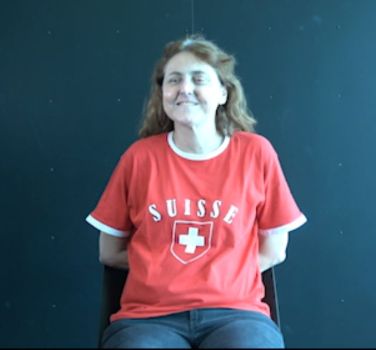 "Interview with Janelle Colquhoun" Janelle Colquhoun is an opera-jazz singer; corporate and community speaker; MC; producer; and writer. Interview Summary Janelle Colquhoun is a passionate and dedicated former opera singer, who in the interview speaks about, starting an entertainment agency to provide professional opportunities for artists with disabilities after losing her sight. She has produced over 1400 events, performed in a variety of concerts, and worked tirelessly to promote inclusivity in the arts, often by showcasing talented disabled artists to mainstream audiences. Janelle talks about how her work challenges the way people think about disability arts and inclusion, and strives to give equal performing opportunities by advocating for the recognition of artists with disabilities as professionals with the same quality of performance as any other artist.
- Rawcus
-
"Kath Duncan, Gerard Goggin, Christopher Newell (2005) ‘Don’t Talk about Me... Like I’m Not Here': Disability in Australian National Cinema. Metro Magazine: Media & Education Magazine.146/147, pp. 152-159. https://search.informit.org/doi/10.3316/informit.043842788583710" Reads, in part "Disability is a central cultural identity and category in Australia, but this is not often realized. We seek to make a contribution to conversations and critical analyses of disability in Australian culture through an exploration of a privileged national cultural form, namely film. The trope of disability looms large in late twentieth century Australian cinema, and yet cultural comment on these ‘disabled’ scripts and performances has not yet considered a disabilities studies perspective. Accordingly, in this article we combine our different perspectives on disability and film into an account of how specific films use disability. In particular, we analyse key films from the 1990s as examples of powerful displays of bodies and personhood." References a range of films, including Proof (Jocelyn Moorhouse, 1991), Romper Stomper (Geoffrey Wright, 1992), Bad Boy Bubby (Rolf de Heer, 1993), Muriel's Wedding (PJ Hogan, 1994), Shine (Scott Hicks, 1996), Moulin Rouge! (Baz Luhrmann, 2001), My One Legged Dream Lover (writer Kath Duncan with dir. Penny Fowler-Smith, Christine Oslen 1998), Pins and Needles (writer Genni Batterham with dir. Barbara Chobocky, 1979), Riding the Gale (Genni Batterham with dir, Hugh Piper, 1987), Dance Me to My Song (writer Heather Rose with dir. Rolf De Heer, 1998), Heather Rose Goes to Cannes (Chris Corin, 1999), Myself When Fourteen, (Ivor, Arthur and Corinne Cantrill 1989),Film of Circles, Squares, Triangles, Lines and Dots (Arthur and Corinne Cantrill 1981), Rainbow Diary (Arthur and Corinne Cantrill 1984), House Gang (Mandy smith, 1997), Quentin Crashes Big Brother (Quentin Kenihan, 2002), Quentin, World at My Wheels (Quentin Kenihan, 2000), Ability Trek (Jacob Baldwin 1998)
-
 "Accessible Arts - AART-BOXX 2009 - Promotional Card" Accessible Arts - AART-BOXX 2009 Promotional Card
-
 "The Arts and Disability 2017" This booklet/brochure provides images, descriptions of the work, and contact details and contact organisations for key organisations in South Australia including: Access2Arts; Company AT; Mindshare; No Strings Attached Theatre of Disability; Restless Dance Theatre; Sit Down, Shut Up and Watch Film and New Media Festival; Sisters of Invention, Tutti Arts; The Jame, The Mix, The Gig.
-
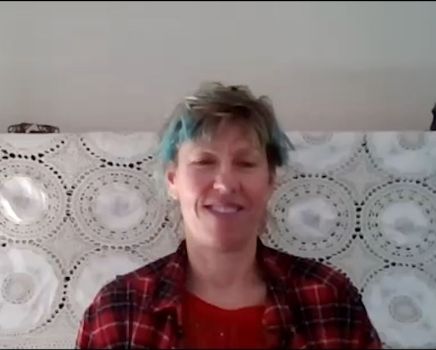 "Interview with Emiko Artemis" Dr Emiko Artemis is a visual artist with a PhD and a history of both solo and group exhibitions. Interview Summary Emiko Artemis identifies as a non-binary queer disabled visual artist. Emiko acknowledges their work essentially reflects their personal experiences with disability and comments on society. Despite interpersonal challenges due to disabilities, Emiko cherishes occasional collaborations, facilitated by clear structures or supportive relationships. Their artwork, often seen as "weird" to the public, aims to be thought-provoking rather than being particularly political. Emiko values the growing visibility of disability in the arts and the increase in acceptance of diversity in society. They proudly embrace their own identity as an integral aspect of their creative practice
-
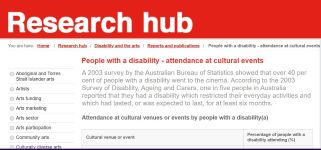 “Australia Council - People with a disability - attendance at cultural events 2008" Australia Council - People with a disability - attendance at cultural events 2008 - reads, in part "A 2003 survey by the Australian Bureau of Statistics showed that over 40 per cent of people with a disability went to the cinema. According to the 2003 Survey of Disability, Ageing and Carers, one in five people in Australia reported that they had a disability which restricted their everyday activities and which had lasted, or was expected to last, for at least six months."
-
 "Australia Council - Annual Report 2000-01" Australia Council Annual Report 2000-2001 - discusses letter from chair of council, corporate overview, year in review, financial statements, analysis of funding and grants for projects, initiatives, new work, programs, presentation and promotions including funding for music development, implementing the Commonwealth Disability Strategy by evaluating current and changing needs of people with disabilities in the arts sector and reflecting this in funding and policies, arts marketing and audience development and triennial grants to disability arts organisations in NSW, South Australia and Victoria
-
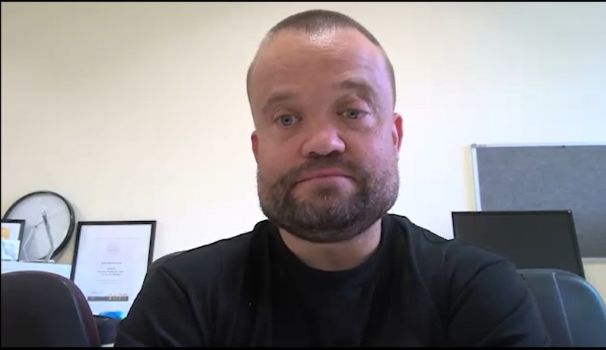 "Interview with Jeremy Smith" Jeremy Smith is a Senior Producer in Western Australia at Performing Lines, has a long career across community, experimental and performing arts, is a disability advocate and previously worked in Australia Council for the Arts (now Creative Australia) as Director – Community Arts and Experimental Arts. Interview Summary Jeremy Smith has vast experience in the arts including working as a director with Australia Council (Creative Australia). Jeremy is currently an arts worker in the performing arts sector. While Jeremy lives with Achondroplasia, he has not always identified as disabled however a transformative project for the 2016 Perth Festival led him to embrace his identity as a disabled person with pride recognising the complexities surrounding personal identification with disability. Jeremy talks about artists and organisations he finds inspirational who are leading change in the disability arts sector and his motivation to also advocate for inclusion and the evolution of public perception of disability arts work.
-
"International Year of the Disabled Person (IYDP)" In 1976, the General Assembly proclaimed 1981 would be the Year of the Disabled Person. The 1981 International Year of the Disabled Person inspired an increase in awareness and disability arts. While UN theme was “full participation and equality” the theme in Australia was “Break down the Barriers”, raising the prole and issues of people with disabilities. The international year of the disabled persons was a catalyst for connecting Australian disability activists to each other and the international disability rights movement (Royal Commission, 2021, p. 6). Australia saw an increase in disability-themed theatre from 1981 to 1984; however, these performances were largely staged with non-disabled casts. Records of these productions can be found on the AusStage database.
-
 "Accessible Arts - NSW Arts and Disability Partnership - Promotion Card" Accessible Arts - NSW Arts and Disability Partnership - Promotion Card - reads, in part "The NSW Government has committed $1.5 million to increase access to arts and cultural activities for people with a disability."
-
”Hadley, Bree, Batch, Morgan, & Whelan, Michael (2021) The entitled ally: Authorship, consultation, and the 'right' to stage autistic people's stories. Disability and Society, 36(9), pp. 1489-1509.” "Theatre has a long tradition of presenting disabled characters as plot devices to tell someone else’s story. A recent production, All in a Row, resulted in heated debate around this issue. This article examines not the play itself, but the conflict between those who objected to the play’s representation of autism, and its creators, who defended their choices by citing their disability-adjacent identities and processes of consultation. For critics, the fact that the creators did not take the community’s concerns seriously was a source of trauma. This article uses this conflict to draw out lessons about how we might better negotiate the right to tell disability stories and strengthen frameworks to support that negotiation. We propose a decision tree diagram to assist artists in understanding the meaning, role, and most importantly the potential consequences of consultation – up to and including a community saying ‘no’ to an artist’s planned representation."
-
"Christopher Newall (1996). The Disability Rights Movement in Australia: A note from the trenches. Disability & Society, 11(3), 429–432. https://doi.org/10.1080/09687599627705" Reads, in part “A recent visitor to Australia from the UK commented to me on their return ‘I looked in vain for the disability rights movement. Can you tell me where they are?’ In essence, the Australia disability rights movement is currently fragmented, predominantly organised around disease labels and seems to have lost ground, compared with the self-help initiatives fostered around the time of the International Year of the Disabled Persons in 1981.”
-
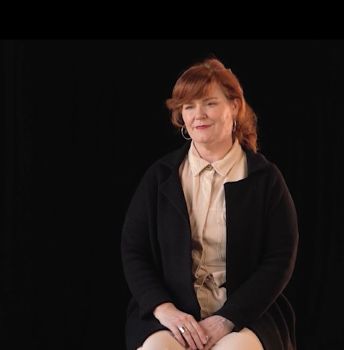 "Interview with Julie Moralee" Julie Moralee is the Chief Executive Officer of Restless Dance Theatre, bringing a wealth of experience in marketing, business development, and festival organisation within the arts sector. Her leadership focuses on showcasing the talents of artists with disability and ensuring sustainable employment opportunities in the arts. Interview Summary Julie Moralee is the CEO of Restless Dance Theatre, where she has focused on promoting the talent and abilities of artists with disability. With a commitment to ensuring sustainable full-time employment in the arts for these artists, she emphasises the importance of audience impact and high-quality performances as measures of success. Julie is mindful of the challenges and perceptions within the disability arts sector and envisions a future where the label "disability art" becomes obsolete, as the quality of the work transcends its creators
-
"Bree Hadley (2015) Participation, politics and provocations: People with disabilities as non-conciliatory audiences. Participations: journal of audience and reception studies, 12(1), pp. 154-174.” "Disability has always had a prominent place on the theatrical stage. Throughout the C19th, C20th and C21st to date, disabled characters have been used to signify corruption, innocence or suffering, and, of course, as salutary examples of how to overcome such suffering. In the past three decades, the work of disability scholars, activists and artists has also provided opportunities for people with disabilities to produce their own plays, performances or installations challenging these stereotypes. Interestingly, though both the body of literature on theatre makers with disabilities and the body of literature on theatre audiences has grown apace over the past decade, there is still surprisingly little written on people with disabilities as theatre audiences. In this article, I draw on observations made during five years of practical, empirical and theoretical research into disability theatre to discuss how people with disabilities work as a distinctive sub-group of spectators, with distinctive spectatorial processes, modalities and preferences, within contemporary theatre audiences. I begin with the factors that make attending theatre difficult for people with disabilities. I note that people with disabilities respond to the challenges they face in attempting to become active audiences of contemporary theatre in three common ways. I then unpack what these spectatorial modalities teach us about people with disabilities as audiences, other marginalised groups as audiences, as well as about audiences, audiencing and the part audiences play in theatre practice more generally."
-
"Australia Council for the Arts (2014) A Million Dollar Commitment to Artists with Disability. Australia Council for the Arts. 28 October 2014" Reads, in part "Australia Council Chief Executive Officer Tony Grybowski made the announcement today at the Arts Activated Conference in Chatswood, Sydney. Mr Grybowski said the decision to extend the dedicated arts and disability funding was made after a successful pilot was run earlier this year."
-
“The Bolshy Divas present ‘The Other 100 Conversations’ to Australian governments heads” In 2011, a group of disability activists called the Bolshy Divas presented a 100-page document, ‘The Other 100 Conversations,’ to heads of all Australian governments who had gathered in Canberra for a Council of Australian Governments (COAG) meeting. The document was addressed “to our elected representatives”. ‘The Other 100 Conversations’ comprised of 100 first-person accounts of participants of disability services in Western Australia, highlighting the lack of support and waiting times experienced.
-
"Amanda Cachia (2022) Networks of Care: Collectivity as Dialogic Creative Access, in Amanda Cachia ed. Curating Access: Disability Art Activism and Creative Accommodation. London: Routledge, 219-230" Reads, in part "The collectives that have formed in recent years and that will be the subject of this chapter include the Feminist Health Care Research Group (FHCRG), the Sickness Affnity Group (SAG), and Power Makes Us Sick (PMS). Each of these groups attempts to be intersectional in their approach, focusing on feminist and crip revisions to health care. Feminist and crip unite in the groups as the participants all identify as both women and as disabled. In shared spaces, which can be found in physical spaces, such as an art gallery or an artist’s home, or online through Zoom, artists can offer mutual understanding of their experiences with chronic illness, disability, the medical industrial complex, and simply be a shoulder to lean on in times of anxiety, anger, and sadness. The collectives also offer an opportunity for the artists to lift each other up, creating an environment of respect, dignity, and self-worth, becoming a strong circle of empowerment, affrmation, and allyship. The proliferation of these support groups shows a general shift in social norms, where the medical feld no longer holds the only authoritative voice on health. This phenomenon also indicates how nonmedical health based groups are flling a need and making up for a lack in social support networks elsewhere, particularly within sanctioned medical arenas."
-
 "Accessible Arts - ACE Arts Creativity Expression - Helen Meekosha, Leanne Dowse and Andrew Jakubowicz - Article: Exposing Mass Culture To Disability Issues - Iss15" Accessible Arts - ACE Arts Creativity Expression - Helen Meekosha, Leanne Dowse and Andrew Jakubowicz - Article: Exposing Mass Culture To Disability Issues - Iss15 -analysis of TV Series 'House Gang'