Items
Search full-text
Accessible Arts - Arts and Disability Expo
- Aviva Sheb
-
 "Arts Disability Technology Library Program" Library access, equity, inclusion, and anti-discrimination seminar and presentation sessions
 -
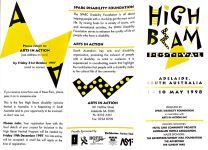 "High Beam Festival 1998 Flyer" High Beam Festival Flyer 1998 reads "This is the first High Beam disability inclusive festival in Australia. It is happening in South Australia and its your opportunity to be involved so don't miss out. … HIGH BEAM FESTIVAL INCLUDES: • A spectacular opening night of celebration. • A lively Cabaret/Porty featuring some of Australia's top entertainers. • Two days of stimulating seminars with topics covering arts, disability and healthy communities. • A week-long program of disability inclusive events at The Governor Hindmarsh Hotel. • A promotional campaign that will attract people from around Australia. • Multi-media promotional opportunities including free entry in the official festival program."
 -
"Juliette Peers (2022) The ArtLink Archive Project: Inside the 'Outsider' Issue, 42(2)" "In 1992–93 ArtLink published Naïve & Outsider Art centring on themes linked by their shared invisibility in mainstream discussions. While the title obviously references art historian Roger Cardinal’s 1972 book Outsider Art, (after Jean Dubuffet’s ‘Art Brut’ or ‘raw art’), this outlying status was described by ArtLink’s founding editor Stephanie Britton in 2022 as ‘…the context changes, but at the time the concept [of various practices lying beyond the mainstream] functioned as a catch up on things that had been under the radar for decades already... [we were] collating a wide range of ideas'[1], a group of practices that existed but were hardly recognised in published texts. Looking back across ArtLink’s history, Naïve & Outsider Art offers much to think through about the magazine’s own platform, intentions and the trajectories of those practices foregrounded thirty years ago under what are now troubling rubrics."
-
"Australia Council commissions a research study on people with disabilities' participation in arts activities" Australia Council commissioned a research study on the problems faced by people with disabilities attempting to participate in art activities (Australia Council Annual reports 1979/1980 and 1980/1981).
-
"The Australian Elizabethan Theatre Trust begins operations in 1954" The Australian Elizabethan Theatre Trust began operations in 1954. The key role of the trust was to support the arts in Australia leading to the independent companies of: Opera Australia, The Australian Ballet Foundation, National Institute of Dramatic Art (NIDA), and Bell Shakespeare Company. At this time there was little involvement of people with disabilities in the arts.
- Footscray Community Arts Centre
-
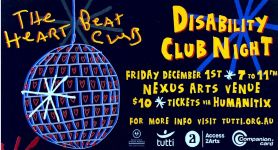 "Tutti Arts - Disability Club Night - Promotional Card" Tutti Arts 'Disability Club Night' Promotional Card
 -
“Disabled actors perform at Melbourne Concert Hall” In 1982, 50 “handicapped” actors (though none were named in the media) were involved in Access Arts’ ‘Theorem’ at the Melbourne Concert Hall, an example of inclusive arts practice. The performance received broad public attention.
-
“The Australian Government’s Creative Nation policy released in 1994” ‘Creative Nation’ was released in 1994. This was the first ever cultural policy formally developed by an Australian Government. Alongside a number of art forms, the policy included establishments like libraries in its definition of culture and pledged $250 million in funding to cultural organisations.
-
 "Australia Council - Annual Report 2007-08" Australia Council Annual Report 2007-08 - discusses letter from chairman, year in review, from the CEO, Excellent and Distinctive Art from various artforms, Access for all Australians from various artforms, A strong and vibrant arts sector including artist’s earnings, philanthropic support and arts sector development, About the Australia Council, Governance, Organisation, Accountability, Workplace and Financial statements but no longer listing grants of organisations or individuals however discusses the DADAA WA radio play “The Proper Shoes” - a series of stories written by young women with a disability, was first broadcast nationally on ABC Radio and then invited to tour the play as part of the TRASNA Festival of Inclusive Theatre.
 -
"Bree Hadley (2017) Disability, Sustainability, Austerity: The Bolshy Divas Arts-Based Protests Against Policy Paradoxes. Centre for Sustainable Practice in the Arts Journal 18 Spring. http://www.sustainablepractice.org." "In this short article, I want consider some of the ways theatrical artists, activists and advocates in Australia are tackling the paradoxical relationship between sustainability and austerity discourses, and, as a result, some changes this may be starting to produce in disabled people’s aesthetic prerogatives. For the last 30 years, artists, activists and scholars in Australia and beyond have avoided casting disability in terms of trauma, crisis, catastrophe and disaster. Accounts of the way disability theatre challenges stereotypes , as well as analysis of disability signifiers in screen, stage, and social performance , have expressed concern about deploying disability as a metaphor for disaster, or defining disabled people as monstrous, tragic, stoic, or inspirational, the way the medical model of disability traditionally defines us. Instead, modern disabled artists and the scholars who analyse them have advocated for work that deploys live art, performance art, and performative intervention in public space to challenge stereotypes, oppressive institutional systems, and other factors the social model of disability sees as the cause of disability oppression .In the last few years, though, there has been an increase in work that does associate disability with trauma, tragedy and disaster, in what seems to be a response to austerity, accountability and economic sustainability agendas that call for cuts to disability services spending to make our societies more sustainable going forward."
-
 "Access Arts - Interacting With People With Disabilities Handbook" Handbook reads "Advocacy is an important part of Access Arts' work. We developed this training program in response to the experiences of cast members during a National tour of an Access Arts performance. Cast members often found themselves in situations where they were discriminated against or did not receive appropriate service. I congratulate your company for taking the initiative to adopt this program, thereby creating disability awareness and better service provision to the general public." Training program includes information on legislation, definitions of disability/disabilities, appropriate language, basic Auslan, and standards.
 -
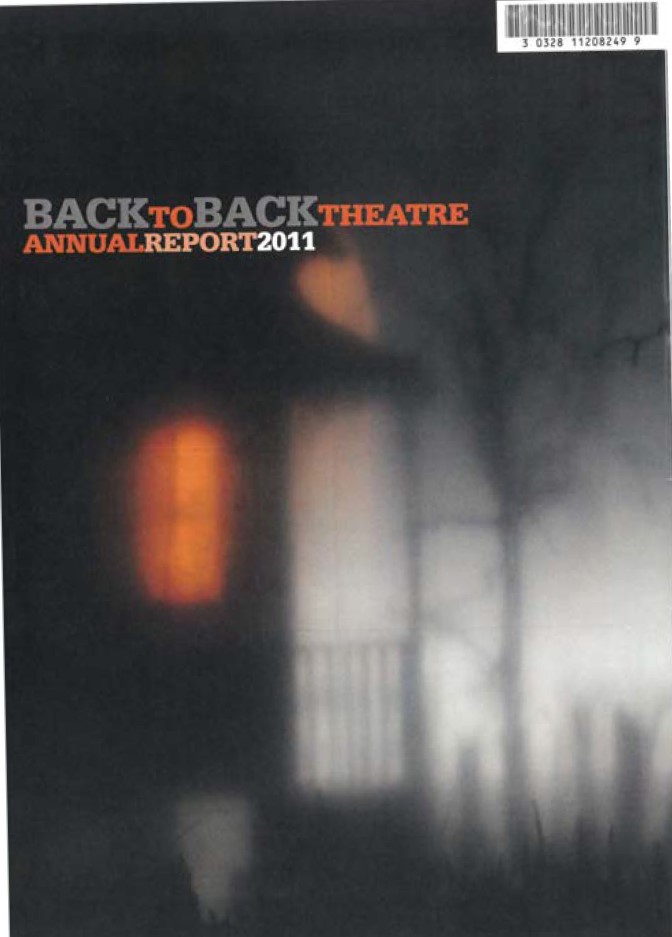 "Back to Back Theatre - Annual Report 2011" Back to Back Theatre Annual Report 2011 - Report from Chair and Executive, information on premiere season of GANESH VERSUS THE THIRD REICH, international tours ofTHE DEMOCRATIC SET, SMALL METAL OBJECTS and FOOD COURT, new collaboration to develop LASER BEAK MAN in collaboration Tim Sharp and Sydney Theatre Company, community/experimental work with THEATRE OF SPEED, networks and industry events, research including doctoral projects by Stanley Opara, Yoni Prior and Caroline Ellison, inclusion in Josephine Machon’s book “lmmersive Theatres: Intimacy and Immediacy in Contemporary Performance" and research on arts-schools partnerrships with Arts Victoria, Melbourne University, and Victorian Department of Education and Early Childhood Development.
 -
 "High Beam Festival Program 2006" High Beam Festival Program 2006 reads "High Beam is a 10 day integrated arts festival showcasing work inspired by or influenced by experiences of disability. Presenting both professional and recreational artists, audiences will see many of the world's most exciting and innovative achievements in arts and disability."
 - Winsome Roberts
- Rachel High
-
”Racheal Missingham, Bree Hadley (2022) Oppression and allyship in Australia's Deaf Arts. Australasian Drama Studies, 80, pp. 304-332.” "In this article, we investigate the history of Deaf theatre in Australia, through the lens of oppression and allyship. Through a review of the to date limited academic, industry, and media literature, in conjunction with survey and interview research with Deaf theatre practitioners, this research sheds light on Deaf theatre makers’ perceptions of the ways in which ally support can operate to create both social benefits and barriers, and how this has impacted on the non-linear development and recent decline in Deaf theatre companies in Australia. It finds that, in developing a framework to scaffold stronger allyship relationships with d/Deaf and hard of hearing artists, it is critical to consider the accessibility and cultural requirements not just in relation to theatre methodologies, but in relation to arts management practices, which support continuing company production, too."
- Salubrious Productions
- Lauren Jones
-
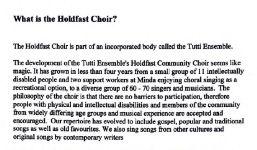 "Tutti Ensemble - Holdfast Choir History, Goals, Friends & Supporters 2002" Tutti Ensemble Holdfast Choir History, Goals, Friends & Supporters 2002 - reads, in part " The development of the Tutti Ensemble's Holdfast Community Choir seems like magic. It has grown in less than four years from a small group of 11 intellectually disabled people and two support workers at Minda enjoying choral singing as a recreational option, to a diverse group of 60 - 70 singers and musicians. The philosophy of the choir is that there are no barriers to participation, therefore people with physical and intellectual disabilities and members of the community from widely differing age groups and musical experience are accepted and encouraged. Our repertoire has evolved to include gospel, popular and traditional songs as well as old favourites. We also sing songs from other cultures and original songs by contemporary writers"
 -
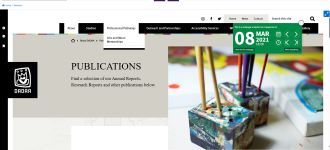 "DADAA Publications Webpage, captured 2021" DADAA Publications Webpage, captured 2021 - Annual Reports 2014-2019, Newsletters 2016-2019, and research reports, including Art Works: Employment in the Arts for People with Disability (2012), and Same Drum CACD Project With Young People from Migrant and Refugee Backgrounds (2018), Oddysea project with Sensorium Theatre (2014), the Lost Generation project (2011)
 -
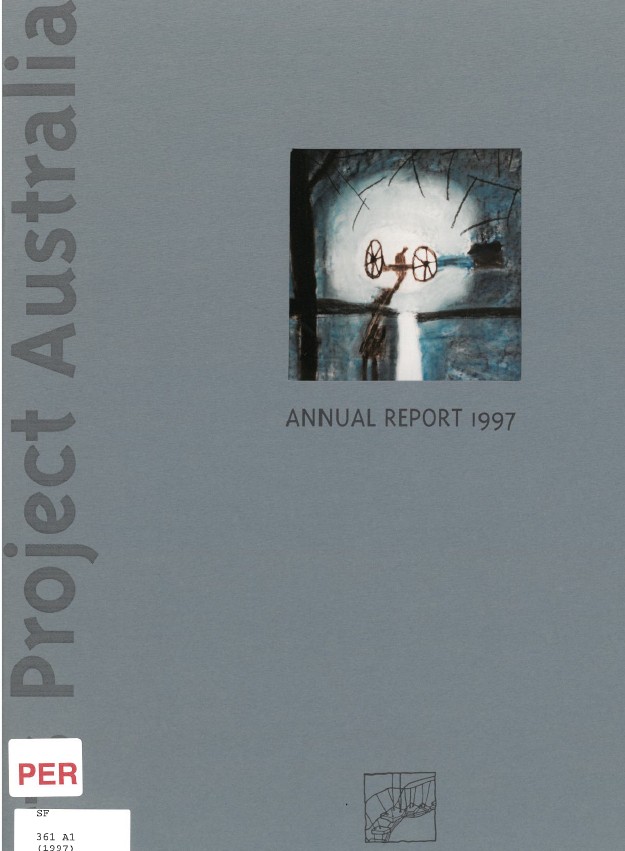 "Arts Project Australia - Annual Report 1997" Arts Project Australia - Annual Report 1997 - Management Committee, Aims and Objectives, President's Report, Director's Report, Studio Workshop Program, Exhibitions, Financial Statements Balance Sheet, Profit and Loss Statement, Income and Expenditure Summary, Statement of Cash Flows, Notes to Statement of Cash Flows, Notes to and Forming Part of the Financial Accounts, Statement to Members, Audit Statement to Members - reads, in part "Arts Project Australia, had its beginnings in 1974. But it was not until 1984 that our first studio workshop was establish.ed, with the aid of a grant from the Commonwealth Schools Commission. Since 1984 the studio workshop programme has physically developed in fairly well-defined cycles of five to six years. Up until 1986 the programme operated in hard to find halls tucked in behind houses or a convent building."
 -
 "Australia Council - Annual Report 2006-07" Australia Council Annual Report 2006-07 - discusses letter from chairman, year in review, from the CEO, Excellent and Distinctive Art from various artforms, Access for all Australians from various artforms, A strong and vibrant arts sector including artist’s earnings, philanthropic support and arts sector development, About the Australia Council, Governance, Organisation, Accountability, Workplace and Financial statements but no longer listing grants of organisations or individuals however discusses the DADAA WA – Lost Generation Project where a five year project intends to have more than 360 people with intellectual disabilities create self-portraits on film – one of the outcomes of DADAA WA receiving $104,775 in 2006-07 as a key organisation of the community partnerships section.
 -
"A Frame Exhibition And Art Auction" Catalogue reads “The A Frame Exhibition and Auction was initially developed to address the critical need for development oi pathways for artists with a disability toward recognition of their work in the visual arts mainstream. To achieve that goal it was important to present works in a prestigious venue, provide a catalogue to document artists work and offer a realistic opportunity for a sale."