Items
Search full-text
Alter State
-
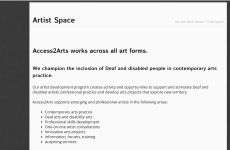 "Access2Arts Artist Space artist development program as first added to website 2016" Access2Arts Artist Space, 4 March 2016.Includes information about Access2Arts "Artist development program creates activity and opportunities to support and stimulate Deaf and disabled artists’ professional practice and develop arts projects that explore new territory. Access2Arts supports emerging and professional artists in the following areas: Contemporary arts practice; Deaf arts and disability arts; Professional skills development; One-on-one artist consultations; Innovative arts projects; Information, forums, training; Auspicing services"
 -
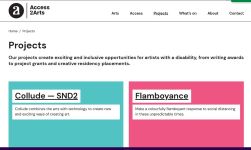 "Access2Arts Project Archive" Access2Arts programs as at 2022
 -
 "Access2Arts - You Tube - Access2Arts Video UNCRPD Article #19 Living independently and being included in the community " Access2Arts Article #19 Living independently and being included in the community - https://www.youtube.com/watch?v=uoqeaDFEjlE
 -
 "Access2Arts - You Tube - Access2Arts Video UNCRPD Article #27 Work and employment" Access2Arts - You Tube - Access2Arts video on United Nations Convention on the Rights of People with Disabilities Article #27 Work and employment - reads, in part "Article #27 of the United Nations Convention of the Rights of People with Disabilities that deals withWork and employment, told by Deaf and disabled people. An Access2Arts Production made possible with support from the City of Adelaide."
 -
 "Access2Arts - You Tube - Access2Arts Video UNCRPD Article #30 Participation in cultural life, recreation, leisure and sport" Access2Arts - You Tube - Access2Arts video on United Nations Convention on the Rights of People with Disabilities Article #30 Participation in cultural life, recreation, leisure and sport - reads, in part "Article #30 of the United Nations Convention of the Rights of People with Disabilities that deals with Participation in cultural life, recreation, leisure and sport, told by Deaf and disabled people. An Access2Arts Production made possible with support from the City of Adelaide."
 -
 "Access2Arts - You Tube - Access2Arts Video UNCRPD Article #5 Equality and non discrimination" Access2Arts - You Tube - Access2Arts video on United Nations Convention on the Rights of People with Disabilities Article #5 Equality and non discrimination - reads, in part "Article #5 of the United Nations Convention of the Rights of People with Disabilities that deals with Equity and non-discrimination, told by Deaf and disabled people. An Access2Arts Production made possible with support from the City of Adelaide.
 -
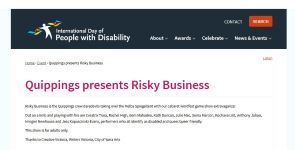 "Quippings presents Risky Business" Reads, in part "Risky Business is the Quippings crew daredevils taking over the Melba Spiegeltent with our cabaret wordfest game show extravaganza!"
 -
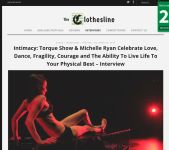 "The Clothesline - Intimacy: Torque Show & Michelle Ryan Celebrate Love, Dance, Fragility, Courage and The Ability To Live Life To Your Physical Best – Interview" The Clothesline (2015) 'Intimacy: Torque Show & Michelle Ryan Celebrate Love, Dance, Fragility, Courage and The Ability To Live Life To Your Physical Best – Interview'
 -
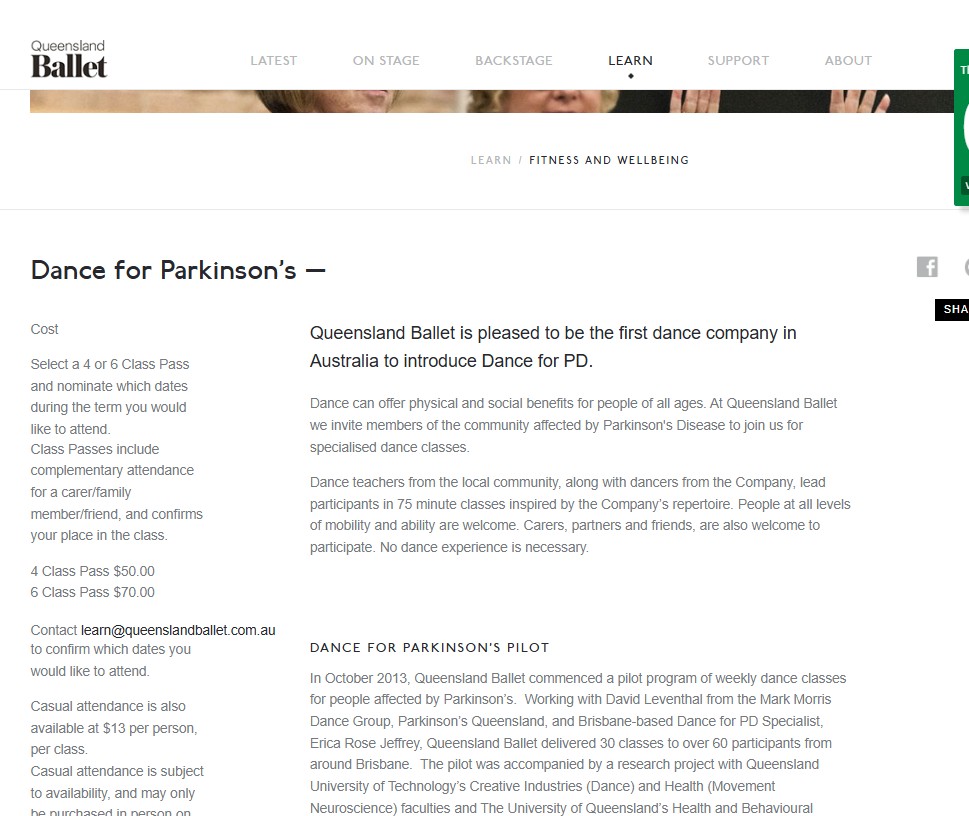 "Queensland Ballet - Dance for Parkinsons" Queensland Ballet 'Dance for Parkinsons' 2015 - reads, in part "Dance can offer physical and social benefits for people of all ages. At Queensland Ballet we invite members of the community affected by Parkinson's Disease to join us for specialised dance classes."
 -
 "YouTube - Take Up Thy Bed and Walk - presented by Vitalstatistix and Gaelle Mellis" YouTube of 'Take Up Thy Bed and Walk' (2013) by Vitalstatisix and Gaelle Mellis - "Take Up Thy Bed & Walk is a subversive performance about women, disability & fiction."
 -
 "Ron Grainer and Doctor Who - Interview - NFSA" Australian composer Ron Grainer, disabled in WWII, wrote the theme song to Doctor Who.
 -
"The Australian Council for the Arts established in 1968" The Australian Council for the Arts was established in 1968. This came after a push during the late 1960s for better support of the arts in Australia. The Council replaced the Elizabethan Trust as Australia’s main arts body, although the Trust continued to receive funding from State governments. The Council was later given statutory authority in 1975 and called Australia Council. Prime Minister Gough Whitlam is recognised as a key political supporter of the arts. The election of Whitlam (serving from December 1972 to November 1975) gave unprecedented and considerable attention and funding to an arts policy which would establish an Australian cultural identity raising international awareness. The Australian Council for the Arts received an unprecedented $14 million in funding in the 1973/74 budget. This was “more than double the allocation the bodies out of which it evolved had received the year before. The Council’s allocation was increased by a further 50 per cent in the 1974/75 Budget."
-
“Tutti Arts is founded in Adelaide by Pat Rix in 1997” Tutti Arts was founded in Adelaide by Pat Rix in 1997. Initially a choir of people with and without disabilities, it quickly added a focus on visual arts. Tutti has since expanded to offer programs in dance, screen, music, acting, and visual arts, and its choir continues. Programs are on offer in Brighton, Port Adelaide, and in the Barossa Valley, for adults as well as kids and youth. Tutti has performed both nationally and internationally, and has taken part in significant co-productions. Tutti Arts and KickstARt 2 Choir presented Up and Away for the KickstART Festival in Vancouver, Canada in 2004. Tutti’s international performance of 'Between the Worlds' in Minneapolis, Minnesota (2007) was remounted as a coproduction with Interact Center for the Performing and Visual Arts. Tutti returned to Minneapolis in 2009 to perform ‘Northern Lights, Southern Cross,’ which they first performed in 2007 for Adelaide Fringe. It was a collaboration with Interact, which brought together Aboriginal, Native American and Disabled Artists from the Northern and Southern hemispheres “to explore personal, racial and environmental trauma.” In 2009, Tutti Ensemble performed with the State Opera of South Australia to present ‘The Shouting Fence’.
-
“Access Arts commissions a multi-arts project, Peter Vance performs the song ‘Welcome to My Day’ at the 1999 Wataboshi Festival in Japan” Peter Vance was asked by Access Arts to team up with Ant McKenna to compose a song. He then performed ‘Welcome to My Day’ at the 5th Asia Pacific Wataboshi Music Festival in Japan in 1999. Access Arts sent disposable cameras out to members across Queensland; each story became a collage in the State Library foyer as a day-in-the-life of each artist.
-
“Carriageworks ‘New Normal’ program plan to commission ten new works presents three performances - Lady Eats Apple (Back to Back Theatre, 2017), Off the Record (Force Majeure, Dance Integrated Australia, 2016), Simple Infinity (Urban Theatre Projects, 2016)" New Normal is Carriageworks “national strategy for the development of disability arts practice.” Carriageworks state an aim to “commission ten new major works across contemporary performance, music, dance and visual arts.” As part of the program, Back to Back Theatres’ Lady Eats Apple (2017), Force Majeure and Dance Integrated Australia’s Off the Record (2016), and Urban Theatre Projects’ Simple Infinity (2016) each presented at Carriageworks. Since then, there has been no update on Carriageworks’ goal, suggesting the program may have fallen short of its initial objectives.
-
“The National Disability Insurance Scheme (NDIS) is launched” Following the spike in interest in the mid to late 2000s, significant steps were made towards the development of the National Disability Insurance Scheme (NDIS). It came about as the result of discussions about alternatives of disability support arrangements from 2007 to 2011. This included National Disability Strategy 2010–2020. A trial phrase of the NDIS was launched in 2013, and the scheme was rolled out across the country from July 2016. The 2022 change of government, which saw the Labor party voted in for the first time in nine years, reflected voter concern for climate change and social policies. The new prime minister Anthony Albanese ordered an independent review of the NDIS. The NDIS Review report was published in 2023 and had a number of recommendations, including affording funding based on functional impairment rather than diagnosis, increasing support for children, a requirement that all providers be registered, and state governments providing supports through other services for people who do not meet NDIS criteria.
-
“Choose Art, the Australian accessible arts directory, is launched” The Australian accessible arts directory Choose Art was launched in 2019. It is an initiative of Arts Access Victoria, designed for and by Deaf and disabled people. Choose Art is a Commonwealth project supported by the Cultural Ministers of each State and Territory through Arts ACT; Arts Tasmania; Create NSW; Creative Victoria; Culture and Arts WA; Arts South Australia; Arts Queensland; Department of Tourism and Culture, NT and the Federal Minister through the Department of Communications and the Arts. Arts Access Victoria has created Choose Art in partnership with Arts Access Australia, Access2Arts, Access Arts, Accessible Arts, Arts Access Darwin, Belconnen Arts Centre, DADAA and Incite Arts.
-
“Bus Stop Films begins operation in 2009” Bus Stop Films began operations in 2009. In their own words, they “educate, create and advocate.” Their primary focus is teaching filmmaking to disabled adults, but they also offer workshops to others of marginalised identities. Bus Stop “makes films with, for and about people from diverse backgrounds and abilities.” Their website lists support workers in every Australian state and territory.
-
"Queensland Government releases Arts & Disability Plan 2024-2026" Reads, in part "The Queensland Government acknowledges the rights of people with disability to participate equally in the state’s cultural life and to have the opportunity to develop and use their creative, artistic and intellectual potential, as recognised in the United Nations Convention on the Rights of Persons with Disability."
-
”Bree Hadley, Janice Rieger, Katie Ellis, Eddie Paterson (2024) Cultural safety as a foundation for allyship in disability arts. Disability & Society, 39(1), pp. 213-233.” "In this article, we argue that cultural safety, respect, and trust is a precursor to good allyship in the creative industries. We outline factors that influence feelings of safety or non-safety for disabled arts and media makers, and the way the legacy of the medical model makes it difficult for many arts and media workers to appreciate and enact enablers of safety as part of an allyship relationship."
-
"Bree Hadley, Eddie Paterson, Madeleine Little, Kath Duncan (2024) How Disability Performance Travels in Australia: The Reality Under the Rhetoric. In Czymoch, Christiane, Maguire Rossier, Kate, & Schmidt, Yvonne (Eds.) How Does Disability Performance Travel?: Access, Art, and Internationalization. Routledge, Abingdon, Oxon, pp. 62-76.” "The last three decades has witnessed the development of a distinct narrative about how disability performance has become a much celebrated component of the Australian theatre landscape. A central aspect of this narrative is the critical importance of festivals, events, and other industry initiatives that allow disabled performers to travel - both conceptually and corporeally - to meet and be mentored by other artists, and to present their work to new and more mainstream audiences, in new spaces and places, around the country, and around the world. In this chapter, we draw on historical data, collected as part of an AusStage ARC LIEF project designed to database information about disability drama, theatre, performance, and dance over the past 100 years, as well as the Last Avant Garde ARC Linkage project on disability performance in Australia, to unpack areas where the reality seems to challenge some of the dominant rhetoric."
-
"Bree Hadley, Janice Rieger, Eddie Paterson (2024) Reinhabiting, Reimagining, and Recreating Ableist Spaces: Embodied Criticality In Art. In Ellis, Katie, Kent, Mike, & Cousins, Kim (Eds.) The Routledge International Handbook of Critical Disability Studies. Routledge, pp. 48-58." "In this chapter we bring critical disability studies into dialogue with disability artworks that resituate critiques of inaccessibility and exclusion as complicated encounters with space, lived experience and embodiment. Drawing on Irit Rogoff’s (2003, 2006) notions of embodied criticality, and the pioneering work of performance studies scholar Petra Kuppers (2003, 2014), we argue for an embodied, embedded and creative form of critical disability studies – enacted through art. We examine two recent performance and installation works in hotels: Welcome Inn (2019) by British artist Christopher Samuel, and Intimate Space (2017) by Australian performance company Restless Dance Theatre."
-
”Bree Hadley, Janice Rieger, Sarah Barron, Sarah Boulton, Catherine Parker (2023) Codesigning Access: A New Approach to Cultures of Inclusion in Museums and Galleries. In Cachia, Amanda (Ed.) Curating Access: Disability Art Activism and Creative Accommodation. Routledge, Abingdon, Oxon, pp. 183-195.” "In museums and galleries, access is often designed and implemented by staff and informed by regulations and guidelines. Codesign approaches have the potential to shift this understanding away from designing access “for” visitors and toward access as a creative process developed “with” visitors. This chapter focuses on the exhibition and practice-led research project Vis-ability: Artworks from the QUT Art Collection, which was presented at the Queensland University of Technology (QUT) Art Museum in Australia in 2019. Vis-ability represented the culmination of five years of international research into access in museums and galleries for visitors who are blind or have low vision."
-
“Angharad Butler-Rees, Bree Hadley(2023) Exploring the Role of the Disabled Body as a Vehicle and Art Form within Anti-Austerity Protest. In Zebracki, Martin & McNeill, Z. Zane (Eds.) Politics as Public Art: The Aesthetics of Political Organizing and Social Movements. Routledge, Abingdon, Oxon, pp. 116-132.” "The impact of neoliberal austerity policy is being felt by people with disabilities across the globe. This chapter attends to disability protest in response to austerity across two contexts—the United Kingdom and Australia. It examines how people with disabilities are choreographing their protest, the strategies they are using, and the outcomes they are seeking."
-
”Hadley, Bree, Paterson, Eddie, & Little, Madeleine (2022) Quick Trust and Slow Time: Relational Innovations in Disability Performing Arts Practice. International Journal of Disability and Social Justice, 2(1), pp. 74-94.” "Despite a range of policies, plans, protocols and funding programmes to support disabled artists and collaborations between mainstream producers and disabled artists, the statistics – at least in our context in Australia – suggest most disability art still occurs outside and alongside an industry that struggles to include these artists. In this article, we draw upon findings from a series of workshops with disabled artists around Australia, conducted as part of the ARC funded Disability in the Performing Arts in Australia: Beyond The Social Model project – known colloquially to its collaborators and participants as ‘The Last Avant Garde’ project (https://lastavantgarde.com.au) – to propose a new approach. We find that while provision of logistical access (ramps, hearing loops, interpreters) and ideological access (stories, characters, discourse and language) is critical, so is methodological access, which embodies disability culture in training, rehearsal and production processes. Disabled artists use crip culture, along with relational space and time to negotiate what happens in disability arts and culture production practices and work through desire, fear, vulnerability and reciprocity to rapidly establish trusting collaborations."