
Items
Search full-text
Art of Difference
-
 "The Arts and Disability No Date #2" Except as permitted by copyright law, you may not reproduce or communicate any of the content on this website, including files downloadable from this website, without the permission of the copyright owner. The Australian Copyright Act allows certain uses of content from the internet without the copyright owner’s permission. This includes uses by educational institutions and by Commonwealth and State governments, provided fair compensation is paid to the copyright owner. For more information, see www.copyright.com.au and www.copyright.org.au.
-
"Australia Council commissions a research study on people with disabilities' participation in arts activities" Australia Council commissioned a research study on the problems faced by people with disabilities attempting to participate in art activities (Australia Council Annual reports 1979/1980 and 1980/1981).
-
"The Australian Elizabethan Theatre Trust begins operations in 1954" The Australian Elizabethan Theatre Trust began operations in 1954. The key role of the trust was to support the arts in Australia leading to the independent companies of: Opera Australia, The Australian Ballet Foundation, National Institute of Dramatic Art (NIDA), and Bell Shakespeare Company. At this time there was little involvement of people with disabilities in the arts.
-
“The Mouth and Foot Painting Artists starts in Australia in 1971” The Mouth and Foot Painting Artists (MFPA) started in Australia in 1971. The roots of the international organisation of mouth and food painting artists go back to the 1950s in Europe.
-
“Tutti Arts is founded in Adelaide by Pat Rix in 1997” Tutti Arts was founded in Adelaide by Pat Rix in 1997. Initially a choir of people with and without disabilities, it quickly added a focus on visual arts. Tutti has since expanded to offer programs in dance, screen, music, acting, and visual arts, and its choir continues. Programs are on offer in Brighton, Port Adelaide, and in the Barossa Valley, for adults as well as kids and youth. Tutti has performed both nationally and internationally, and has taken part in significant co-productions. Tutti Arts and KickstARt 2 Choir presented Up and Away for the KickstART Festival in Vancouver, Canada in 2004. Tutti’s international performance of 'Between the Worlds' in Minneapolis, Minnesota (2007) was remounted as a coproduction with Interact Center for the Performing and Visual Arts. Tutti returned to Minneapolis in 2009 to perform ‘Northern Lights, Southern Cross,’ which they first performed in 2007 for Adelaide Fringe. It was a collaboration with Interact, which brought together Aboriginal, Native American and Disabled Artists from the Northern and Southern hemispheres “to explore personal, racial and environmental trauma.” In 2009, Tutti Ensemble performed with the State Opera of South Australia to present ‘The Shouting Fence’.
-
“The national tour of the exhibition BodySuits results in commissions and new opportunities for artists” A visual arts exhibition, BodySuits, toured nationally between 1997 and 1999. It was curated by Jane Trengove. This resulted in commissions and new opportunities for artists. Arts Access Victoria published a catalogue for the exhibition in 1997; the exhibition showed in Melbourne from 5 July - 2 August 1997 at 200 Gertrude Street, Fitzroy (a location now known as Gertrude Contemporary).
-
“Salubrious Productions (QLD) established in 1999” Salubrious Productions (Queensland) was established in 1999. Salubrious is an agency for disabled artists, representing musicians, writers and composers, theatre performers and actors, visual artists, and technicians in the creative industries. The agency continues operation today. Their website describes them as follows: “Salubrious Productions is a Brisbane-based entertainment and production agency. We represent a core of more than 200 diverse acts and artists and draw further from a large network of professional artists throughout Queensland and Australia.”
-
“The Australian Government’s Creative Nation policy released in 1994” ‘Creative Nation’ was released in 1994. This was the first ever cultural policy formally developed by an Australian Government. Alongside a number of art forms, the policy included establishments like libraries in its definition of culture and pledged $250 million in funding to cultural organisations.
-
"A contemporary visual arts exhibition, Connected 2008, is presented in 2008" In 2008, Arts Access Victoria produced Connected 2008, a contemporary visual arts exhibition attracting over 400 entries from artists with a disability across Victoria.
-
“Studio A established in 2000” Studio A (NSW) was established in 2000 to create access and opportunities for visual artists with intellectual disabilities; their in-house artists’ “practices range from painting and drawing to sculpture, textiles and digital media”. In their own words, “At Studio A, we are dedicated to professionally empower artists with disability and have their voices heard within contemporary Australian culture.”
-
“The paralympic arts festival, Invincible Summer, is held in conjunction with the 2000 Paralympic games” In 2000, Sydney held the Paralympic games. The paralympic arts festival, Invincible Summer, featured comedy, dance, film, art, music, theatre, and street performance, featuring collaborations between artists with and without disabilities.
-
Theatre performance ‘Take Up Thy Bed & Walk’ integrates ‘aesthetic access’” The 2012 performance ‘Take Up Thy Bed & Walk’ designed by Gaelle Mellis and produced by Vitalstatistix proved that accessibility measures could be aesthetic. As Creative Australia describes it “is credited as Australia’s first performance work incorporating ‘aesthetic access’. It embedded the performer’s physicality and communication styles – and those of potential audiences – at the centre of the creative process. The work integrated audio description, captioning, sign language and interactivity uniquely into the core of the work.” Gaelle Mellis has said of the performance that “aesthetic access can be used in ways that add layer, texture, meaning and richness to a work. Art, at its simplest, is primarily about communication. Aesthetic access, at its simplest, is a form of communication that communicates to everyone.”
-
“Larissa Macfarlane leads the installation of Australia’s first Disability Pride Mural” In 2017, Larissa Macfarlane led the installation of Australia’s first Disability Pride Mural. It was unfortunately removed by accident by council workers. It was re-installed in 2018 and was constructed of paper and fixed to the wall with wheat paste glue so that it was temporary. The aim was to raise awareness of Disability Pride in Australia.
-
“The arts sector is forced to adapt in the face of COVID-19 lockdowns” Government-enforced lockdowns in response to the COVID-19 pandemic saw arts events cancelled and disability arts organisations temporarily close physical premises as social distancing rules came into play. While Coronavirus 19 restricted social contact, there were some benefits that arose such as increased digital access for social connection, online ordering accessible via screen readers and home delivery, virtual tours of art galleries, online choirs, and telehealth appointments.
-
 "Juliet London and Des Walsh (1995) Arts & Disability: Report Australia Council: Surry Hills." Juliet London and Des Walsh - Arts & Disability, Australia Council 1995 - Reads, in part "The Australian Bureau of Statistics estimates that 18 per cent of the Australian population has a disability. There is a basic lack of data on participation in the arts by artists with a disability. No figures were available on the number of people with disabilities applying for grants from the Australia Council or from State or Territory arts agencies. The current dearth of statistical information needs to be overcome by systematic and sustained research."
-
”Hadley, Bree, Paterson, Eddie, & Little, Madeleine (2022) Quick Trust and Slow Time: Relational Innovations in Disability Performing Arts Practice. International Journal of Disability and Social Justice, 2(1), pp. 74-94.” "Despite a range of policies, plans, protocols and funding programmes to support disabled artists and collaborations between mainstream producers and disabled artists, the statistics – at least in our context in Australia – suggest most disability art still occurs outside and alongside an industry that struggles to include these artists. In this article, we draw upon findings from a series of workshops with disabled artists around Australia, conducted as part of the ARC funded Disability in the Performing Arts in Australia: Beyond The Social Model project – known colloquially to its collaborators and participants as ‘The Last Avant Garde’ project (https://lastavantgarde.com.au) – to propose a new approach. We find that while provision of logistical access (ramps, hearing loops, interpreters) and ideological access (stories, characters, discourse and language) is critical, so is methodological access, which embodies disability culture in training, rehearsal and production processes. Disabled artists use crip culture, along with relational space and time to negotiate what happens in disability arts and culture production practices and work through desire, fear, vulnerability and reciprocity to rapidly establish trusting collaborations."
-
"Carriageworks (2015) NSW Arts and Disability Partnership Launched at Carriageworks Including $100,000 Support for Two Major New Works. Carriageworks, 30 January 2015" Reads, in part "Sydney, Australia: The NSW Minister for Disability Services, Minister John Ajaka MLC, today launched an extension of the NSW Arts & Disability Partnership, announcing funding of $475,000 for 2015 to support four programs that promote social inclusion through the arts and disability sector. The Partnership includes $100,000 support for Carriageworks to commission two major new works developed by artists with disability in collaboration with NSW arts companies and artists."
-
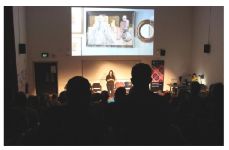 "Janice Rieger, Jasmien Herssens, Megan Strickfaden, Bree Hadley (2019) International Inclusive Film Screening, DfA Week (with films from Finland, Canada, China and Australia)." "The inclusive international film screening included films from Australia, Finland, Canada and China that represent different kinds of abilities, disabilities, inclusion and exclusion through material culture, architecture, urban spaces, landscapes and design. This screening was about access, inclusion and community outreach and included live audio descriptions and Auslan interpretation. The Film screening was separated into two parts with a total of 9 films screened: Part 1: ‘Seeing’ things from a Different Perspective, which included the films: Bakala, Australia (Aboriginal); Eske, (Finland); Musical Notes (Canada); Visitability #1 (Canada) Part 2: Part 2: Temporal and Embodied Encounters: Design, Disability and Slowing Down, which included the films: Smoke Time (Canada & China); Visitability #2 (Canada); Heel of a Time, Canada; Visitability #3 (Canada) ; Wandering on the Braille Trail (Australia)."
-
"Sarah Austin, Chris Brophy, Lachlan MacDowell, Edward Paterson, and Winsome Roberts (2015) Beyond Access: The Creative Case for Inclusive Arts. Melbourne: Arts Victoria." Reads, in part "Beyond Access sought to create an evidence base for the creative case for inclusive arts practice to support greater recognition for artists with a disability by transforming and extending notions of what art is and who produces it."
-
"Bree Hadley (2022) Disability and the Arts, Creative, and Cultural Industries in Australia. Australian Academy of Humanities" Reads, in part "There are five interrelated factors that support arts workers, arts organisations, and the arts sector at large to develop improved policy, protocol, and training practices."
-
"Commonwealth of Australia (2024) Equity: the Arts and Disability Associated Plan" "Equity: the Arts and Disability Associated Plan (the Plan) was released on 14 November 2024. The Plan is a four-year roadmap of activities to build the foundations for equity for artists, arts workers and audiences with disability across Australia, with an $8.1 million investment in actions to drive change."
-
"Parkinson's Queensland (2015) Research Study finds Dance has positive benefits for people with Parkinson’s, 4 March 2015, https://webarchive.nla.gov.au/awa/20150311153726/http://parkinsons-qld.org.au/danceforpd/" Parkinson's Queensland -Research Study finds Dance has positive benefits for people with Parkinson’s (2015) - reads, in part "Now, in exciting research findings, Parkinson’s Queensland, in conjunction with Queensland Ballet and research undertaken by QUT and The University of Queensland (UQ) demonstrate that Queensland Ballet’s Dance for Parkinson’s program had positive physical, social, cognitive and emotional benefits for participants affected by Parkinson’s."
- Sit Down Shut Up and Watch Film Festival
- Victorian State Opera
- Unlimited UK