Items
Search full-text
Create Ability: A Conference on Creativity and Disability
-
“Writeability (VIC) is established in 2012” The Writeability program was established in 2012, beginning as a partnership between Writers Victoria and Arts Access Victoria. "Writeability program supports writers with disability wanting to develop their skills and writing careers." It aims to remove barriers and provide information, resources, and fellowships so disabled writers can “tell their own stories in their own way”.
-
“Screen Australia launches an access coordinator training program” Screen Australia launched an access coordinator training program in 2023. “The Access Coordinator role is intended for people from the Deaf/Disabled and/or Neurodivergent (DDN) communities who are committed to improving disability representation and removing barriers to inclusion.” Screen Australia partnered with the following organisations for the initiative: the New Zealand Film Commission, Screen Queensland, Screen Tasmania, Screen Territory, Screenwest, VicScreen, the South Australian Film Corporation, Screen ACT, Screen NSW, and the Australian Film Television Radio School.
- Petra Kuppers
-
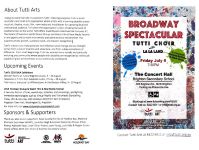 “Tutti Arts – Tutti Choir - Broadway Spectacular 2018 – Promotional Program” Tutti Arts – Tutti Choir ‘Broadway Spectacular’ 2018 Promotional Program – reads, in part “Taking its name from the musical term 'tutt', meaning everyone, Tutti is South Australia's only multi arts organisation where artists with a learning disability create visual art, theatre, music, film, new media and installations for a growing local and international audience. To further the organisation's vision of taking the work of disabled artists to the world, Tutti offers disability-led collectives like Company AT, The Sisters of Invention and Sit Down Shutup and Watch Film & New Media Festival a rare opportunity to work in an artistic and administrative environment. This supports artistic growth, audience reach, and industry recognition.”
 -
”Bree Hadley, Janice Rieger, Katie Ellis, Eddie Paterson (2024) Cultural safety as a foundation for allyship in disability arts. Disability & Society, 39(1), pp. 213-233.” "In this article, we argue that cultural safety, respect, and trust is a precursor to good allyship in the creative industries. We outline factors that influence feelings of safety or non-safety for disabled arts and media makers, and the way the legacy of the medical model makes it difficult for many arts and media workers to appreciate and enact enablers of safety as part of an allyship relationship."
-
"Bree Hadley (2022) Disability and the Arts, Creative, and Cultural Industries in Australia. Australian Academy of Humanities" "This week saw the release of Ensuring Occupations are Responsive to People with Disabilities, a landmark report by the Australian Council of Learned Academies (ACOLA) commissioned by the Australian Government Department of Social Services. As part of the Academy of Humanities’ support for the project, Professor Bree Hadley provided a study of disability in the arts, creative, and cultural industries for the project, and Professor Gerard Goggin was a member of the Expert Reference Group. In this week’s Five-Minute Friday Read, they explain why disability training needs fundamental reform now."
-
"Gerard Goggin, Christopher Newell (2003). Digital disability: The social construction of disability in new media. Rowman and Littlefield." Media representation of and for the disabled has been recharged in recent years with the expansion of new media worldwide. Interactive digital communications--such as the Interact, new varieties of voice and text telephones, and digital broadcasting--have created a need for a more innovative understanding of new media and disability issues. This engaging analysis offers a global perspective on how people with disabilities are represented as users, consumers, viewers, or listeners of new media, by policymakers, corporations, programmers, and the disabled themselves.
-
 "Victoria : disability fact pack for arts and cultural organisations - DADAA National Network and Australia Council (1998)" Disability fact pack for arts and cultural cultural organisations in Victoria
 - Arts Access Australia
-
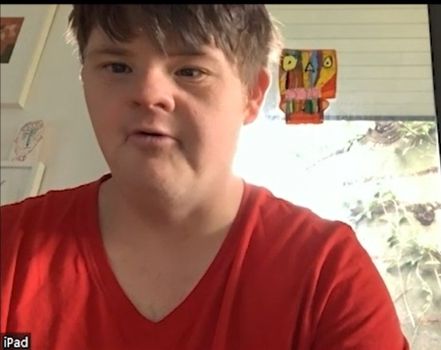 "Interview with Digby Webster" Digby Webster is a visual artist working with the mediums of oil pastels and acrylics and is also a performer, designer and co-founding member of past performance ensemble Ruckus Ensemble. Interview Summary Digby Webster is an artist with a wide range of creative talents, including theater, dance, animation, and mural painting. He has worked on various projects, including an animated short film called "Blockhead and Sparkles," and has had his artwork displayed in places like the Sydney Olympic Park and Vivid Sydney. Digby does not define himself by his disability and takes pride in the various creative endeavors he's involved in, aiming to have his art reach people in meaningful ways outside traditional galleries. In the future, he is interested in exploring fashion, designing artwork for clothing, and he hopes to see more people wearing his art.
 - Nina Angelo
- SunshineTroupe
- Ability Bunch Drama Group
- Alex Sideratos
- Ashleigh Smart
- Bailey Richards
- Blaise Borrer
- Bridie McKim
- Carl Emmerson
- Clay Antonio
- Dane Jaeger
- Dan Sanguineti
- Emma Barry
- George Holahan-Cantwell
- Ian Heydon