
Items
Search full-text
Create Ability: A Conference on Creativity and Disability
-
“Flow Festival, Australia’s Deaf Arts festival, is founded” Flow Festival, Australia’s Deaf Arts festival, was founded in 2018 by Ramas McRae, Irene Holub, and Medina Sumovic. The Deaf-led biennial festival provides a groundbreaking and dedicated platform for established and emerging Deaf/Hard of Hearing artists. Flow is held in Victoria but is described as “Australia’s national celebration of Deaf arts and culture”.
-
“The documentary series ‘You Can't Ask That’ premieres in 2016” The ABC started a documentary series in 2016 called ‘You Can't Ask That,’ which asks "outrageous, uncomfortable and shocking questions to uncover the truth behind some of the most marginalised and misunderstood Australians." The series has featured episodes focused on people with short stature, Downs syndrome, schizophrenia, and autism, Deaf people, blind people, and wheelchair users.
-
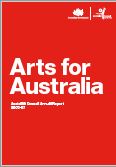 "Australia Council - Annual Report 2006-07" Australia Council Annual Report 2006-07 - discusses letter from chairman, year in review, from the CEO, Excellent and Distinctive Art from various artforms, Access for all Australians from various artforms, A strong and vibrant arts sector including artist’s earnings, philanthropic support and arts sector development, About the Australia Council, Governance, Organisation, Accountability, Workplace and Financial statements but no longer listing grants of organisations or individuals however discusses the DADAA WA – Lost Generation Project where a five year project intends to have more than 360 people with intellectual disabilities create self-portraits on film – one of the outcomes of DADAA WA receiving $104,775 in 2006-07 as a key organisation of the community partnerships section.
-
"The Arts and Disability" This booklet/brochure provides images, descriptions of the work, and contact details and contact organisations for key organisations in South Australia including: Access2Arts; Bearded Dragon Gallery; Broughton Art Society; Community Bridging Services Inc. (CBS); Company AT; Learning Creative Skills; Lolly Jar Circus; mindshare; No Strings; Restless Dance Theatre; Sit Down, Shut Up and Watch Film and New Media Festival
-
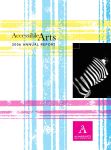 "Accessible Arts - Annual Report 2006" Accessible Arts - Annual Report 2006 - About Accessible Arts, Chair’s report, Chief Executive Officer’s report, Accessible Arts’ people, Strategic Outcomes, Service, Arts programs, Training, Audience Development, Information and Public Relations
-
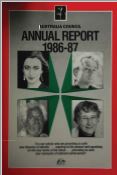 "Australia Council - Annual Report 1986-87" Australia Council Annual Report 1986-87- discusses functions and objectives, structures, process and membership of Council, Council Committees and members, board members, assessment panels, staff lists, organisation chart, main activities of Council and its Boards, and includes financial statements and lists of grants made including grants for programs, workshops for disabled people in community arts, funding for posters on theme of disability, grant for Theatre of the Deaf Braille Book of the Year award and Sound Pot Purri literary magazine for Royal Blind Society
-
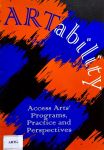 "Artability - Access Arts' Programs, Practice and Perspectives" Explains history, members rights, policies, arts pathways, training, classes, and planning to support these activities, plus information on programs – including Caberet Erratica, Cartoon Advocacy, Melrose Park Project, New Farm Park Mosaics, Visual Arts Exhibition, Explaining Discrimination Video Project – and examples of writing by Access Arts members
- Belinda Mason Lovering
- Belinda Mason
- Michael Donnelly
-
“The Broughton Art Society is founded in 1965” The Broughton Art Society was established in 1965 by Ian Broughton (as The Arts Society for the Handicapped). Broughton, who had muscular dystrophy, was a resident at The Home for Incurables. BAS offers community-based art classes to adults living with disability.
-
“Crossroad Arts (Queensland) founded in 1996” Crossroad Arts (Queensland) was founded in 1996 by Steve Mayer-Miller. "Crossroad Arts collaboratively develops opportunities for people who experience a disability, to access and participate in the arts".
-
“Access Arts establishes the SAFE Grant” In 2007, Access Arts established the SAFE Grant – Sacred Angel Funding Empowerment. It is a one-off grant for $1,000 to “emerging and professional artists with disability living in Queensland. It is designed to fund the costs (up to $1,000) of attending conferences, training courses, events or mentoring to help enhance an artist’s professional career.” The SAFE grant was established by Peter Vance, whose wife Marilyn passed away from angiosarcoma. In 2019, Choice, Passion, Life (CPL) “committed to upholding the legacy of Peter and Marilyn for an additional 10 years”.
-
“Sydney Film Festival launches Screenability program in 2017” Sydney Film Festival launched its Screenability program in 2017. The international program was intended to offer a platform for screen practitioners with disability. Sofya Gollan was Screenability’s inaugural programmer and remained in the role until 2021.
- Michelle Ryan
-
"Hickey Moody, Anna. 2009. Unimaginable Bodies: Intellectual Disability, Performance and Becomings. Rotterdam: Sense." Reads, in part "Unimaginable Bodies radically resituates academic discussions of intellectual disability. Through building relationships between philosophy, cultural studies and communities of integrated dance theatre practice, Anna Hickey-Moody argues that dance theatre devised with and performed by young people with and without intellectual disability, can reframe the ways in which bodies with intellectual disability are known."
-
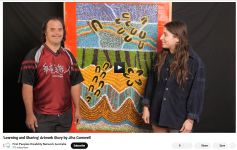 "NuunaRon Art Group - ‘Learning and Sharing’ Artwork Story by Jiha Cornwell" First Peoples Disability Network NuunaRon Art Group - ‘Learning and Sharing’ Artwork Story by Jiha Cornwell - reads, in part "The 'Culture is Inclusion' art exhibition showcases art work by the NuunaRon First Nations art group, with a lived experience of disability, telling their stories of resilience and strength through connecting to their culture"
- Gaelle Mellis
-
 "Accessible Arts and Arts OutWest - Artability Music Workshops - Press Release" Accessible Arts and Arts OutWest - Artability Music Workshops 1995 - Press Release - reads, in part "Local musicians in Bathurst, Orange, and Dubbo are being sought by Accessible Arts Inc to run music workshops for people with disabilities. Free Music Improvisation training days for local artists, musicians, arts, and disability workers will also be run by Accessible Arts in October 1995. Anyone interested in participating is invited to attend the community consultancy meetings in each centre, held from Monday 11 September to Wednesday 13 September 1995."
-
"The Australian Council for the Arts established in 1968" The Australian Council for the Arts was established in 1968. This came after a push during the late 1960s for better support of the arts in Australia. The Council replaced the Elizabethan Trust as Australia’s main arts body, although the Trust continued to receive funding from State governments. The Council was later given statutory authority in 1975 and called Australia Council. Prime Minister Gough Whitlam is recognised as a key political supporter of the arts. The election of Whitlam (serving from December 1972 to November 1975) gave unprecedented and considerable attention and funding to an arts policy which would establish an Australian cultural identity raising international awareness. The Australian Council for the Arts received an unprecedented $14 million in funding in the 1973/74 budget. This was “more than double the allocation the bodies out of which it evolved had received the year before. The Council’s allocation was increased by a further 50 per cent in the 1974/75 Budget."
-
“Assistance to Composers Advisory Board created by the Commonwealth government.” In 1967, the Commonwealth government created the Assistance to Composers Advisory Board with an aim to advise on funding needs for music composition and promotion of Australian composers. The Board was to judge work based on “musical distinction or excellence of its kind, and on the promotion of Australian composers both in Australia and abroad”. The Board’s functions were later absorbed by the Australia Council.
-
“WHO International Classification of Impairment, Disabilities and Handicaps (1976)” International classification of impairments, disabilities, and handicaps: a manual of classification relating to the consequences of disease, published in accordance with resolution WHA29.35 of the Twenty-ninth World Health Assembly, May 1976
-
“Deaf Arts Network (DAN) established in 2000” The Deaf Arts Network (DAN) was established with the aid of Arts Access Victoria in Melbourne in 2000. DAN “is dedicated to increasing the participation of deaf and hard of hearing people in the arts as artists, arts workers and audiences. […] DAN provides an authentic and unique cultural voice for the deaf community, a community historically marginalised from participation in the arts.”
-
“Auslan features intermittently on Australian television throughout the 1990s, 2000s, and 2010s” Auslan appeared intermittently on Australian television throughout the 1990s, 2000s, and 2010s. Ana Maria Belo has curated a video compilation of scenes featuring Auslan. Belo calls it “a very brief history lesson on Deaf Actors on Australian Television before Social Media.” As she explains, “this is not a complete list of performances, but a nod to the actors who blazed a mighty trail for those of us who attempt to follow.”
-
"Ruth Rentschler, Boram Lee, Ayse Collins, Jung Yoon (2023) ‘I am a professional dancer’: A case study of performing artists with disability. In Wyszomirski, M. J. & Chang, W. (Eds.), Building professionalism in the creative sector. Oxon: Routledge, 227-246" "The demand for professional recognition for artists with disability is growing. There is little research, however, on the ways in which disability arts are associated with professionalism. This study examines professionalization in disability arts by comparing it with the concept of professionalization in the arts generally. It identifies three components of professionalization in disability arts by means of a case study of an inclusive arts organization. This qualitative study entails 17 semi-structured interviews with artists, staff members, and other stakeholders both with and without disabilities."