Items
Search full-text
Create Ability: A Conference on Creativity and Disability
-
"Commonwealth of Australia (2017) “National Arts Disability Strategy Evaluation Report 2013–2015.” Canberra: Meeting of Cultural Ministers." Reads, in part "The second Evaluation Report was endorsed by cultural ministers in September 2017. It concludes that progress continues to be made against the Strategy. It also identifies that there have been significant changes to the arts and disability sector since the release of the Strategy in 2009 such as the introduction of the National Disability Insurance Scheme."
-
"Bree Hadley (2022) Disability and the Arts, Creative, and Cultural Industries in Australia. Australian Academy of Humanities" Reads, in part "There are five interrelated factors that support arts workers, arts organisations, and the arts sector at large to develop improved policy, protocol, and training practices."
-
"Commonwealth of Australia (2024) Equity: the Arts and Disability Associated Plan" "Equity: the Arts and Disability Associated Plan (the Plan) was released on 14 November 2024. The Plan is a four-year roadmap of activities to build the foundations for equity for artists, arts workers and audiences with disability across Australia, with an $8.1 million investment in actions to drive change."
- Alice Springs Youth Arts Group (ASYAG)
- InCite Youth Arts
-
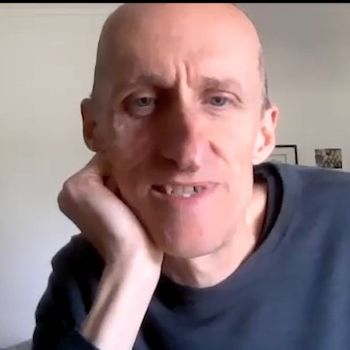 "Interview with Andy Jackson" Andy Jackson is a published poet focusing on disability and difference, has completed a PhD and is a lecturer of poetry and creative writing. INTERVIEW SUMMARY This is an oral history interview with poet Andy Jackson. Andy, who has Marfan syndrome, discusses how disability and visible difference have shaped his writing and poetry, explaining that he often writes about the meaning of the body within society. He emphasizes the importance of Disability Arts, noting a growing community of disabled writers and expressing the need for both disability-specific literary spaces and mainstream recognition. Andy also highlights the transformative role of online communities in creating networks for disabled individuals and the emergence of disability-focused literary journals, anticipating an anthology from a collaborative writing project he is involved with.
-
 "Australia Council - Annual Report 2002-03" Australia Council Annual Report 2001-2002 - discusses letter from chair of council, corporate overview, year in review, financial statements, analysis of funding and grants for projects, initiatives, new work, programs, presentation and promotions including funding for implementing the Commonwealth Disability Strategy by evaluating current and changing needs of people with disabilities in the arts sector and reflecting this in funding and policies, arts marketing and audience development and triennial grants to disability arts organisations in NSW, South Australia and Victoria as well as a Fellowship by the Community Cultural Development Board (CCDB) to Tony Doyle to develop models for disability-led community building and on-the-job training for disability support workers and performance of “Soft” by Back to Back theatre at the Melbourne Festival and on tour to Switzerland and Germany.
-
 "Australia Council - Annual Report 1989-90" Australia Council Annual Report 1989-90 - discusses objectives, highlights, support for artform development, main activities of Council and its Boards, and includes financial statements and lists of grants made including grants for conferences, access and touring, programs training and resource development as well as publications such as “The Arts and People with Disabilities”
-
 "Accessible Arts - Avenues into Creativity for People with Disability 1986- Report" Accessible Arts - Avenues into Creativity for People with Disability 1986- Report - PANEL ON 'WHY THE ARTS - Joan Hume: Why the Arts? An overview of the Need; - Lydia Fegan: Citizen Advocacy INFORMATION EXCHANGE - Who's Who - What's Happening SPECIFIC PROJECTS - Jo Caust: Arts Access Society Melbourne; - Angelika Pechloff: Good Time Junk Machine; - Laura Hastings-Smith: Adolescent Medical Unit Children's Hospital, Camperdown ON ART - Pam Fairburn: Cromehurst Special School OPEN SESSION: COMMUNITY GROUPS- Rozelle Arts and Drama Group: Sue MacDonald; - Art Reach: Melissa Lee VIDEOS - Linda Dyer: Activities Research Department, RNSH- Arts with the Aged: Jana Cattanach; The Ward Game- Laura Hastings-Smith: Adolescent Medical Unit; Children's Hospital, Camperdown; ENTERTAINMENT: 'Finger Ballet' - Chin Yu; PUTTING IDEAS INTO ACTION - Jana Cattanach: Artist in Residence, Tweed Shire Council; - Margot Currey: Community Artist/Sculptor; - Nan Bosler: Co-ordinator of the Narrabeen Community Learning Centre & Northern Beaches Creative Leisure Movement; ACCESS: OBSTACLES AND SOLUTIONS! - Ellen Bynum: Accessibility Consultant; - Lis Pack: Royal Blind Society; - Wendy Miners: Recreation Project Officer, AAMR; INTEREST GROUPS - Drama & Movement - Alison Lee; - Computer Art - Duncan Wallace; - Music - John Broomhall, Wollongong; - Silkscreen - Nina Angelo; - Craft - Branka Kringas
-
 "Accessible Arts - ACE Arts Creativity Expression -1998 Win - Iss2" Accessible Arts - ACE Arts Creativity Expression News Publication issue 2 Winter 1998 - information/reviews of Creative Writing, Music, Dance, Theatre and Performance programs,opportunities, resources, Accessible Arts AGM
-
“ABC appoints Stella Young as editor of Ramp Up” In 2010, ABC announced the appointment of Stella Young as editor of its first (and short-lived) dedicated disability platform, ABC Ramp Up. Shawn Burns’s 2014 article in The Conversation laments the closure of the initiative and the loss of a vital platform for better disability representation in Australian media. The URL link to the Ramp Up page now opens with the following statement: “This website is no longer being updated but remains online as an archive of three and a half years of discussions and conversations regarding disability in Australia.”
-
"Margaret Cooper (1999) The Australian Disability Rights Movement Lives. Disability & Society, 14(2), 217–226. https://doi.org/10.1080/09687599926280" Reads, in part "The Australian Disability Rights Movement is surviving despite funding threats to advocacy programmes. The integral relationship of advocacy funding to the Australian Disability Rights Movement is outlined. A brief history of the Australian Disability Rights' Movement is given, and whether this is a new social movement, or not, is discussed. The role of Women With Disabilities Australia is outlined."
-
 "Australia Council - Annual Report 2016-17" Australia Council Annual Report 2016-2017 – discusses purpose, reports from chair and CEO, year in review, report from the CEO, Strategic priorities, funding overview, statement of outcome, about the Australia Council including The Governing Council and the Board, Structure of the Australia Council with new grants model; performance outcomes, manageability and accountability, financial statements and discussion of the final year of delivering $1.3 million over four years to support artists with disability with their careers and funding more organisations to support producing and touring disability-led and mixed-ability arts practice as well as mentoring arts leaders with disabilities and publication of the Council’s 2014–16 Disability Action Plan review.
-
“Tutti Arts is founded in Adelaide by Pat Rix in 1997” Tutti Arts was founded in Adelaide by Pat Rix in 1997. Initially a choir of people with and without disabilities, it quickly added a focus on visual arts. Tutti has since expanded to offer programs in dance, screen, music, acting, and visual arts, and its choir continues. Programs are on offer in Brighton, Port Adelaide, and in the Barossa Valley, for adults as well as kids and youth. Tutti has performed both nationally and internationally, and has taken part in significant co-productions. Tutti Arts and KickstARt 2 Choir presented Up and Away for the KickstART Festival in Vancouver, Canada in 2004. Tutti’s international performance of 'Between the Worlds' in Minneapolis, Minnesota (2007) was remounted as a coproduction with Interact Center for the Performing and Visual Arts. Tutti returned to Minneapolis in 2009 to perform ‘Northern Lights, Southern Cross,’ which they first performed in 2007 for Adelaide Fringe. It was a collaboration with Interact, which brought together Aboriginal, Native American and Disabled Artists from the Northern and Southern hemispheres “to explore personal, racial and environmental trauma.” In 2009, Tutti Ensemble performed with the State Opera of South Australia to present ‘The Shouting Fence’.
-
"Catherine Grant (2013). Participating in arts- and cultural-sector governance in Australia: Experiences and views of people with disability. Arts & Health, 6(1), 75–89. https://doi.org/10.1080/17533015.2013.826259" Reads, in part "This study sought the perceptions and experiences of people with disability relating to their potential or current involvement in the governance of arts and cultural organisations in Australia. Methods: A total of 32 people participated in an online survey, and results were analysed qualitatively and quantitatively. Results: The findings revealed that those participants who had been involved in governance benefited from it in terms of self-esteem, participation in society and well-being." Contains tables with survey data.
-
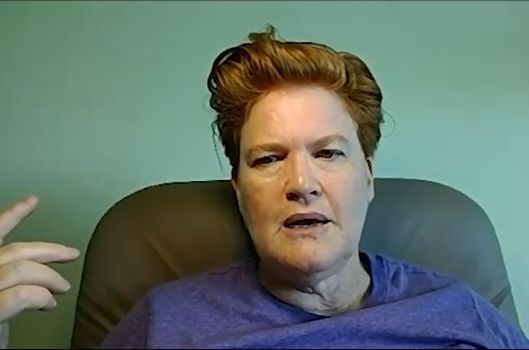 "Interview with Michèle Saint-Yves" Michèle Saint-Yves is a playwright, filmmaker, poet, and director. Interview Summary Michèle Saint-Yves’ background includes a colonial upbringing in Pacific territories, a Scottish boarding school education, and a complex personal journey of confronting her own inherent racism and colonial legacy, particularly through her writing. Her work as an artist with disability is deeply informed by her sense of otherness and focuses on creating inclusive performance-based work that challenges mainstream audiences and systems, aiming for transformative experiences that impact disability justice and community. Michèle actively embraced the social model of disability, which shifted her understanding of herself and her art, and has received recognition for her pioneering work with the prize-winning show "Clock for No Time." However, recognising the social model’s limitations, her current creative endeavours are concerned with 'access intimacy' and evaluating the lasting impact of her performances, in collaboration with other artists and through research grants.
-
"Janice Rieger and Megan Strickfaden(2019) “Dis/ordered assemblages of disability in museums.” In The Routledge Handbook of Disability Art, Culture, and Media, edited by Bree Hadley and Donna McDonald, 48–61. London & New York: Routledge." "Museums are spaces of power and care. They are institutions that present assemblages (Deleuze & Guattari 2002), which are reconstructions and representations of history and societal values, and thus are partial realities that curate human existence. These assemblages cannot ever represent the totality of human existence because it is never possible to do so, and yet these assemblages are embedded with power because choices are made about what ought or ought not be represented within museums (Ott 2013; Bennet 2017). The nature of partial realities is that, at their centre, these are still representations that tell stories of what one would imagine to be the most significant events related to a place (nation, city), with a particular focus on a societal event or issue (war, art, sports, nature, human rights, etc.) and peoples (e.g. immigrants, migrants, First Nations or Indigenous peoples, etc.). Persons attending museums rely on the expertise of historians, curators, archivists, conservators, and exhibition designers to present materials within the museum that focus upon and represent societal values. Most museum visitors are not aware of the power that museums hold, although more and more museum visitors push against narratives which they do not feel to be adequate representations of the places, events, issues, and peoples of society (Hooper-Greenhill 1992, 2000; Anderson 2004; Janes 2009, 2010). Where there is power, there is also care. Historians, curators, archivists, conservators, and exhibition designers take great care in how they assemble materials within museums."
- ABC
-
 "Accessible Arts - ACE Arts Creativity Expression -2003 Nov - Iss29" Accessible Arts - ACE Arts Creativity Expression News Publication Issue 29 November 2003 - information/reviews of Creative Writing, Music, Dance, Theatre and Performance programs,opportunities, resources, including establishment of a Disability Arts Workers Network, and new accessible theatre for Sydney Theatre Company
-
“Inaugural High Beam festival in 1998” High Beam was a biennial community-based disability arts festival. It was a joint initiative of SPARC Disability Foundation and Arts In Action (through the direction of Tony Doyle). (Arts in Action later became Arts Access SA.) The 10-day event was the first of its kind in the Southern hemisphere, attracting around 20,000 people at each festival. The festival showcased theatre, dance, comedy, and music. Some celebrity artists included Adam Hills and David Helfgott. The inaugural festival (1998) invited Swedish Disability Theatre Company Mooms Teatern to perform; the company also conducted workshops with a disability-led Australian theatre company, No Strings Attached. This first festival was also the site of Tutti's first public performance as a choir.
-
"A number of theatre companies are established in the 2000s" A number of theatre companies were established in the 2000s, particularly towards the end of the decade. Some key companies in disability theatre or inclusive arts practice to emerge in the 2000s are: Second Echo Ensemble (2005, integrated, often producing work in partnership with the Tasmanian Theatre Company), Ever After Theatre Company (2006, performers with disability), Rollercoaster Theatre Company (2007, performers with disability), DirtyFeet (2008, inclusive), and Blue Roo Theatre (2009, performers with disability).
-
"Bree Hadley, Gerard Goggin, Petra Kuppers, Colette Conroy, Meagan Shand, Donna McDonald, Martin Paten, Norm Horton, Sarah Moynigan, Veronica Pardo, Caroline Bowditch, Morwenna Collett, Kerry Comerford, David Doyle, Pat Swell, Clark Crystal, Peter Stuart (2019) The NDIS and disability arts in Australia: Opportunities and challenges. Australasian Drama Studies, 74, pp. 9-38." "In Australia, disabled people’s participation in the arts has historically been afforded by means of direct-to-organisation grants that arts, community services or disability services arms of government award to arts organisations, charities or disability service organisations, who then deliver programmes. The introduction of the National Disability Insurance Scheme (NDIS) is creating wide-reaching changes for disability arts practice in Australia. We undertake a first step in addressing the need for research into how the NDIS will alter the landscape of disability arts practice in Australia. We highlight a set of questions that all performing and creative arts industry stakeholders will need to respond to, in order to ensure that the excellent work done in disability arts in Australia to date can continue in the new climate that the NDIS brings."
-
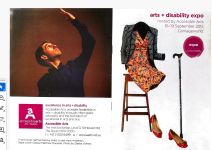 "Accessible Arts - Arts and Disability Expo - Program" Accessible Arts - Arts and DIsability Expo 2015 - Program - reads, in part "'Welcome to the first arts + disability expo. The arts + disability expo aims to provide you with information, advice and access to arts and cultural opportunities. With a variety of arts programs, organisations, venues and practitioners on hand, we hope to provide you with all the support that you need to become involved in creative pursuits. We encourage you to watch some of the performances, listen to the talks about the National Disability Insurance Scheme (NDIS), and view the photographic exhibition. The expo is also a good opportunity to see new and different levels of creative work by artists with disability.' - Sancha Donald, CEO, Accessible Arts"
-
 "Australia Council - Annual Report 2004-05" Australia Council Annual Report 2004-2005 - discusses letter from chair of council, letter from CEO, corporate overview, year in review, goals, financial statements, analysis of funding analysis and grants list, including funding for key organisations, new work, presentation and promotion, audience participation (with publication “Access All Areas”), skills and arts development with Arts Access partnering with Helicon Dance to provide 10 workshops in Princess Alexandra hospital Mental Health Service to find out which arts the community members wanted to pursue with a reference group including the University of Queensland and funding for Back to Back theatre to perform Small Metal Objects, in collaboration with sound artist Hugh Covill, animator Rhian Hinkley, director/designer Bruce Gladwin to shed light on, provoke and transform society, and to position artistic creativity as an integral part of the nation’s agenda. Triennial funding to Arts Access Australia (formerly known as Disability in the Arts Disadvantage in the Arts Australia—DADAA)
-
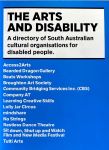 "The Arts and Disability No Date #2" Except as permitted by copyright law, you may not reproduce or communicate any of the content on this website, including files downloadable from this website, without the permission of the copyright owner. The Australian Copyright Act allows certain uses of content from the internet without the copyright owner’s permission. This includes uses by educational institutions and by Commonwealth and State governments, provided fair compensation is paid to the copyright owner. For more information, see www.copyright.com.au and www.copyright.org.au.