Items
Search full-text
Creative Writing
- Bree Hadley
- Boram Lee
-
"Amanda Cachia (2013) ‘Disabling’ the museum: Curator as infrastructural activist. J. 12.3. pp. 257–289" Reads, in part "This article will explore how I attempt to ‘disable’ the museum through my infrastructural curatorial practice, which is the basis for my scholarly research and writing. By infusing my curatorial projects with critical reflection and theoretical development, I hope to begin this process of building a new vocabulary and methodology around curating disability and access."
-
 "Let Me See - review by Keiran Finnane 2015, captured 2016" Describes InCite Arts ‘Starts with D Performance Ensemble’ members Tiffany Malthouse, Matt Woodham, Brandon Williams, Martin Armstead and director Kat Worth’s production of ‘ Meet You at the Edge’, as part of ‘Let Me See’ produced by Red Hot Arts Central Australia at Araluen Centre for the Arts, including film, use of audio description, writing, and choreography
 -
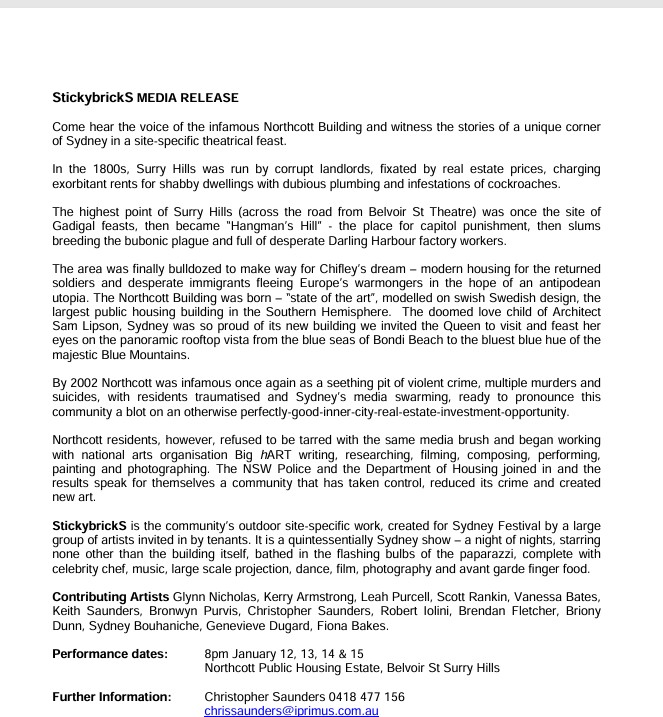 "Sydney Festival - StickybrickS MEDIA RELEASE - 2006" Sydney Festival - StickybrickS 2006 MEDIA RELEASE - Reads, in part "By 2002 Northcott was infamous once again as a seething pit of violent crime, multiple murders and suicides, with residents traumatised and Sydney’s media swarming, ready to pronounce this community a blot on an otherwise perfectly-good-inner-city-real-estate-investment-opportunity. Northcott residents, however, refused to be tarred with the same media brush and began working with national arts organisation Big hART writing, researching, filming, composing, performing, painting and photographing."
 -
"Bree Hadley, Clark Crystal (2017) Style, stage presence, and the poetic subversion of stereotypes: A case study of Blue Roo Theatre Company. Social Alternatives, 36(4), pp. 15-21." "In this article, we consider the work of Blue Roo Theatre Company (http://www.bluerootheatre.org.au/), a Brisbane-based theatre company which “creates contemporary performances lead by the artistry, experiences and imaginations of an ensemble of artists with diverse ability and impairment” (http://www.bluerootheatre.org.au/). Writing from a dual insider-outsider perspective – as a scholar of disability theatre and a creator of disability theatre in conversation – we discuss the work done in the training and rehearsal room in the lead up to Blue Roo Theatre Company’s performances, such as the company’s recent sell-out performance of Orpheus and Eurydice in collaboration with Opera Queensland at the Judith Wright Centre for Contemporary Arts, and the way it creates a distinctive performance style, poetics, stage presence, pleasure for the spectators who come along to witness the results of the work, and sense of community. We document moments in which facilitators, collaborators, co-creating artists, audiences and the media alike feel the physical, psychological, and aesthetic focus and force of voice, movement and character work by people with disabilities. We identify ways in which this stage presence can subvert dominant depictions of people with disabilities as innocent, childlike, or inspirational as significantly as the content of a show. In doing so, we provide insights into Blue Roo Theatre Company’s processes, and the aesthetic results it produces, and contribute to a growing body of commentary around disability theatre and performance, which – though increasingly well understood by those working in the form – clearly can still provide surprises for audiences and commentators anticipating conventional representations of people with disabilities onstage."
-
 "The Other Film Festival Revisited 2020" The Other Film Festival 2020 Revisited - information about the Festival, program, achievements, including in 2020 writers room activity, daily screen writing prompt tasks, and events relating to climate change
 -
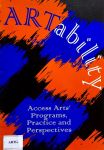 "Artability - Access Arts' Programs, Practice and Perspectives" Explains history, members rights, policies, arts pathways, training, classes, and planning to support these activities, plus information on programs – including Caberet Erratica, Cartoon Advocacy, Melrose Park Project, New Farm Park Mosaics, Visual Arts Exhibition, Explaining Discrimination Video Project – and examples of writing by Access Arts members
 -
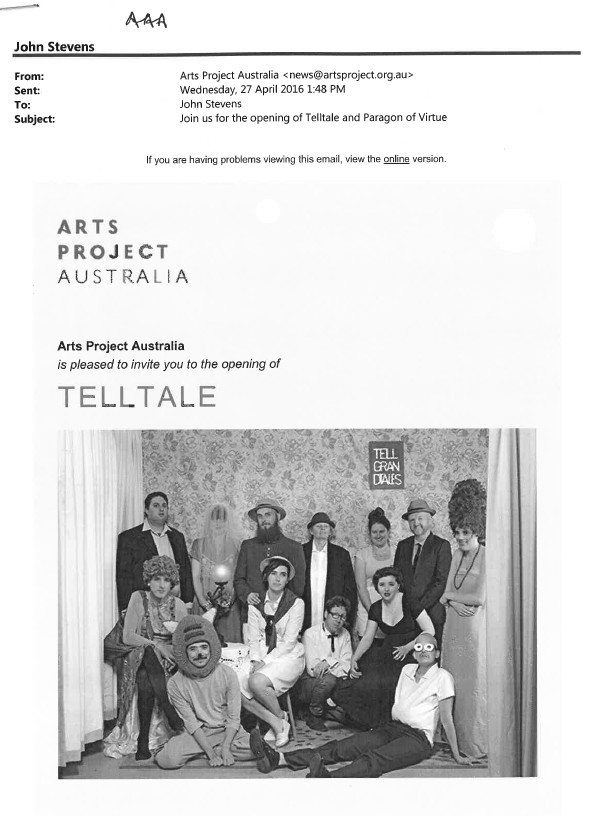 "Arts Project Australia - Telltale - ParagonOfVirtue Exhibition 2016 - Email Promotional Flyer" Arts Project Australia - Telltale - ParagonOfVirtue Exhibition 2016 - Email Promotional Flyer - Telltale is a writing and exhibition project centred on a narrative conceived by ten artists, written by Justin Hinder and explored over a series of collaborative workshops and studio sessions at Arts Project Australia. Telltale was developed through Next Wave's Emerging Curators Program with Arts Project Australia for Next Wave Festival 2016."
 -
 "Tutti Arts -Tutti Kids - Kids and Youth Program Showcase 2017 - Program" Tutti Kids and Youth 2017 Showcase Program – reads, in part "The Tutti Kids and Youth Program provides Adelaide's only out of school hours arts program where young people living with disability are invited to develop their creativity through singing and song-writing, music, dance, movement, drama and theatre skills.”
 -
 "Tutti Arts -Tutti Kids - Kids and Youth Program Showcase 2016 - Program" Tutti Kids and Youth 2016 Showcase Program – reads, in part "The Tutti Kids and Youth Program provides Adelaide's only out of school hours arts program where young people living with disability are invited to develop their creativity through singing and song-writing, music, dance, movement, drama and theatre skills.”
 -
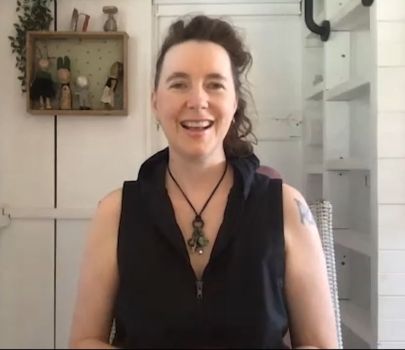 "Interview with Asphyxia" Asphyxia is an artist, author, activist and performer who has founded Amplio, a music app for Deaf and hard of hearing people. She also provides free online Auslan lessons and online art courses. Interview Summary Asphyxia is a Deaf artist whose journey into the arts started with a deep love for ballet, but after facing discrimination due to her Deafness, she pivoted to a successful career in circus performance and later puppetry, which embraced her Deafness and signing skills. Her work in performance art led her to write and illustrate the Awards-winning art-journal book, Future Girl, which explores Deaf identity and environmental issues. She has now moved into music, creating an app that makes music accessible and writing music designed with Deaf and hard of hearing audiences in mind. Although not sure about the major milestones in disability arts history in Australia, she considers her art to be both political and personal, often tackling issues related to her identity as a Deaf person and the aesthetics of disability equipment. While Asphyxia identifies as a Deaf artist, above all, she sees herself as an artist whose work appeals to the mainstream while celebrating Deafness and diversity.
 -
"Liz Ferrier (2000) Vulnerable Bodies: Creative Disabilities in Contemporary Australian Film. In Ian Craven ed. Australian Cinema in the 1990s. Routledge. https://doi.org/10.4324/9780203045022" Reads, in part "The internationally-acclaimed film Shine is one of a number of contemporary Australian movies which portray embattled artists or performers. Reminiscent of earlier works such as Starstruck (1982), Man of Flowers (1983), Malcolm (1986) and Sweetie (1989), and several more recent productions – Proof (1991), Strictly Ballroom (1992), Bad Boy Bubby (1994), The Adventures of Priscilia, Queen of The Desert (1994), Muriel's Wedding (1994), Cosi (1996), Lilian's Story (1996), and Jane Campion's New Zealand/Australian films, An Angel at My Table (1990) and The Piano (1993) – it depicts a disadvantaged individual overcoming setbacks through the passionate and eccentric expression of his creativity. The film and the cycle to which it belongs offers a peculiar vantage point from which to examine the problems and possibilities of Australian cinema in the 1990s."
-
"Queensland Government (2024) Arts and Disability Plan. 25 September 2024. https://www.arts.qld.gov.au/projects-and-initiatives/arts-and-disability-plan-web" Reads, in part "The Queensland Government acknowledges the rights of people with disability to participate equally in the state’s cultural life and to have the opportunity to develop and use their creative, artistic and intellectual potential, as recognised in the United Nations Convention on the Rights of Persons with Disability."
-
 "From Dust to Dust - Prologue" Reads, in Part, "A hybrid artist-curatorial project, inviting experimentation and conversations amongst Benjamin Hancock, Bryan Phillips, Jen Bervin, Shelley Lasica, Katie West, Simon Charles, Pippa Samaya, Gabriel Curtin, Adam Leslie, Zeno d'Evie, Anna Seymour, Ravi Vasavan, and in absentia, Aaron McPeake, Andy Slater, Jennifer Justice, and Lucreccia Quintanilla. Welcome to Country by Uncle Rick Nelson and Aunty Paulette Nelson.Afternoon tea by Murnong Mammas."
 - Fayen d'Evie
-
 "Undercover Artist Festival Program Released 2021" Undercover Artist Festival 2021, curated by Festival Director Madeleine Little, including Lauren Watson’s Nerve, Andi Snelling’s Happy-Go-Wrong, Naavikaran’s Brown Church, Oliver Hetherington-Page’s The No Bang Theory in the ‘Creative’ program track, and work by Timothy Orton, Mitchell Runcie and Allycia Staples from The Sunshine Troupe in the ‘Community’ track.
 -
 "Philip Channells - Dance Integrated Australia - Off the Record - Webpage" Philip Channells - Dance Integrated Australia 'Off the Record' Webpage - Reads, in part "The new collaboration between Dance Integrated Australia and Force Majeure, OFF THE RECORD underwent a first stage creative development at Carriageworks in Sydney during the first two weeks of December 2015."
 -
 "Australia Council - Annual Report 2017-18" Australia Council Annual Report 2017-2018 – discusses Rawcus and Julia Hales as examples of highquality work - reads, in part "Through our Disability Action Plan we continued to build the capability of our staff, including Easy English and the continuity of our audio description group. "
 -
 "Australia Council - Annual Report 2020-21" Australia Council - Annual Report 2020-21 - reads, in part "• We awarded two new prestigious National Arts and Disability Awards on the International Day of People with Disability in December 2020, to Emily Crockford and Gaelle Mellis. The Council partnered with Arts Access Australia (AAA) on our 2020 Arts and Disability Awards supporting the Arts Access Australia’s National Leadership Award to recipient Abbie Madden.", and "Research underway includes analysis of data from the Australian Consortium for Social and Political Research Incorporated (ACSPRI) national study on social inequality, analysis of access and equity in the online sphere and an Australian Research Council (ARC) Linkage Partnership exploring the evolution of Disability Arts in Australia."
 -
 “Australia Council - Events, captured 1998” Australia Council (Creative Australia) events captured December 1998, including Online Australia Day, National Arts Awareness Research and Strategy, Next Stage - The Performing Arts in the 21st Century Forum, 30th Anniversary, Media Releases and Artforce
 -
 "Australia Council - Access and audience development in Australia" Australia Council - 'Access and audience development in Australia' reports - reads, in part "These reports were commissioned in 2004 to assess what is currently being done, and what needs to be done, to increase access to the performing arts and museums & galleries in Australia for people with a disability."
 -
 "Australia Council - Making the Journey: Arts and Disability in Australia" Reads, in part "A collection of inspiring examples of how to include people with disabilities in the arts, as participants, creators and organisers"
 -
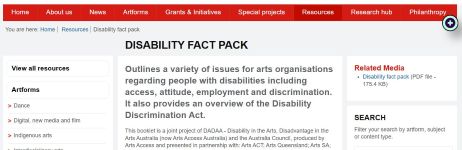 "Australia Council - Disability Fact Pack 1998" The website reads “Outlines a variety of issues for arts organisations regarding people with disabilities including access, attitude, employment and discrimination” - Noelene Gration
 -
"The Australian Council for the Arts established in 1968" The Australian Council for the Arts was established in 1968. This came after a push during the late 1960s for better support of the arts in Australia. The Council replaced the Elizabethan Trust as Australia’s main arts body, although the Trust continued to receive funding from State governments. The Council was later given statutory authority in 1975 and called Australia Council. Prime Minister Gough Whitlam is recognised as a key political supporter of the arts. The election of Whitlam (serving from December 1972 to November 1975) gave unprecedented and considerable attention and funding to an arts policy which would establish an Australian cultural identity raising international awareness. The Australian Council for the Arts received an unprecedented $14 million in funding in the 1973/74 budget. This was “more than double the allocation the bodies out of which it evolved had received the year before. The Council’s allocation was increased by a further 50 per cent in the 1974/75 Budget."