Items
Search full-text
Focus On Ability Film Festival
-
“2023 Screen industry report ‘Disability and Screen Work in Australia’ finds disabled people fulfil a range of roles in the screen industry, despite facing prejudice and exclusion, and should be treated as experts of their access requirements” ‘Disability and Screen Work in Australia: Report for Industry’ (2023) was compiled by researchers Radha O’Meara, Laura Dunstan, Anna Debinski and Catherine Ryan. The study was supported by Melbourne Disability Institute and A2K Media. The authors summarise that disabled people fulfil a range of roles in the screen industry, despite facing prejudice and exclusion, and should be treated as experts of their access requirements. They find that “Disabled people experience a more precarious, lower paid, and less powerful position in the screen industry than their non-disabled counterparts.” O’Meara and her colleagues call for widespread change in the industry to expand access.
-
”Bree Hadley, Donna McDonnald (Eds.) (2019) The Routledge Handbook of Disability Arts, Culture, and Media. Routledge International Handbooks. Routledge, London; New York.” “In the last 30 years, a distinctive intersection between disability studies – including disability rights advocacy, disability rights activism, and disability law – and disability arts, culture, and media studies has developed. The two fields have worked in tandem to offer critique of representations of disability in dominant cultural systems, institutions, discourses, and architecture, and develop provocative new representations of what it means to be disabled. Divided into 5 sections:- Disability, Identity, and Representation; Inclusion, Wellbeing, and Whole-of-life Experience; Access, Artistry, and Audiences; Practices, Politics and the Public Sphere; Activism, Adaptation, and Alternative Futures - this handbook brings disability arts, disability culture, and disability media studies – traditionally treated separately in publications in the field to date – together for the first time.”
-
"Bree Hadley, Donna McDonnald (2019) Introduction: disability arts, culture, and media studies - mapping a maturing field. In Hadley, B & McDonald, D (Eds.) The Routledge handbook of disability arts, culture, and media. Routledge, United Kingdom, pp. 1-18.” Reads, in part "In this book, an internationally recognised collection of established and emerging scholars, artists, and activists from across the US, UK, Europe, Asia, and Australasia come together to trace the development of disability arts, culture, and media studies in recent decades, flag current interests, and forecast future concerns."
-
"Bree Hadley (2014) Disability, Public Space Performance, and Spectatorship: Unconscious Performers. London: Palgrave Macmillan." "Why would disabled people want to re-engage, re-enact and re-envisage the everyday encounters in public spaces and places that cast them as ugly, strange, stare-worthy? In Disability, Public Space Performance and Spectatorship: Unconscious Performers, Bree Hadley examines the performance practices of disabled artists in the US, UK, Europe and Australasia who do exactly this. Operating in a live or performance art paradigm, artists like James Cunningham (Australia), Noemi Lakmaier (UK/Austria), Alison Jones (UK), Aaron Williamson (UK), Katherine Araniello (UK), Bill Shannon (US), Back to Back Theatre (Australia), Rita Marcalo (UK), Liz Crow (UK) and Mat Fraser (UK) all use installation and public space performance practices to re-stage their disabled identities in risky, guerilla-style works that remind passersby of their own complicity in the daily social drama of disability. In doing so, they draw spectators' attention to their own role in constructing Western concepts of disability. This book investigates the way each of us can become unconscious performers in a daily social drama that positions disability people as figures of tragedy, stigma or pity, and the aesthetics, politics and ethics of performance practices that intervene very directly in this drama. It constructs a framework for understanding the way spectators are positioned in these practices, and how they contribute to public sphere debates about disability today."
-
"Katie Ellis, Gerard Goggin, Beth Haller, Rosemary Curtis ed. (2019) Routledge Companion to Disability and Media. London & New York: Routledge." Reads, in part "An authoritative and indispensable guide to disability and media, this thoughtfully curated collection features varied and provocative contributions from distinguished scholars globally, alongside next-generation research leaders."
-
"Gerard Goggin, Christopher Newell (2003). Digital disability: The social construction of disability in new media. Rowman and Littlefield." Media representation of and for the disabled has been recharged in recent years with the expansion of new media worldwide. Interactive digital communications--such as the Interact, new varieties of voice and text telephones, and digital broadcasting--have created a need for a more innovative understanding of new media and disability issues. This engaging analysis offers a global perspective on how people with disabilities are represented as users, consumers, viewers, or listeners of new media, by policymakers, corporations, programmers, and the disabled themselves.
-
"Katie Ellis, Gerard Goggin (2015). Disability media participation: Opportunities, obstacles and politics. Media International Australia, 154 (1), pp. 78-88." This article discusses participatory media from a critical disability perspective. It discusses the relative absence of explicit discussion and research on disability in the literatures on community, citizen and alternative media. By contrast, disability has emerged as an important element of participatory cultures and digital technologies. To explore disability participatory cultures, the article offers analysis of case studies, including disability blogs, ABC's Ramp Up website and crowd-funding platforms (such as Kickstarter).
-
"Katie Ellis, Tama Leaver, Mike Kent, M, eds. (2023). Gaming Disability: Disability Perspectives on Contemporary Video Games. London and New York: Routledge." This book explores the opportunities and challenges people with disabilities experience in the context of digital games from the perspective of three related areas: representation, access and inclusion, and community. Drawing on key concerns in disability media studies, the book brings together scholars from disability studies and game studies, alongside game developers, educators, and disability rights activists, to reflect upon the increasing visibility of disabled characters in digital games.
-
"Radha O'Meara, Laura Dunstan, Anna Debinski, Catherine Ryan (2023). Disability and Screen Work in Australia: Report for Industry 2023. In Disability and Screen Work in Australia: Report for Industry. Melbourne Disability Institute, University of Melbourne." Disability is a key vector of inequality in Australian society. The screen industry has the potential to create meaningful change, in our workplaces and working practices, for our colleagues and our audiences. We need to pay more attention to disability and take more action to include disabled people in our industry. Disability equity, inclusion and accessibility training tailored to the screen industry can make a significant impact. Consultation, innovation and funding can transform industrial structures to create a more inclusive and sustainable industry for all screen workers. We must normalise talking about and providing access requirements to support disabled workers. The findings of this research reflect the need to build greater understanding, transparency and accountability in order to fully include disabled workers in the Australian screen industry.
-
"Bree Hadley (2007) Review - Mirage, by Igneous, Australian Stage Online" Reads, in part "In Mirage, a performance installation by Brisbane-based multimedia company Igneous, dancer James Cunningham uses a combination of dance and data projection to draw the audience into a strange new perceptual space, in which body parts can be transposed, twinned and mirrored, providing new capacity for movement in the face of challenges to a body’s conventional structure and integrity. The work, like Cunningham’s previous collaboration with multimedia artist Suzon Fuks on The Body in Question (1999), is based on Cunningham’s experience after a motorcycle accident in 1992 left him paralysed in his left arm. Both works touch on the perceptions and realities of the human body as it reacts, recovers and rediscovers its potentialities in the wake of injury"
-
"Katie Ellis (2008) Disabling Diversity: The Social Construction of Disability in 1990s Australian National Cinema" Reads, in part "This book critically examines numerous 1990s Australian films with reference to socio-political influences to approach disability as a problem with society rather than as one within a damaged body."
-
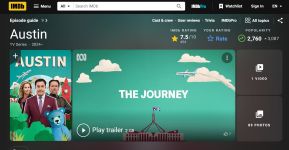 "Austin - IMBD" Austin' Internet Movie Database (IMDB) entry - reads, in part "When author Julian's offensive post goes viral, his career seems over until his neuro divergent son Austin suddenly arrives. Embracing Austin may be Julian's path to redemption if he and wife Ingrid can move past his mistakes."
 -
"Tutti Ensemble - Membership Form/Flyer" Tutti Ensemble Membership Flyer - reads, in part "At the heart of Tutti's work is the mission to develop a pioneering approach to integrated methods of performing arts and choral training. Together, the Tutti Choir and Tutti Arts perform to thousands of people every year. Hundreds of people of all ages and abilities from all walks of life regularly participate in Tutti's local and regional choral workshops."
-
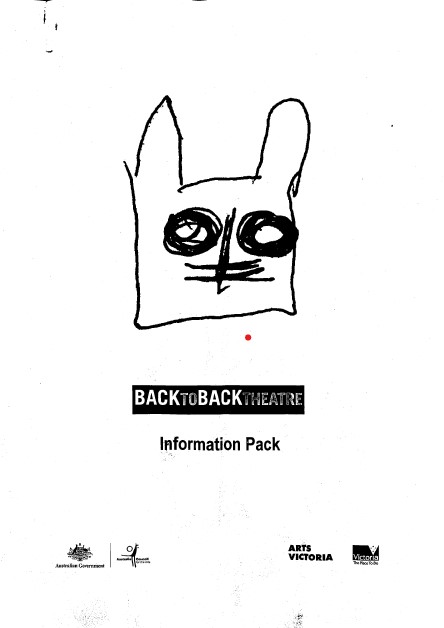 "Back to Back Theatre - Information Pack"
 -
 "DADAA Annual Report 2013-2014" DADAA Annual Report 2013-2014 - information about Vision, Mission and Goals, Chairperson and Executive Director’s Reports, Staff list, Staff training and development, Capital works, Participation, Programs including Sculptures by the Sea Tactile Tours, StARTSpeak, Art Link Be Active Program for Children and Young People, Esperance: The Emergence Project, HERE&N0W13, Aging & Disability, Regional Arts Australia Summit, Nexus Arts Grant, Regional Development and Consultancy, Partners, and Financials
 -
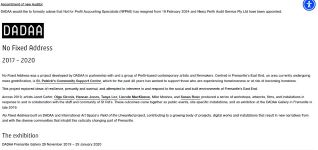 "DADAA No Fixed Address - Promotion Card" DADAA No Fixed Address 2017-2020 promotion card - Coverreads, in part "No Fixed Address was a project developed by DADAA in partnership with and a group of Perth-based contemporary artists and filmmakers. Centred in Fremantle’s East End, an area currently undergoingmass gentrification, is St. Patrick’s Community Support Centre, which for the past 40 years has worked to support those who are experiencing homelessness or at risk of becoming homeless."
 -
 "Accessible Arts - Annual Report 1988" Accessible Arts - Annual Report 1988 - includes Part 1 Artistic Report (Summary of year's activities and evaluation); Part 2 Report on Riverina Project; Part 3 Report on RBS Project; Part 4 Report on Restructuring of Project; Part 5 Report on Melbourne Trip
 -
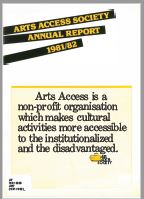 “Arts Access Victoria – Arts Access Society Annual Report 1981-82”
 -
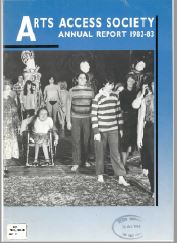 “Arts Access Victoria – Arts Access Society Annual Report 1982-83”
 -
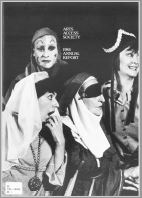 “Arts Access Victoria – Arts Access Society Annual Report 1984”
 -
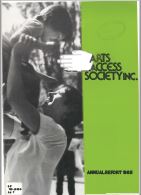 “Arts Access Victoria – Arts Access Society Annual Report 1985”
 -
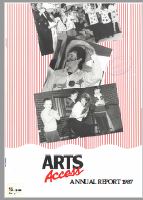 “Arts Access Victoria – Arts Access Society Annual Report 1987”
 -
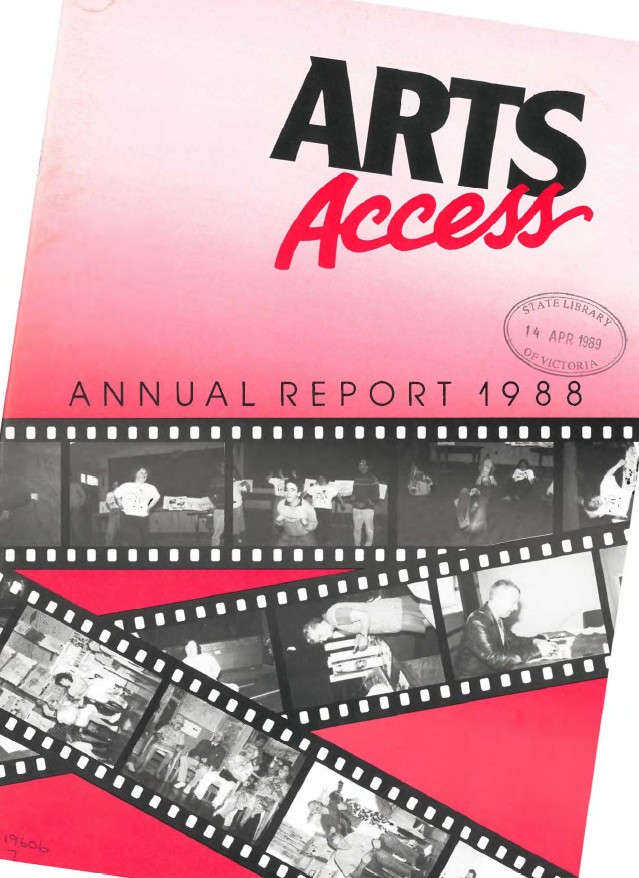 “Arts Access Victoria – Arts Access Society Annual Report 1988”
 -
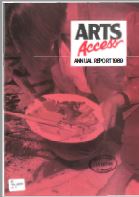 “Arts Access Victoria – Arts Access Society Annual Report 1989”
 -
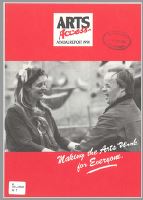 “Arts Access Victoria – Arts Access Society Annual Report 1990”