Items
Search full-text
Focus On Ability Film Festival
- Tina Fielding
- Tony Sarre
- David Helfgott
- Richard Vabre
-
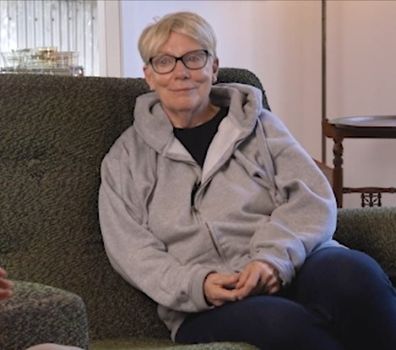 "Interview with Pat Rix" Pat Rix is a Disability Ally and Social Change advocate, and the recently retired Founder and CEO of TUTTI ARTS Incorporated. Interview Summary Pat Rix is an Artistic Director who has made extraordinary and sustained contributions to Australia’s cultural life through her artistic practice and leadership. A significant arts contributor since 1985, Pat made her early mark through plays and music-theatre productions which drew attention to social injustice and championed social inclusion. Her journey in disability arts began in 1997 with the formation of an inclusive choir at Minda Inc. which in 2001 incorporated to become the independent multi arts organisation known as ‘Tutti’ - embodying the inclusive Italian term meaning ‘everyone’. At a time when there were no vocational pathways for learning disabled and neuro divergent people, Tutti became a national trailblazer in creating a work environment where learning disabled and neuro diverse artists could create visual art, theatre, music, film and experimental art in a way that authentically nurtured their professional growth and recognition. Pat stresses the importance of disabled artists having control over their work. She believes that art is inherently political, and that it is finding your voice, being heard and being taken seriously that contributes to any artist's success. Pat looks forward to the future evolution of disability arts and the role of technology in enabling disabled artists to develop local and global partnerships which continue to provide exciting opportunities for artistic development.
-
“Screen Australia launches an access coordinator training program” Screen Australia launched an access coordinator training program in 2023. “The Access Coordinator role is intended for people from the Deaf/Disabled and/or Neurodivergent (DDN) communities who are committed to improving disability representation and removing barriers to inclusion.” Screen Australia partnered with the following organisations for the initiative: the New Zealand Film Commission, Screen Queensland, Screen Tasmania, Screen Territory, Screenwest, VicScreen, the South Australian Film Corporation, Screen ACT, Screen NSW, and the Australian Film Television Radio School.
-
"Kath Duncan, Gerard Goggin, Christopher Newell (2005) ‘Don’t Talk about Me... Like I’m Not Here': Disability in Australian National Cinema. Metro Magazine: Media & Education Magazine.146/147, pp. 152-159. https://search.informit.org/doi/10.3316/informit.043842788583710" Reads, in part "Disability is a central cultural identity and category in Australia, but this is not often realized. We seek to make a contribution to conversations and critical analyses of disability in Australian culture through an exploration of a privileged national cultural form, namely film. The trope of disability looms large in late twentieth century Australian cinema, and yet cultural comment on these ‘disabled’ scripts and performances has not yet considered a disabilities studies perspective. Accordingly, in this article we combine our different perspectives on disability and film into an account of how specific films use disability. In particular, we analyse key films from the 1990s as examples of powerful displays of bodies and personhood." References a range of films, including Proof (Jocelyn Moorhouse, 1991), Romper Stomper (Geoffrey Wright, 1992), Bad Boy Bubby (Rolf de Heer, 1993), Muriel's Wedding (PJ Hogan, 1994), Shine (Scott Hicks, 1996), Moulin Rouge! (Baz Luhrmann, 2001), My One Legged Dream Lover (writer Kath Duncan with dir. Penny Fowler-Smith, Christine Oslen 1998), Pins and Needles (writer Genni Batterham with dir. Barbara Chobocky, 1979), Riding the Gale (Genni Batterham with dir, Hugh Piper, 1987), Dance Me to My Song (writer Heather Rose with dir. Rolf De Heer, 1998), Heather Rose Goes to Cannes (Chris Corin, 1999), Myself When Fourteen, (Ivor, Arthur and Corinne Cantrill 1989),Film of Circles, Squares, Triangles, Lines and Dots (Arthur and Corinne Cantrill 1981), Rainbow Diary (Arthur and Corinne Cantrill 1984), House Gang (Mandy smith, 1997), Quentin Crashes Big Brother (Quentin Kenihan, 2002), Quentin, World at My Wheels (Quentin Kenihan, 2000), Ability Trek (Jacob Baldwin 1998)
-
"Bree Hadley, Clark Crystal (2017) Style, stage presence, and the poetic subversion of stereotypes: A case study of Blue Roo Theatre Company. Social Alternatives, 36(4), pp. 15-21." "In this article, we consider the work of Blue Roo Theatre Company (http://www.bluerootheatre.org.au/), a Brisbane-based theatre company which “creates contemporary performances lead by the artistry, experiences and imaginations of an ensemble of artists with diverse ability and impairment” (http://www.bluerootheatre.org.au/). Writing from a dual insider-outsider perspective – as a scholar of disability theatre and a creator of disability theatre in conversation – we discuss the work done in the training and rehearsal room in the lead up to Blue Roo Theatre Company’s performances, such as the company’s recent sell-out performance of Orpheus and Eurydice in collaboration with Opera Queensland at the Judith Wright Centre for Contemporary Arts, and the way it creates a distinctive performance style, poetics, stage presence, pleasure for the spectators who come along to witness the results of the work, and sense of community. We document moments in which facilitators, collaborators, co-creating artists, audiences and the media alike feel the physical, psychological, and aesthetic focus and force of voice, movement and character work by people with disabilities. We identify ways in which this stage presence can subvert dominant depictions of people with disabilities as innocent, childlike, or inspirational as significantly as the content of a show. In doing so, we provide insights into Blue Roo Theatre Company’s processes, and the aesthetic results it produces, and contribute to a growing body of commentary around disability theatre and performance, which – though increasingly well understood by those working in the form – clearly can still provide surprises for audiences and commentators anticipating conventional representations of people with disabilities onstage."
-
 "Australia Council - Annual Report 1995-96" Australia Council Annual Report 1995-96- discusses functions, organisation chart, arts funding, audience development and advocacy with collaboration with various government departments to focus on advocacy for minority groups including people with disabilities, strategy and policy with Arts and Disability report, describing the barriers to intellectual and physical access to the arts experienced by people with a disability and the implications for arts organisations of the Disability Discrimination Act 1992, main activities of Council and its Boards, and includes financial statements and lists of grants made including grants for programs, projects, information and advocacy.
-
 "Tutti Arts - Sit Down Shut Up & Watch - Awards - Press Release 2014" Tutti Arts - 'Sit Down Shut Up & Watch' Awards 2014 Press Release - reads, in part, "Best Animation Award Cafe Chat - North Melbourne Institute of Technology (NMIT), Victoria; SA Film Corporation Most Original Film Award Our Story - William Gregory, South Australia; The Hive Award Wild@Heart Community Arts, Victoria; Funniest Film Award Next Factor - Caleb Rixon, Victoria; Best Special Effects Award- Eye TV - James Kurtze, South Australia; Arts Access Australia Best New Media/ Video Art Award- Dexter Aliens - James Kurtze, South Australia; People's Choice Award- Our Story- William Gregory, South Australia.”
-
“Inaugural High Beam festival in 1998” High Beam was a biennial community-based disability arts festival. It was a joint initiative of SPARC Disability Foundation and Arts In Action (through the direction of Tony Doyle). (Arts in Action later became Arts Access SA.) The 10-day event was the first of its kind in the Southern hemisphere, attracting around 20,000 people at each festival. The festival showcased theatre, dance, comedy, and music. Some celebrity artists included Adam Hills and David Helfgott. The inaugural festival (1998) invited Swedish Disability Theatre Company Mooms Teatern to perform; the company also conducted workshops with a disability-led Australian theatre company, No Strings Attached. This first festival was also the site of Tutti's first public performance as a choir.
-
“Flow Festival, Australia’s Deaf Arts festival, is founded” Flow Festival, Australia’s Deaf Arts festival, was founded in 2018 by Ramas McRae, Irene Holub, and Medina Sumovic. The Deaf-led biennial festival provides a groundbreaking and dedicated platform for established and emerging Deaf/Hard of Hearing artists. Flow is held in Victoria but is described as “Australia’s national celebration of Deaf arts and culture”.
- Wataboshi Festival
- Wataboshi Music Festival
- Asia Pacific Wataboshi Festival
- Asia Pacific Wataboshi Music Festival
-
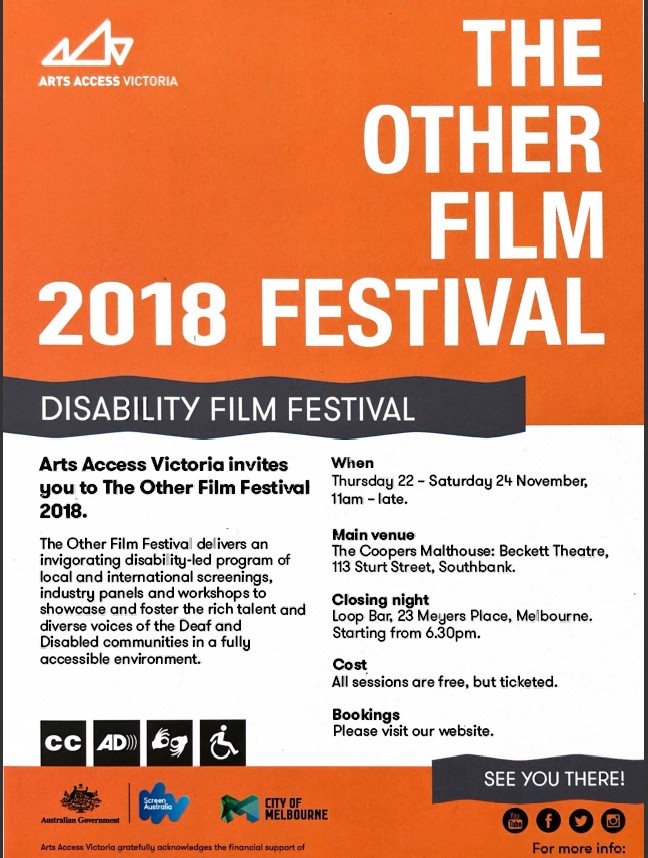 “Arts Access The Other Film Festival 2018 Invitation”
- Sit Down Shut Up and Watch Film Festival
- DADAA
- Australian Network for Art and Technology
- Alter State
- DADAA WA
- DADAA Inc
-
“Deaf film ‘A Silent Agreement’ is released in 2017” The Deaf film ‘A Silent Agreement’ was released in 2017 (written and directed by Davo Hardy). This romantic drama features a profoundly Deaf human rights activist and his filmmaker boyfriend with a speech impediment. It is said to be the first Australian film to feature Auslan as the main dialogue. Some scenes are entirely in Auslan. Screen Australia calls it the “first Australian film to feature Auslan.”
-
”Bree Hadley, Janice Rieger, Sarah Barron, Sarah Boulton, Catherine Parker (2023) Codesigning Access: A New Approach to Cultures of Inclusion in Museums and Galleries. In Cachia, Amanda (Ed.) Curating Access: Disability Art Activism and Creative Accommodation. Routledge, Abingdon, Oxon, pp. 183-195.” "In museums and galleries, access is often designed and implemented by staff and informed by regulations and guidelines. Codesign approaches have the potential to shift this understanding away from designing access “for” visitors and toward access as a creative process developed “with” visitors. This chapter focuses on the exhibition and practice-led research project Vis-ability: Artworks from the QUT Art Collection, which was presented at the Queensland University of Technology (QUT) Art Museum in Australia in 2019. Vis-ability represented the culmination of five years of international research into access in museums and galleries for visitors who are blind or have low vision."