
Items
Search full-text
Fuse Festival (Victoria)
- David Fajgenbaum
- Colin Ferris
- Cathy Staughton
- Catherine Staughton
- Bruno Conci
- Bernie M Jansen
- Abbie Twiss
- Victoria
-
"Weave Movement Theatre formed" Weave Movement Theatre was formed in 1997 following a series of workshops (organised by Arts Access) led by Adam Benjamin, director of CandoCo, a world-renowned inclusive dance company. Janice Florence was asked to facilitate classes prior to the workshops.
-
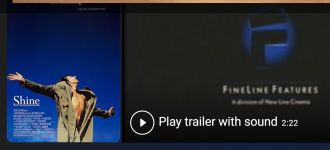 "Shine - IMDB" Reads, in part "David Helfgott, a gifted pianist, struggles through childhood as his dysfunctional father abuses him and his siblings. Years later, he suffers a mental breakdown but manages to return as a legend."
 -
“Australia Council praises NSW Theatre of the Deaf and provides some funding to the Deaf theatres throughout the 1970s” The 1976/77 Australia Council annual report stated: "The NSW Theatre of the Deaf is a significant achievement. The only funded organisation in Australia working in nonverbal theatre, its production of King Lear received widespread praise. This company is now accepted as operating in a legitimate area of theatre rather than performing mime works for the deaf. This offers wide scope for innovation." The Council’s 1977/78 annual report recorded that it granted funding to the NSW Theatre of the Deaf “towards salaries of artistic director, deaf director, and tutors’ fees in 1978” for $25,000; the “presentation of theatre pieces (mime, clowning, puppetry) in public performance” for $2,500, and “towards costs of a production in 1978” for $4,000. It also awarded $1,980 to Queensland Theatre of the Deaf “towards the cost of transporting company to Sydney for seminar with NSW Theatre of the Deaf”. Drama Resource Centre (Victoria) received $2,840 “to develop student theatre at Victoria School for Deaf Children” and $630 went to Children’s Activities Time Society (Western Australia) for the “cost of deaf mime artist, Rae Gibson, to undertake four week visit to Melbourne and Sydney to work with deaf artists”. The following annual report for 1978/79 recorded that the Council granted $25,000 to the NSW Theatre of the Deaf “towards salaries of artistic director, administrator and tutors” in 1979. The Council also awarded $1,800 to the Queensland Theatre of the Deaf towards a salary for Geoffrey Rush to work with the company in 1979. The 1979/1980 Australia Council annual report mentions funding “provided for a playwright-in-residence at the NSW Theatre of the Deaf.”
-
“Disabled actors perform at Melbourne Concert Hall” In 1982, 50 “handicapped” actors (though none were named in the media) were involved in Access Arts’ ‘Theorem’ at the Melbourne Concert Hall, an example of inclusive arts practice. The performance received broad public attention.
-
“Disability in the Arts, Disadvantage in the Arts, Australia (DADAA), based in Western Australia, is established in 1994” The National Participate Conference, hosted by Arts Access Victoria in 1990, set the scene for the emergence of the DADAA network. This came after several years of conversations among Western Australian artists about starting an organisation; the organisation was officially established in 1994. “In 1986, a small group of artists with disability met to discuss starting their own WA-based arts organisation. It is from this meeting that DADAA slowly grew, from a pilot project it became an organisation in its own right in 1994: taking the name Disability in the Arts, Disadvantage in the Arts, Australia – DADAA.”
-
“Fusion Theatre established in 1997” Fusion Theatre (Victoria) was established in 1997. "Since its beginnings as a drama group, Fusion has expanded into two main performance ensembles that make up the company. The ensemble members collaborate with professional theatre makers, guest performing artists and designers, to devise theatre performances based on the stories, imagination and ideas of all participants." Fusion Theatre’s ongoing association with Deakin University's Faculty of Arts and Education means that each year, Deakin’s theatre and drama students work with Fusion as artists, performers, assistants, and theatre technicians. Some alumni continue to be involved with the company.
-
”Hadley, Bree, Paterson, Eddie, & Little, Madeleine (2022) Quick Trust and Slow Time: Relational Innovations in Disability Performing Arts Practice. International Journal of Disability and Social Justice, 2(1), pp. 74-94.” "Despite a range of policies, plans, protocols and funding programmes to support disabled artists and collaborations between mainstream producers and disabled artists, the statistics – at least in our context in Australia – suggest most disability art still occurs outside and alongside an industry that struggles to include these artists. In this article, we draw upon findings from a series of workshops with disabled artists around Australia, conducted as part of the ARC funded Disability in the Performing Arts in Australia: Beyond The Social Model project – known colloquially to its collaborators and participants as ‘The Last Avant Garde’ project (https://lastavantgarde.com.au) – to propose a new approach. We find that while provision of logistical access (ramps, hearing loops, interpreters) and ideological access (stories, characters, discourse and language) is critical, so is methodological access, which embodies disability culture in training, rehearsal and production processes. Disabled artists use crip culture, along with relational space and time to negotiate what happens in disability arts and culture production practices and work through desire, fear, vulnerability and reciprocity to rapidly establish trusting collaborations."
-
"Anthea Skinner, Grace Thompson, Katrina Skewes McFerran (2022). Professional Pathways for Musicians with Disability in Victoria, Australia. Musicology Australia, 44(1), 21–42. https://doi.org/10.1080/08145857.2022.2088930" Reads, in part "The work of disabled musicians has become the focus on of an increasingly large body of academic work; however, existing literature rarely provides details about the educational experiences of these musicians, or how disability impacted these experiences. This study interviewed eleven performing musicians living with disability in Australia to elucidate the barriers and enablers that they faced in their music educations and careers."
-
“‘Arts and Disability: A Research Report’ published in 1995” In 1995, ‘Arts and Disability: A Research Report’ was published. Des Walsh and Juliet London were commissioned by the Australia Council to prepare the report. However, they found little information that was relevant to the theme of the report. In addition to a review of existing literature, they met with people involved in arts organisations, disability organisations and organisations dedicated to both, as well as funding bodies. Walsh and London outlined the different ways that disabled people interact with the arts: as artists, consumers, and through art therapy. They also recognised the “negative or unduly limiting notions attached to arts in relation to disability” (12). Overall, they found “no conclusive evidence […of a] widely shared, articulated concept of a ‘disability arts’ movement in Australia” at that time. The report was intended to inform meaningful policy going forward. They made recommendations related to buildings and physical barriers, leadership, education and training and action plans.
-
 "Back to Back Theatre - Information Pack"
 - Alana Hoggart
- Andrew McLean
- Andrew Mcqualter
- Bron Batten
- Bronwyn Hack
- Gary McFeat
- Jane Millett