Items
Search full-text
Paralympic Arts Festival
- Emily O'Brien
- Elise Bialylew
- Danny Jennings
- Curtis Taylor
- Corey Shadforth
- Christina Tzidris
- Chloe Matthews
- Bernie Clifford
- Bee Feldman
- Avni Dauti
- Alice Ewing
- Alexander Straub
- Alex Warman
-
“Production company A2K Media founded in 2007, as a 'a Disabled-led production company, creating connections that entertain, educate, and empower'” A2K Media is “a Disabled-led production company, creating connections that entertain, educate, and empower.” In 2024, A2K launched their Disability Justice Lens course, which teaches screen professionals how to bring disabled people onto their productions and make their workplaces more accessible and empowering.
-
“Captioned films launched in Australia” In 2001, captioned films were launched in Australia with a speech by then Disability Discrimination Commissioner Dr Sev Ozdowski OAM. The process with a series of submissions from both the film industry and the Deaf and hard of hearing community. These submissions led to the establishment of a Forum comprised of representatives from the film distribution and exhibition sector, the Deaf and hearing impaired communities and the Australian Caption Centre. After a trial run in Sydney and Melbourne, three major cinema exhibiters (Greater Union, Hoyts, and Village) agreed to show open captioned films at selected venues throughout the country.
-
“Australian Caption Centre opened in 1982” The Australian Caption Centre was opened 13 September, 1982. A tour took place at the Australian Caption Centre in Sydney in the 1990s; the video (now available on YouTube) explains how the Centre worked. In 2005, the Centre sold its commercial operations including the captioning services to Red Bee Media and formed Media Access Australia.
-
"Back to Back Theatre established" The theatre company Back to Back was established in 1987. They are a drama group comprising artists with intellectual disabilities who have since toured both nationally and internationally in mainstream Australian theatre.
-
"International Year of the Disabled Person (IYDP)" In 1976, the General Assembly proclaimed 1981 would be the Year of the Disabled Person. The 1981 International Year of the Disabled Person inspired an increase in awareness and disability arts. While UN theme was “full participation and equality” the theme in Australia was “Break down the Barriers”, raising the prole and issues of people with disabilities. The international year of the disabled persons was a catalyst for connecting Australian disability activists to each other and the international disability rights movement (Royal Commission, 2021, p. 6). Australia saw an increase in disability-themed theatre from 1981 to 1984; however, these performances were largely staged with non-disabled casts. Records of these productions can be found on the AusStage database.
-
"SENSORIA: Access & Agency. ArtLink Magazine Issue 42.2, Spring 2022." Reads, in part "This issue platforms a range of contemporary art practices and debates written by and with artists who identify as part of the disabled, d/Deaf, vision impaired or neurodiverse communities. The commissioned essays, profiles and conversations offer diverse perspectives of lived experience and (in)visibility in the art worlds of Australia, Aotearoa/New Zealand and the UK."
-
"Screen Australia (2023) Seeing Ourselves 2: Diversity, equity and inclusion in Australian TV drama. Screen Australia" Reads, in part "Screen Australia has released new research into diversity on Australian screens, titled Seeing Ourselves 2: Diversity, Equity and Inclusion in Australian TV Drama. A follow up to the landmark 2016 study, Seeing Ourselves 2 examines the diversity of main characters in 361 scripted Australian TV and online dramas broadcast between 2016 and 2021, how this compares to the Australian population, and what has changed since the previous Seeing Ourselves report."
-
"Screen Australia (2016) Seeing ourselves: Reflections on diversity in Australian TV drama. Screen Australia" Reads, in part "Whose stories are our TV dramas exploring? Screen Australia has benchmarked current levels of diversity in Australian TV drama and explore the challenges and opportunities involved in making TV drama more broadly representative of Australian society."
-
"Bree Hadley (2014) Practice as method: The ex/centric fixations project. In Bolt, B & Barrett, E (Eds.) Material inventions: applying creative arts research. I.B. Tauris Publisher, United Kingdom, pp. 145-165.” "In this chapter, I consider the efficacy of creative practice as a research method, concentrating specifically on its applications in the performing arts, using one of my own recent projects, The Ex/centric Fixations Project (2009), as an example."
-
"Bree Hadley (2022) A ‘Universal Design’ for audiences with disabilities? In Reason, Matthew, Connor, Lynne, Johanson, Katia, & Walmsley, Ben (Eds.) Routledge Companion to Audiences and the Performing Arts. Routledge, Abingdon, Oxon, pp. 177-189.” “Understanding of how to create inclusive performance experiences for spectators with disabilities remains nascent in research, policy, and practice. In this chapter, I survey the state of knowledge in this field – or, as it turns out, fields, given that specialist knowledge of sign language interpretation for d/Deaf spectators, audio description for blind spectators, and relaxed performance for neurodiverse spectators, has developed separately, without intersection. I then investigate recent efforts to create inclusive aesthetics that incorporate accessibility features into performance work, as an integral part of the aesthetic, rather than as interpretations, captions, or descriptions alongside the work. I examine why this ‘Universal Design’ approach has been embraced with enthusiasm, both by disabled producers and spectators, and by non-disabled producers and spectators.”
-
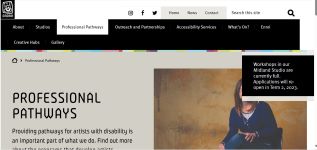 "DADAA Professional Pathways Webpage, captured 2023" DADAA Professional Pathways Webpage, captured 2023 - reads, in part "DADAA supports artists to develop professionally and to realise their dreams however big or small. To support you on your journey as an artist, we offer a range of programs at all levels so that you can progress as an artist as you learn and build your skills."
 -
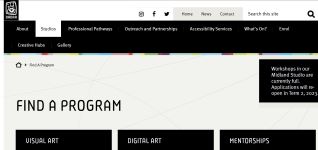 "DADAA Find A Program Webpage, captured 2023" DADAA Find A Program Webpage, captured 2023 – includes information about Visual Art, Digital Art, Dance and Performance, Music, Children and Young Adult, and Mentorship programs