Items
Search full-text
Paralympic Arts Festival
-
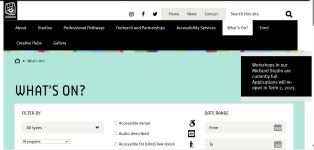 "DADAA What's On Webpage, captured 2023" DADAA What's On Webpage, captured 2023 - includes a search function, with filters for venue accessible, blind/low vision accessible, audio described, and braile events
 -
 "DADAA - The Lost Generation Project" DADAA - The Lost Generation Project 2007 - reads, in part "The project was conceived from a partnership between DADAA and the WA Disability Services Commission, which began in 2002. After working on 15 small projects, the partners decided to develop a large-scale project in 2007 to continue developing arts and cultural interventions with and for people with intellectual disability living in supported accommodation across the Perth metropolitan area. The project's rich CACD strategy has seen numerous successful workshops, exhibitions and related projects come to fruition in partnership with local governments and other community arts organisations.?
 -
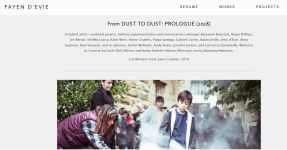 "From Dust to Dust - Prologue" Reads, in Part, "A hybrid artist-curatorial project, inviting experimentation and conversations amongst Benjamin Hancock, Bryan Phillips, Jen Bervin, Shelley Lasica, Katie West, Simon Charles, Pippa Samaya, Gabriel Curtin, Adam Leslie, Zeno d'Evie, Anna Seymour, Ravi Vasavan, and in absentia, Aaron McPeake, Andy Slater, Jennifer Justice, and Lucreccia Quintanilla. Welcome to Country by Uncle Rick Nelson and Aunty Paulette Nelson.Afternoon tea by Murnong Mammas."
 -
 "Australia Council - Annual Report 2019-20" Australia Council - Annual Report 2019-20
 -
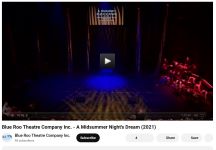 "Blue Roo Theatre Company - You Tube - A Midsummer Night Dream (2021)" Blue Roo Theatre Company - You Tube - A Midsummer Night Dream (2021) QPAC Cremorne Theatre - reads, in part "Blue Roo Theatre Company Inc. proudly presents A Midsummer Night's Dream. Introduced by the Variety Kids Choir singing an original song, Blue Roo Theatre Company’s A Midsummer Night’s Dream is a unique re-imagining of Shakespeare’s classic tale set in regional Australia after a catastrophic bush-fire. Audiences will be taken on a journey as the ghost of Shakespeare himself wakes to watch yet another adaptation and retelling of his prized story."
 -
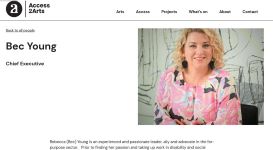 "Bec Young Chief Executive" Announcement of new CEO of Access2Arts, South Australia, Rebecca (Bec) Young, in 2022
 -
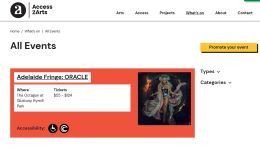 "Access2Arts Events" Access2Arts news, events, and program information as at 2022
 -
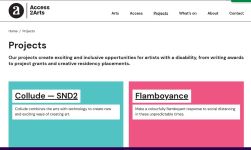 "Access2Arts Projects" Access2Arts current projects as at 2022
 -
“Larissa Macfarlane leads the installation of Australia’s first Disability Pride Mural” In 2017, Larissa Macfarlane led the installation of Australia’s first Disability Pride Mural. It was unfortunately removed by accident by council workers. It was re-installed in 2018 and was constructed of paper and fixed to the wall with wheat paste glue so that it was temporary. The aim was to raise awareness of Disability Pride in Australia.
-
"Soprano Marjorie Lawrence performs in her wheelchair in the 1940s" In the 1940s, Australian soprano Marjorie Lawrence contracted polio and performed in her wheelchair, both nationally and internationally, showing veterans life after disability was possible. Platforms were modied for her wheelchair so she could perform.
-
"Australian Film Commission created" In 1975, the Australian Film Commission was created, providing grants for film and television projects.
-
“The Mouth and Foot Painting Artists starts in Australia in 1971” The Mouth and Foot Painting Artists (MFPA) started in Australia in 1971. The roots of the international organisation of mouth and food painting artists go back to the 1950s in Europe.
-
“7-part series ‘Fair Go’ produced by Film Australia” In 1981, Film Australia produced a 7-part series, called Fair Go, on Australians with mental and physical disabilities and how it impacted their lives and the lives of their families. “Each program is presented from the viewpoint of the person with the disability and demonstrates the practical implications of coping with a disability in daily life at home, in the community, in the workplace or at school.” Film Australia was consolidated into Screen Australia in 2008.
-
“Salubrious Productions (QLD) established in 1999” Salubrious Productions (Queensland) was established in 1999. Salubrious is an agency for disabled artists, representing musicians, writers and composers, theatre performers and actors, visual artists, and technicians in the creative industries. The agency continues operation today. Their website describes them as follows: “Salubrious Productions is a Brisbane-based entertainment and production agency. We represent a core of more than 200 diverse acts and artists and draw further from a large network of professional artists throughout Queensland and Australia.”
-
“House Gang debuts on SBS” In 1996, a comedy television series debuted on SBS called ‘House Gang’ featuring three actors with intellectual disabilities.
-
“Screen Australia commissions the reports ‘Seeing Ourselves’ (2016) and ‘Seeing Ourselves 2’ (2023)” In 2016, Screen Australia commissioned a report "Seeing ourselves: Reflections on diversity in Australian TV drama". The report highlighted the lack of characters on TV with a disability. When characters with a disability were part of the story they were played by actors without a disability and were portrayed as either unemployed or retired. Screen Australia commissioned a follow-up report in 2023 called "Seeing Ourselves 2 - Diversity, equity and inclusion in Australian TV drama". This report shows that, while diversity is a global conversation and there is an increase of disability representation, it remained significantly lower than the actual disabled population.
-
“Essay collection ‘Growing Up Disabled in Australia’ is published in 2021” In 2021, Carly Findlay edited a book ‘Growing Up Disabled in Australia,’ a collection of more than 40 Australian writers with disabilities sharing their lived experiences.
-
“Off The List Records (VIC) established in 2020” Off The List Records (VIC) was established in 2020. Their Facebook page describes them as “an access-friendly and disability-led record label, working within the DIY, experimental and indie music scenes in and around Naarm.”
-
“Screen producer, editor, and accessibility consultant Stephanie Dower is interviewed for Screen Queensland On Air, in an episode called How They See Us: Disability in the Screen Industry” Stephanie Dower was interviewed in 2020 for Screen Queensland On Air, in an episode called How They See Us: Disability in the Screen Industry. Dower is an editor, producer, and writer for screen. She has also worked with Get Skilled Access and as an accessibility consultant for Queenslanders with Disability Network.
-
“Bus Stop Films begins operation in 2009” Bus Stop Films began operations in 2009. In their own words, they “educate, create and advocate.” Their primary focus is teaching filmmaking to disabled adults, but they also offer workshops to others of marginalised identities. Bus Stop “makes films with, for and about people from diverse backgrounds and abilities.” Their website lists support workers in every Australian state and territory.
-
“2023 Screen industry report ‘Disability and Screen Work in Australia’ finds disabled people fulfil a range of roles in the screen industry, despite facing prejudice and exclusion, and should be treated as experts of their access requirements” ‘Disability and Screen Work in Australia: Report for Industry’ (2023) was compiled by researchers Radha O’Meara, Laura Dunstan, Anna Debinski and Catherine Ryan. The study was supported by Melbourne Disability Institute and A2K Media. The authors summarise that disabled people fulfil a range of roles in the screen industry, despite facing prejudice and exclusion, and should be treated as experts of their access requirements. They find that “Disabled people experience a more precarious, lower paid, and less powerful position in the screen industry than their non-disabled counterparts.” O’Meara and her colleagues call for widespread change in the industry to expand access.
-
“Screen Australia launches an access coordinator training program” Screen Australia launched an access coordinator training program in 2023. “The Access Coordinator role is intended for people from the Deaf/Disabled and/or Neurodivergent (DDN) communities who are committed to improving disability representation and removing barriers to inclusion.” Screen Australia partnered with the following organisations for the initiative: the New Zealand Film Commission, Screen Queensland, Screen Tasmania, Screen Territory, Screenwest, VicScreen, the South Australian Film Corporation, Screen ACT, Screen NSW, and the Australian Film Television Radio School.
-
"Bree Hadley (2015) Participation, politics and provocations: People with disabilities as non-conciliatory audiences. Participations: journal of audience and reception studies, 12(1), pp. 154-174.” "Disability has always had a prominent place on the theatrical stage. Throughout the C19th, C20th and C21st to date, disabled characters have been used to signify corruption, innocence or suffering, and, of course, as salutary examples of how to overcome such suffering. In the past three decades, the work of disability scholars, activists and artists has also provided opportunities for people with disabilities to produce their own plays, performances or installations challenging these stereotypes. Interestingly, though both the body of literature on theatre makers with disabilities and the body of literature on theatre audiences has grown apace over the past decade, there is still surprisingly little written on people with disabilities as theatre audiences. In this article, I draw on observations made during five years of practical, empirical and theoretical research into disability theatre to discuss how people with disabilities work as a distinctive sub-group of spectators, with distinctive spectatorial processes, modalities and preferences, within contemporary theatre audiences. I begin with the factors that make attending theatre difficult for people with disabilities. I note that people with disabilities respond to the challenges they face in attempting to become active audiences of contemporary theatre in three common ways. I then unpack what these spectatorial modalities teach us about people with disabilities as audiences, other marginalised groups as audiences, as well as about audiences, audiencing and the part audiences play in theatre practice more generally."
-
"Fayden D'Evie (2022) From Dust to Dust: Hallucinating the Absent Exhibition, in Amanda Cachia ed. Curating Access: Disability Art Activism and Creative Accommodation. London: Routledge, 87-98" Reads, in part "Over several months in 2018, I developed a hybrid artist-curatorial project for the Old Castlemaine Gaol, with the working title From Dust to Dust , which sought to invert the site’s association with the sensorial policing of bodies."
-
"Katherine Gale (2013) Review - Take Up Thy Bed and Walk, Arts Hub" Review of 'Take Up Thy Bed and Walk' (2013) by Vitalstatisix and Gaelle Mellis - reads, in part "The latest Vitalstatistix Theatre Company production asks subtle questions about society’s perception of people with disabilities."